
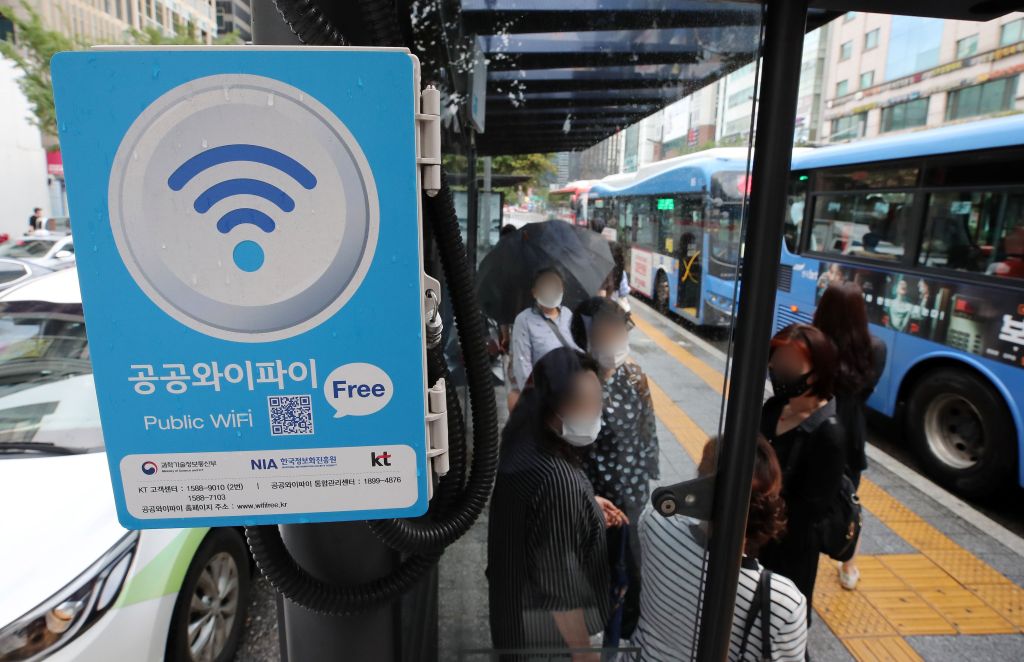
A government analysis revealed that over 1,600 of the 47,089 public Wi-Fi facilities nationwide showed no users or data usage over the past three months. The government had expanded public Wi-Fi infrastructure between 2019 and 2022, investing 155.8 billion Korean won in national funds, aiming to reduce citizens’ communication costs and bridge the digital divide.
According to data submitted by the National Information Society Agency (NIA) to Democratic Party of Korea lawmaker Lee Joo-hee, a member of the National Assembly’s Science, ICT, Broadcasting and Communications Committee, as of the 13th, there were 47,089 public Wi-Fi facilities nationwide. Of these, 1,643 facilities (3.5%) had no users or data usage in the past three months.
Public Wi-Fi facilities, primarily installed in public spaces such as buses, libraries, and traditional markets under the leadership of the central and local governments, are free for anyone to use. The government began expanding the infrastructure in 2012 in collaboration with telecom companies and local governments, scaled it up in 2019 through the “Wireless Internet Infrastructure Expansion Project,” and included it in the Digital New Deal initiative in 2020.
However, criticism has persisted over lax operational management, including insufficient checks on actual usage and delayed repairs for malfunctioning facilities. Among service providers, SK Broadband had the highest rate of unused facilities, with 118 out of 1,971 (6.0%) facilities unused. KT had 978 out of 24,744 (4.0%), and LG Uplus had 547 out of 20,374 (2.7%).
Delays in restoring services after outages were also confirmed. The Ministry of Science and ICT and NIA recommend dispatching personnel within 24 hours and completing repairs within three days of a service outage. However, 802 out of 3,653 outage cases (22%) between 2024 and August this year exceeded the three-day repair period.
Complaints about usage difficulties have also increased. Public Wi-Fi-related complaints rose from 994 cases in 2024 to 1,417 cases last year, with 1,242 cases reported by August this year. Over 90% of all complaints were related to connection failures.


 jasdooit
Leave a comment