

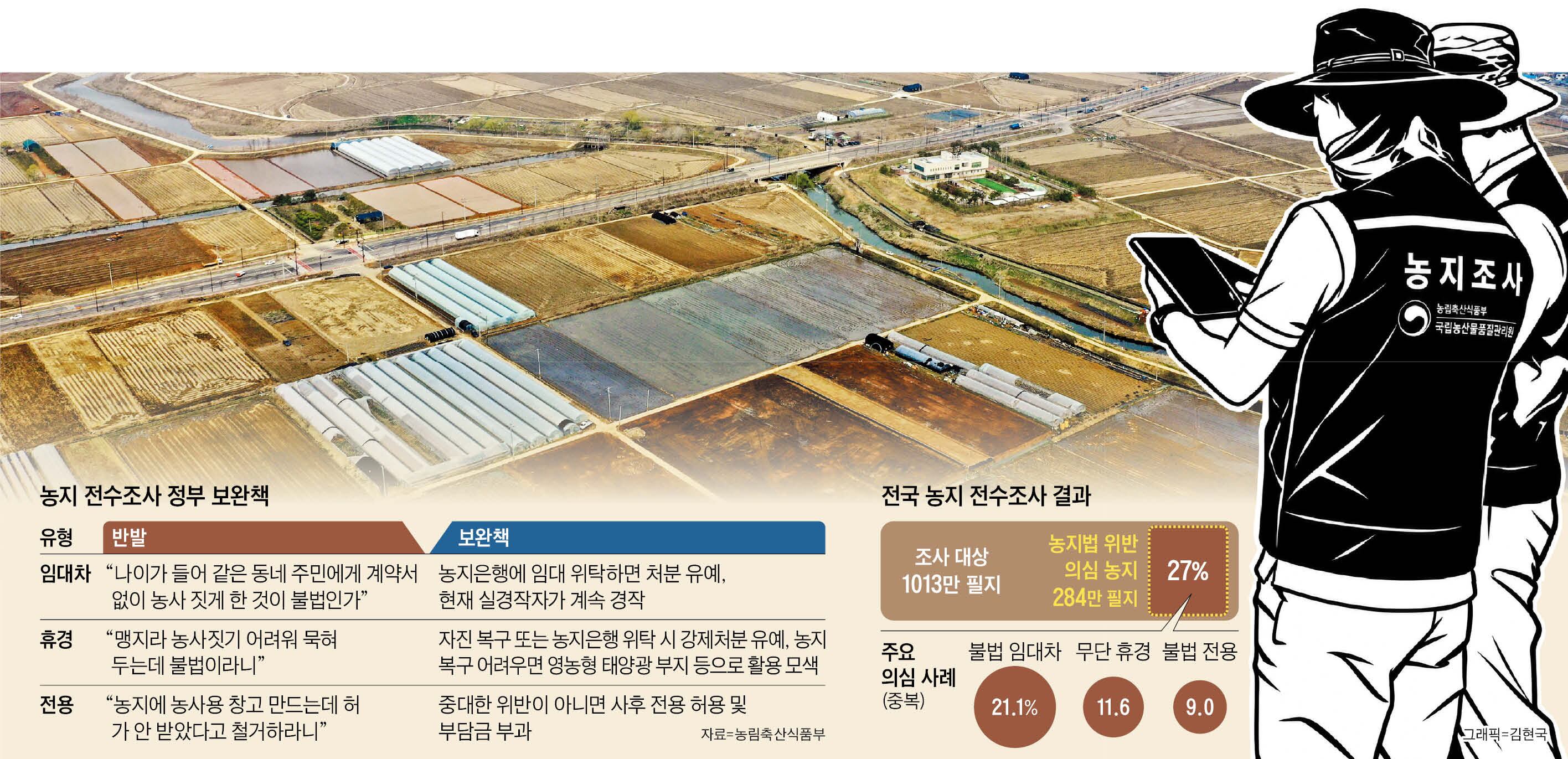
As farmers’ anxieties grew over the nationwide farmland survey launched last May—with concerns such as “the government is trying to seize land” and “policies aimed at catching speculators are harming innocent tenant farmers who make a living from rice paddies”—the government and the ruling party presented measures to address the situation. They agreed to postpone forced disposal (sale) for customary leases, fallow land, etc., excluding speculation, if entrusted to the Farmland Bank. The Democratic Party of Korea and the Ministry of Agriculture, Food and Rural Affairs announced on the 21st that they reached an agreement on these measures during a party-government consultation meeting.
However, significant chaos has already occurred in rural areas, with tenant farmers being evicted en masse, farmland transactions coming to a halt, and land prices plummeting. The half-baked policy has become a “self-inflicted wound,” and the countermeasures feel belated. Although the farmland survey was initiated under President Lee Jae Myung’s directive to establish the principle of “those who till the land own it” (耕者有田), it has only exacerbated side effects. The survey has cost a budget of 67 billion Korean won.
◇ Distinguishing Speculation from Rural Practices
The party and government agreed to legalize illegal leases if entrusted to the Farmland Bank of the Korea Rural Community Corporation. For farmland owned for over three years, if entrusted to the Farmland Bank for management, the current lease will not be considered illegal. This allows actual cultivators to obtain legal tenant status and continue farming. Such cases will also be excluded from future supplementary farmland surveys.
Meanwhile, the Ministry of Agriculture, Food and Rural Affairs decided to extend the special lease rectification period, originally set to end on July 31, until November 15. During this period, leaseholders can apply to entrust their land to the Farmland Bank. For farmland co-owned by multiple parties, it can be entrusted to the Farmland Bank with the consent of shareholders holding a majority stake.
Under the current Farmland Act, private farmland leases are only permitted for: farmland acquired before 1996, inherited or abandoned farmland of 1ha or less, and farmland cultivated by individuals aged 60 or older for at least five years. Due to these stringent requirements, many elderly landowners and heirs have relied on verbal contracts to lease their land. In the first nationwide farmland survey, which concluded in July, illegal leasing was the top violation, accounting for 21.1%. A source from the Ministry of Agriculture, Food and Rural Affairs stated, “Over 90% of farmland has been owned for more than three years,” adding, “Most customary leases will not face unfair disposal.”
The same applies to unauthorized fallow land. Farmland left uncultivated by elderly owners or heirs, or land listed for sale but left idle due to lack of buyers, will not face forced disposal if management is entrusted to the Farmland Bank. For marginal or sloped land that had to be abandoned due to cultivation difficulties, the Farmland Bank will take charge and explore utilization methods. Agricultural solar power projects are among the proposed solutions.
◇ Legalizing Minor Illegal Conversions
The government decided to allow post-facto conversion of illegally converted farmland after paying the farmland preservation levy. For example, if someone built a warehouse on farmland without proper procedures, they can now apply for conversion, pay the levy, and have it approved. This marks the first effort since 1988 to align actual farmland use with official records. However, cases where structures like greenhouses or mushroom cultivation facilities are used to disguise non-agricultural activities—such as operating restaurants or solar power generation—will be granted a correction period to revert to original uses.
◇ “Chaos Already Ensues—Who Is Accountable?”
To postpone or exempt disposals, the National Assembly must enact a special measures law. The government plans to complete legislation within this year. The self-rectification period for unauthorized fallow land is also under discussion. Kim Hong-sang, director of the Agricultural Policy Research Center, stated, “The confusion arose from handling complex farmland issues with haste.” He added, “Many tenants have already been evicted, and farmland transaction prices have plummeted—who will take responsibility?” In the second quarter of this year (April–June), the average transaction price per square meter of farmland nationwide was 49,017 Korean won, an 8.1% decrease from the previous year.


 jasdooit
Leave a comment