
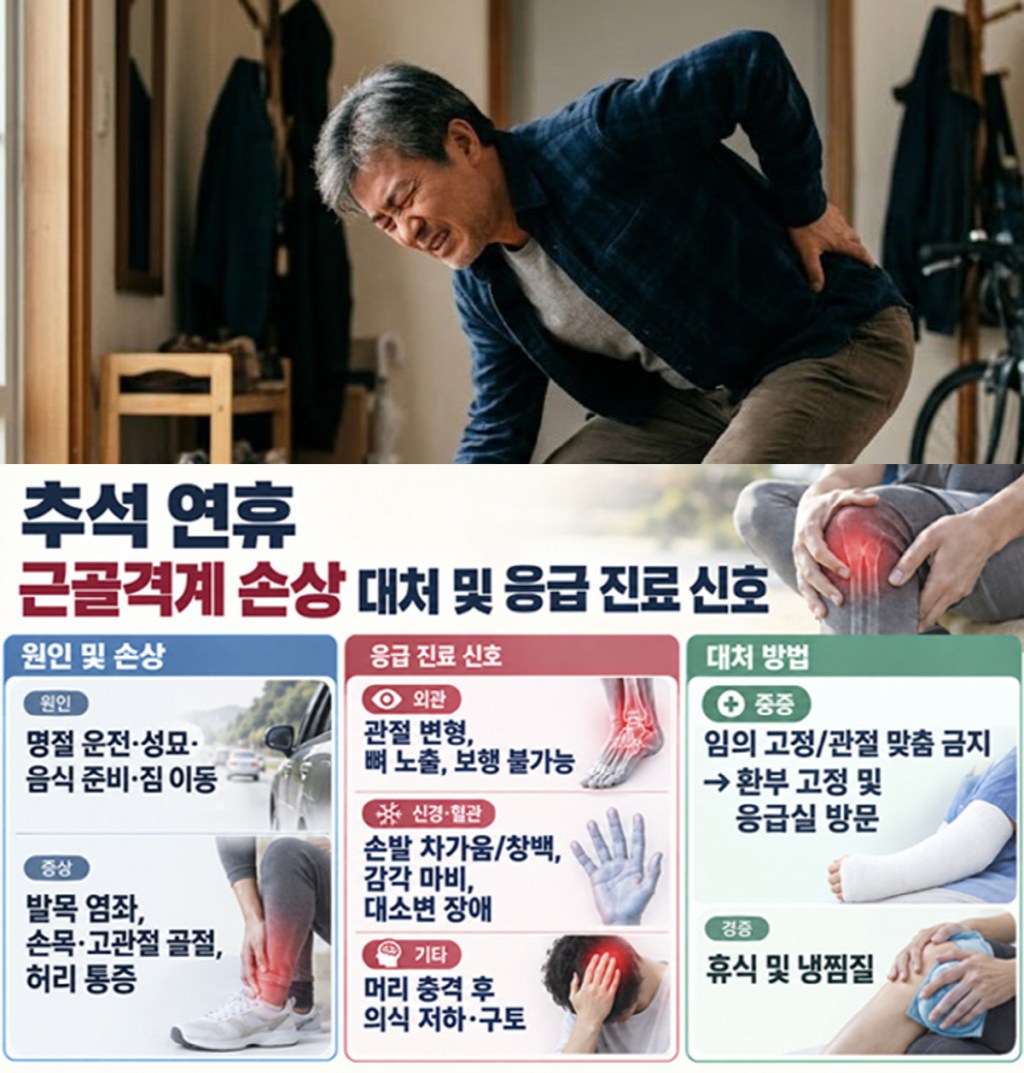
[Jang Jong-ho Reporter] During the Chuseok holiday, people are much more active than usual because of long-distance travel, visits to ancestral graves and grave maintenance, outings, and preparing holiday food. Long hours of driving or sitting on the floor can worsen back and knee pain. People may also sprain an ankle or injure their wrists, shoulders, or knees by falling during visits to ancestral graves or other outdoor activities. Back pain can arise after lifting heavy luggage or gift boxes, while shoulder pain may suddenly worsen.
Mild muscle pain or sprains may improve with rest and ice, but severe pain, difficulty moving the injured area, joint deformity, or abnormal sensations should not be ignored. Fractures, dislocations, and ligament or tendon injuries may initially cause only swelling and pain, making them difficult to distinguish. The circumstances of the injury and the symptoms should therefore be assessed together.
Lee Myung-geun, an orthopedic specialist at H Plus Yangji Hospital, explained, “During the holiday, people travel and engage in outdoor activities more than usual, and many carry heavy objects or remain in the same position for long periods, which can lead to various musculoskeletal pains and injuries.”
Ankle sprains can commonly occur when people walk more than usual, such as when visiting ancestral graves, clearing weeds around graves, or going on outings. Missteps on uneven ground can stretch or tear the ankle ligaments, and severe impacts may also cause fractures.
Immediately after an injury, it is best to avoid walking unnecessarily, apply ice, and monitor the condition. However, imaging tests may be needed to check for a fracture if swelling rapidly worsens, the ankle becomes deformed, or pain makes it difficult to put weight on the foot.
Bracing a fall with the hands can injure the wrists or shoulders. Older adults, in particular, may suffer wrist or hip fractures even after relatively minor falls. If pain develops in the groin or buttocks after a fall, making it difficult to stand or bear weight on one leg, a hip fracture should be considered. A wrist fracture may also be suspected if the wrist swells or becomes deformed, or if moving the fingers is difficult.
Maintaining the same position for extended periods, such as during long drives or while preparing holiday food, can also strain the back and knees. People with a history of a herniated disk, spinal stenosis, or degenerative arthritis may experience a sudden worsening of their existing pain.
If there is only mild back or joint pain, people can change positions, get sufficient rest, and monitor their condition. However, emergency evaluation is needed to check for neurological problems if back pain is accompanied by sudden weakness in the legs, severe abnormal sensations, or bowel or bladder dysfunction. When a fracture or dislocation is suspected, the injured area should not be forcibly moved, and caregivers should not try to realign the joint themselves. Doing so could cause additional damage to nearby blood vessels or nerves. The injured area should be immobilized as much as possible. If there is bleeding, apply pressure with clean gauze or cloth to stop it, then seek medical attention.
Not everyone who develops musculoskeletal pain during the holiday needs to visit an emergency medical center. If the pain is relatively mild, the joint can be moved, and symptoms decrease over time, it is advisable to rest, apply ice, and monitor the condition first. However, early evaluation is important for injuries in which a fracture or dislocation is suspected or nerve or blood vessel damage is possible. Medical attention should be sought especially in cases of deformity in a joint or limb, severe swelling, limited movement, difficulty bearing weight, or abnormal sensations.
Because access to regular outpatient care is limited during the holiday, it can also be helpful to identify emergency medical institutions in advance that have a collaborative care system involving emergency medicine and major medical departments.
Lee Myung-geun emphasized, “When you are injured during the holiday, you should consider more than just the intensity of the pain. You should also check whether you can move the injured limb normally, bear weight on it, and whether deformity or abnormal sensations are present.” He added, “In particular, after a fall in an older adult or a severe injury, a fracture may be hidden even when the visible wound is not extensive. If abnormal symptoms persist, it is best to seek medical attention without delay.”
Jang Jong-ho Reporter bellho@

This article has been translated by GripLabs Mingo AI.
- Mir, Whose Girlfriend Is a Pilates Instructor, Reveals His Newlywed Home… “Some People Still Don’t Know I’m Married”
- Five Years After Leaving “Superman Is Back,” Gary Still Draws Fans’ Cameras at Thai Airports and on the Street… Son Ha O Also Gains Popularity
- Lee Hee-jin, 47, Recounts Painful Past Romance After Fortune Teller Says She Has No Marriage Luck: “My Ex Cheated and Even Spent My Money”
- Shownu of Kkingkkingkking Will Strip Down Again This Year… Teases Bold WATERBOMB Reveal: “I’ll Go with a Minimal Outfit” (Thursday Night)
- Park Mi-sun Endured Seven Hours by the Hangang River While Battling Cancer: “A Woman Crazy About Fireworks”


 jasdooit
Leave a comment