
Police are investigating allegations that body cameras (Body Cam) introduced by a KT consortium last year are of Chinese origin, while domestic telecommunications and security conglomerates are selling Chinese-made video equipment to businesses and general consumers, raising security concerns. The Chinese video surveillance equipment companies involved have been designated by the U.S. government as subjects of national security regulations and are also identified as military enterprises owned by the Chinese People’s Liberation Army.
Telecommunications and security firms claim there is no security threat because only the hardware of closed-circuit TVs (CCTVs) is manufactured in China, while the software is designed domestically. However, security experts counter that no product is entirely free of vulnerabilities. A source from the security industry stated, “Recent incidents of hacking and unauthorized video leaks have occurred in Chinese-made robot vacuums and indoor cameras,” adding, “In 2024, over 1,300 Chinese-made CCTVs were discovered and removed from frontline military units, highlighting significant security concerns over Chinese products.”
◇Domestic Conglomerates Selling Chinese-Made CCTVs
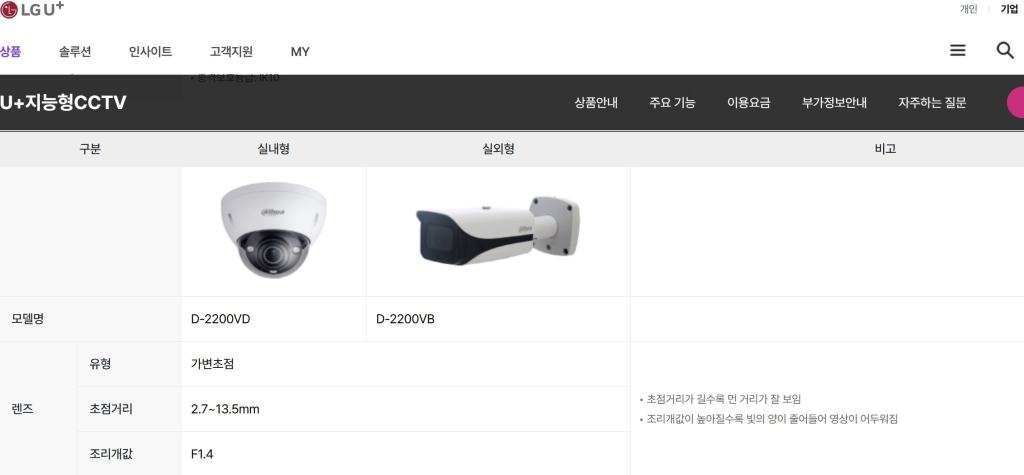
According to this newspaper’s investigation on September 23, LG Uplus, SK Shieldus, and KT Telecop are currently selling products from Chinese video security companies Dahua and Hikvision. These firms are leading Chinese surveillance equipment manufacturers. Domestic telecommunications and security conglomerates sell Chinese products because manufacturing costs are significantly lower than domestic alternatives. A CCTV industry official explained, “Manufacturing in China costs 50,000 Korean won per unit, while domestic production ranges from 130,000 to 180,000 Korean won,” adding, “Consumers also tend to prefer cheaper Chinese products over expensive domestic ones.”
However, the U.S. Federal Communications Commission (FCC) has included a significant number of surveillance and communication devices produced or provided by Dahua and Hikvision in its ‘Covered List’ of national security risk equipment. The FCC asserts these devices pose “unacceptable risks” to U.S. national security or the safety and security of U.S. persons, including hacking and data leaks. Since 2021, the FCC has listed Dahua and Hikvision on this registry, imposing supply chain restrictions such as banning new equipment certifications. Without FCC certification, import, distribution, and sales in the U.S. are blocked. The FCC also explicitly regulates “white-label” products—where manufacturers attach other companies’ brands to identical products—to prevent circumvention of sales restrictions.
◇Experts: “Security Vulnerabilities Always Exist”
Dahua and Hikvision were previously designated by the U.S. Department of Defense from 2020 to 2022 as military enterprises owned or controlled by the Chinese military. Security experts warn that using equipment regulated by the U.S. could lead to information leaks and strain South Korea–U.S. security cooperation. A source from the security industry remarked, “It is practically difficult for the government to impose import bans on Chinese products,” adding, “General consumers can easily purchase Chinese-made CCTVs online, and security risks must be considered.”
Chinese-made CCTVs have already permeated the domestic security sector. According to data received last month by Kang Myoung-gu, a People Power Party lawmaker, from the National Police Agency, 1,359 of the agency’s CCTVs lacked Telecommunications Technology Association (TTA) security certification, with 385 of those being Chinese-made. Over half of the Chinese units were Hikvision products. Kang’s office stated, “Hikvision has been restricted from use by government agencies in the U.S. and Canada due to national security threats and video leak concerns.”
In response, SK Shieldus and KT Telecop officials stated, “We supply products manufactured through outsourcing and do not use Chinese-made core components or software,” adding, “We conduct thorough security reviews, including simulated hacking and vulnerability diagnostics.” An LG Uplus official claimed, “We only outsource hardware manufacturing (OEM) to China to reduce costs, while all software required for CCTV operation is developed domestically, ensuring no security issues like video leaks.”
However, Professor Kim Yong-dae from the Department of Electrical and Electronic Engineering at KAIST argued, “Claiming a product has no security vulnerabilities is implausible.” He explained, “Dahua’s official website alone lists multiple vulnerabilities, such as authentication bypass without passwords and security flaws that disable devices via remote reboot,” adding, “While the issue is tied to China, stating IoT devices have no security issues is irresponsible.”






Leave a comment