
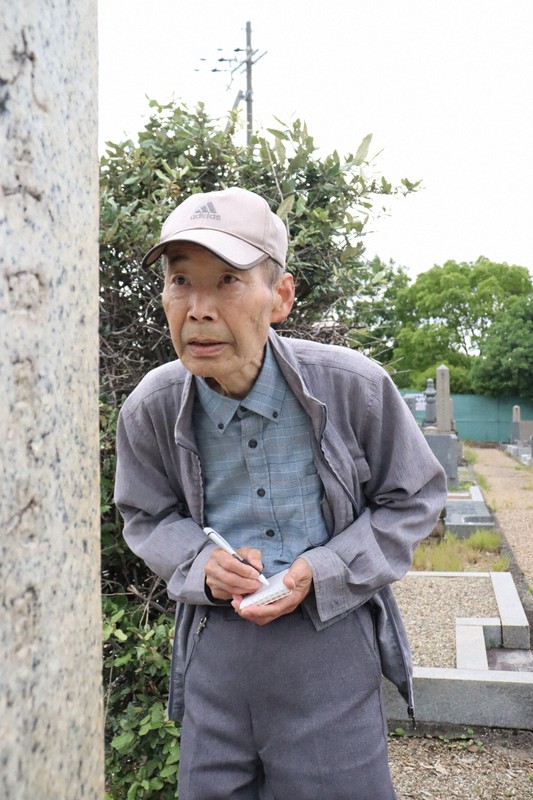
HIRAKATA, Osaka — For two decades, a local historian here has been visiting cemeteries documenting the names of residents who died in Japan’s wartime campaigns. Through his work, he hopes to ensure that those lost to war are remembered not merely as statistics, but as individuals who once had families and lives of their own.
About 3.1 million Japanese died in the Second Sino-Japanese War (1937-1945) and the Pacific War (1941-1945), including some 2.3 million military personnel and civilian employees attached to the armed forces.
“The victims of war cannot be reduced to numbers. Every one of them had a name and a family. We must not forget that,” said 83-year-old Tadayoshi Onawa.
Since retiring in 2006, he has traveled across Hirakata, Osaka Prefecture, carrying residential maps and visiting cemeteries, recording mainly the names of military personnel and civilian employees of the armed forces who could be identified as war dead from inscriptions on gravestones. His research covers the period from 1936, the year before the outbreak of full-scale war between Japan and China, through 1950. It includes those who died after the war as prisoners or internees, as well as victims of the 1939 explosion at the former Kinya army ammunition depot in the city.
As of August 2026, Onawa had documented about 790 individuals. He has also interviewed surviving family members and, with the cooperation of the city’s association of bereaved families, collected details such as ages and places of death.
According to his research, more than half of the roughly 700 people whose time of death was known died during the final stages of the Pacific War in 1944 and 1945.
Those in their early 20s accounted for the largest group. Nearly 70% were in their 20s or 30s when they died, while five were still teenagers. “If the war had ended even one year earlier, many of these people would not have died,” Onawa says angrily.
China was the most common place where residents lost their lives, followed by the Philippines, the Central Pacific and eastern New Guinea. For bereaved relatives who know the place names but not where they are located, Onawa prepared hand-drawn maps showing the sites where their family members died.
After graduating from university, Onawa joined the Osaka Prefectural Government. After retiring, he became involved in producing newsletters for his neighborhood association. While researching local history, he came to think, “Understanding the hardships and sacrifices of previous generations requires attention to individual lives rather than statistics.”
Even after surrendering his driver’s license at age 75, he continued his research by bicycle and bus. After turning 80, he began having trouble walking and now relies on a cane when he goes out. Yet he remains committed to work. “Each person had a family and a life. Numbers alone cannot convey the pain,” he said.
One of the people who assisted his research is Hirakata resident Kimiko Hatanaka, 86. Her father, Izo, died in battle in Manila, the Philippines, in May 1945 at the age of 34. “I heard that he served in the navy, but I don’t know exactly how he died,” she said. Hatanaka was 5 years old at the time and has no memory of her father. Instead, she shared with Onawa stories she heard later from her mother and others.
Shortly after the war ended, her mother went to bring her father home. What she returned with was only a “white box,” empty inside.
“That’s not my father!” Hatanaka said she cried and screamed.
She also remembered feeling envy when neighbors welcomed family members home from the war. Sometimes she would walk to their houses and peek through the windows at families eating together. She held a faint hope that “maybe my father is alive, too,” but Izo never came home.
“There are few opportunities to talk about the war now, and there is no one left who can tell me about my father. I appreciate that records are being kept and that these stories continue to be passed on,” she said.
Eighty-one years have passed since the end of World War II. “Japan must reflect on the fact that it produced so many war dead,” Onawa muttered while wiping away his streaming sweat, and continued his research.
(Japanese original by Mio Matsumoto, Osaka City News Department)



Leave a comment