

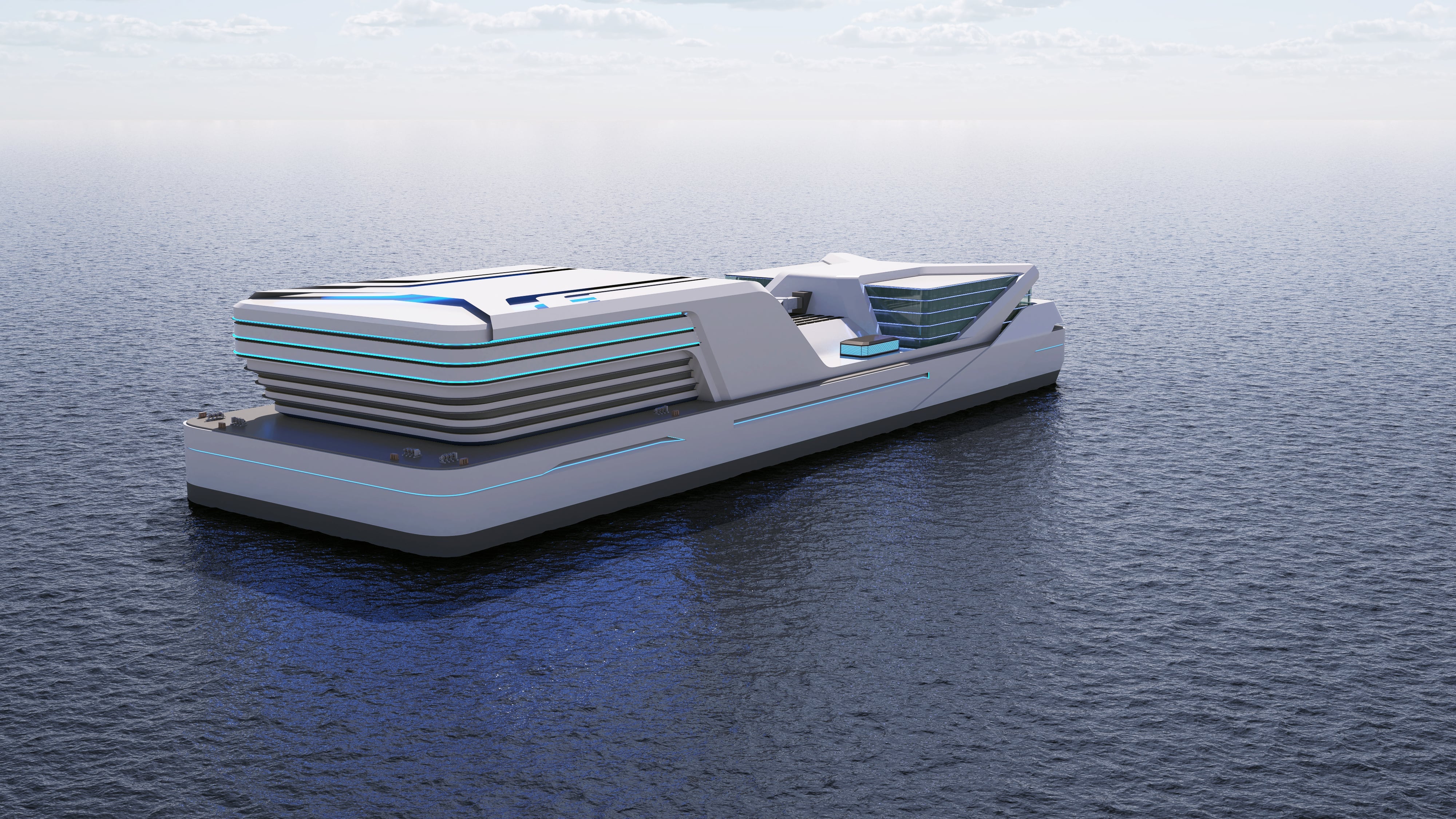
The U.S.-China summit concluded amicably, but the two nations are engaged in fierce competition across nearly all sectors. One such arena is the **Floating Nuclear Data Center (FNDC)**. The FNDC is a futuristic maritime platform that integrates a small offshore nuclear power plant on a vessel with a data center on its upper structure. It has garnered attention as an innovative project poised to reshape the global energy and data industries.
Unlike traditional methods relying on power transmission lines from land-based nuclear plants, the FNDC concept unifies power generation and ultra-high-density computing infrastructure within a single offshore structure. In the future, the number of FNDCs deployed globally and their operational scale are expected to become a key metric of national competitiveness. Christopher Wiernik, president of the American Bureau of Shipping (ABS), a leading non-profit marine technical certification organization, recently emphasized the FNDC as a “technical solution to address power shortages and cooling challenges caused by the proliferation of generative AI,” expressing strong support for its adoption.
The core power generation system of the FNDC platform is a small pressurized water reactor (PWR). These vessels can be deployed to remote or conflict zones facing urgent power needs, providing clean energy and AI computing capabilities immediately. For instance, if the FNDC were constructed and deployed to North Korea after unification, it could rapidly supply stable power without the need for complex large-scale land-based grid infrastructure. Similarly, deploying FNDCs to disaster-stricken areas—such as regions hit by earthquakes or typhoons—could efficiently support recovery efforts by providing electricity and communication services. Military applications are also significant. The U.S. anticipates that China, which already operates an AI data center under the South China Sea near Shanghai, may deploy offshore nuclear power platforms to areas like the Spratly Islands.
Technologically, the FNDC combines South Korea’s world-class shipbuilding and vessel construction capabilities, U.S. small-scale offshore nuclear power technology, and South Korea’s high-spec semiconductor modules—key components of data centers. The massive heat generated during computations is managed through a seawater-based water-cooled system.
The FNDC can bypass or replace many land-based permits required for constructing nuclear plants or large data centers, such as land-use approvals and foundational infrastructure permits. It also simplifies processes like obtaining permits for power grid infrastructure, environmental impact assessments, and water intake/discharge approvals. However, new regulations apply: for instance, mooring a vessel at sea and using seawater as coolant requires marine compatibility assessments. Additionally, safety reviews for the reactor itself, such as approvals from the U.S. Nuclear Regulatory Commission (NRC), will remain as stringent as those for land-based nuclear plants.
A surprising fact is that Samsung Heavy Industries designed such a floating nuclear power plant approximately 15 years ago. If a massive consortium involving U.S. energy companies, Google, Amazon, Samsung Heavy Industries, Samsung Electronics, and SK Hynix were formed, it could align with South Korea’s strategic investment framework in the U.S. Allocating a portion of South Korea’s pledged $350 billion in strategic investments to the U.S. toward the FNDC project could simultaneously achieve the dual benefits of revitalizing the U.S. shipbuilding industry and strengthening the South Korea-U.S. high-tech security alliance.
Washington experts evaluate the FNDC initiative as the epitome of future industries converging shipbuilding, nuclear power, AI, semiconductors, and defense. It is time for South Korea’s government and industries to establish an active and meticulous participation strategy to preemptively secure this new frontier of offshore AI and nuclear markets.




Leave a comment