
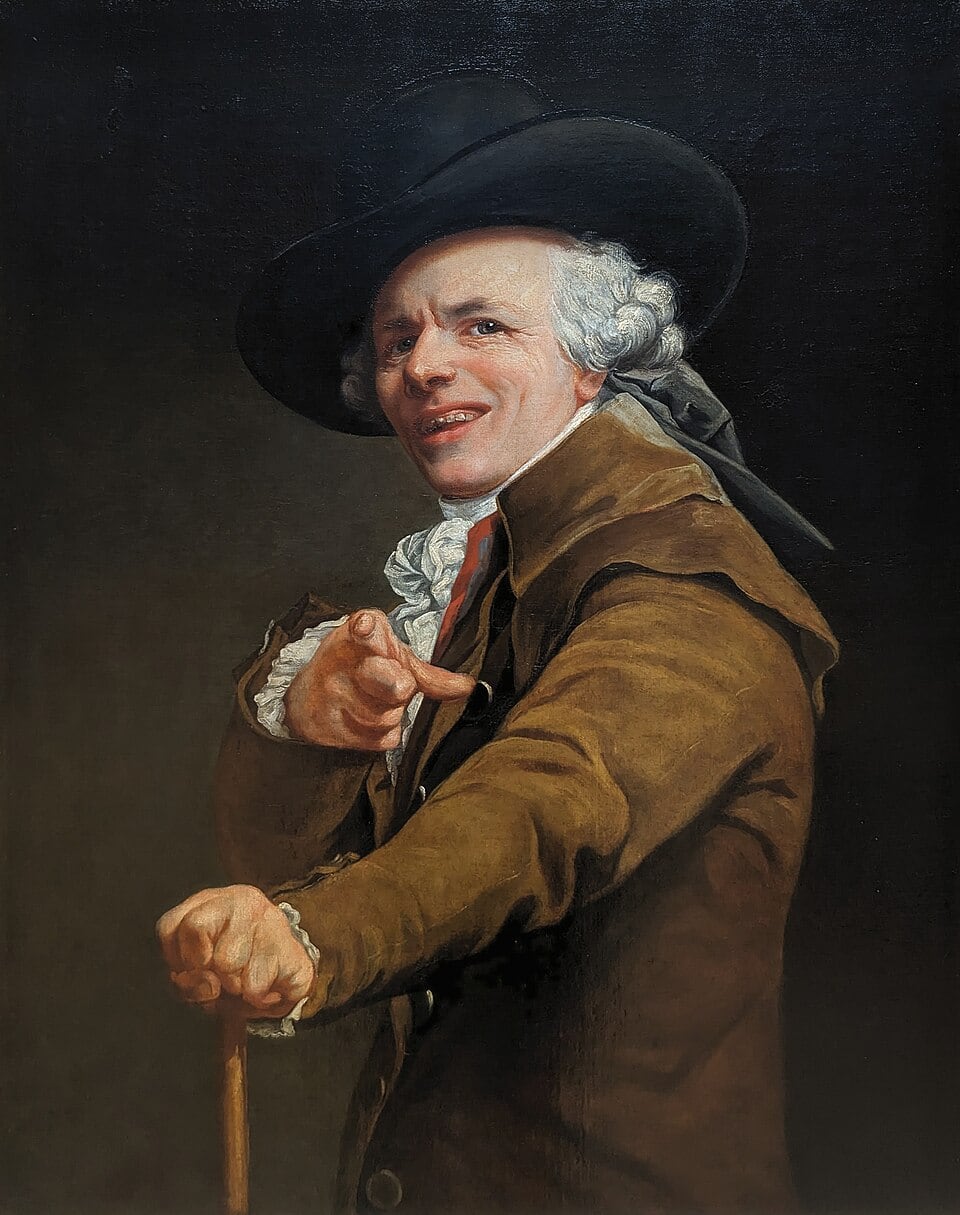
This man, openly pointing and mocking the audience, is Joseph Ducreux (1735–1802), an 18th-century French painter. Born the son of a painter, he received early art training and left for Paris. There, he learned delicate portraiture from Quentin de La Tour, the foremost pastel artist of the time. From Jean-Baptiste Greuze, who captured ordinary life with dramatic tension, he mastered emotional expression. Though he grew into an exceptional portraitist, Ducreux repeatedly failed to become a member of the Royal Academy, the sole gateway for artists at the time—his fiery temper was said to be the reason.
In 1769, Ducreux seized a golden opportunity: painting a portrait of Marie Antoinette, the fiancée of the French crown prince, whom he had never met. Enthralled by his depiction of her doll-like beauty, dignity, grace, and even shyness, Marie Antoinette granted him a baronetcy and appointed him the queen’s principal painter—a position typically unattainable without Royal Academy membership. Nobles soon lined up to commission portraits from him.
The aristocrats in Ducreux’s portraits are uniformly elegant and refined. Yet he sought to capture how human emotions, inherent in everyone regardless of status, reveal themselves in expressions. Unable to distort the faces of high-ranking subjects, he turned to self-portraiture. Before the canvas, he exaggerated expressions of arrogance, contempt, laziness, boredom, shock, bewilderment, wit, and impulsiveness. His uninhibited self-portraits, over 200 years later, have become internet memes circulating the globe—something no ordinary Royal Academy member could have dreamed of.





Leave a comment