
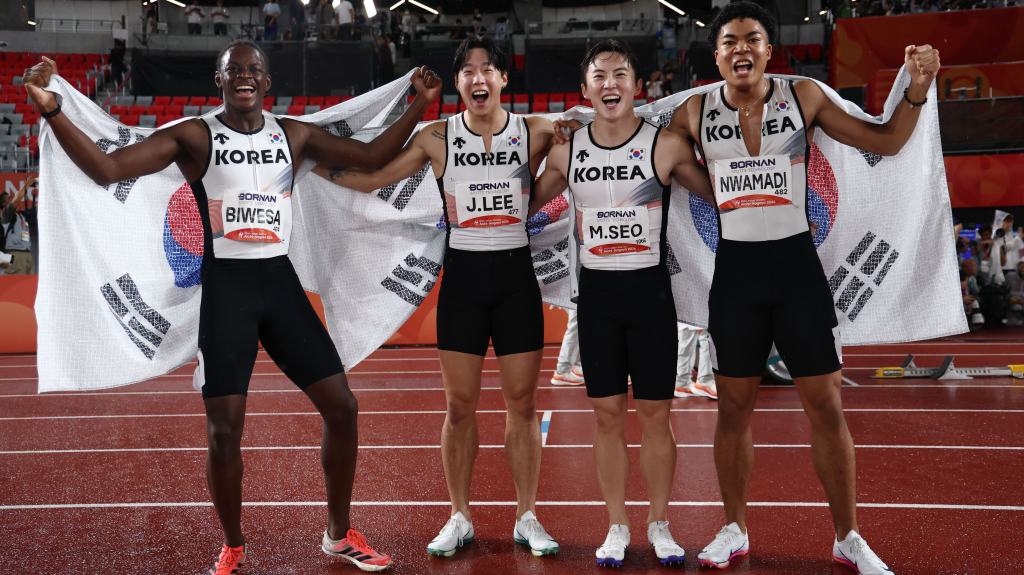
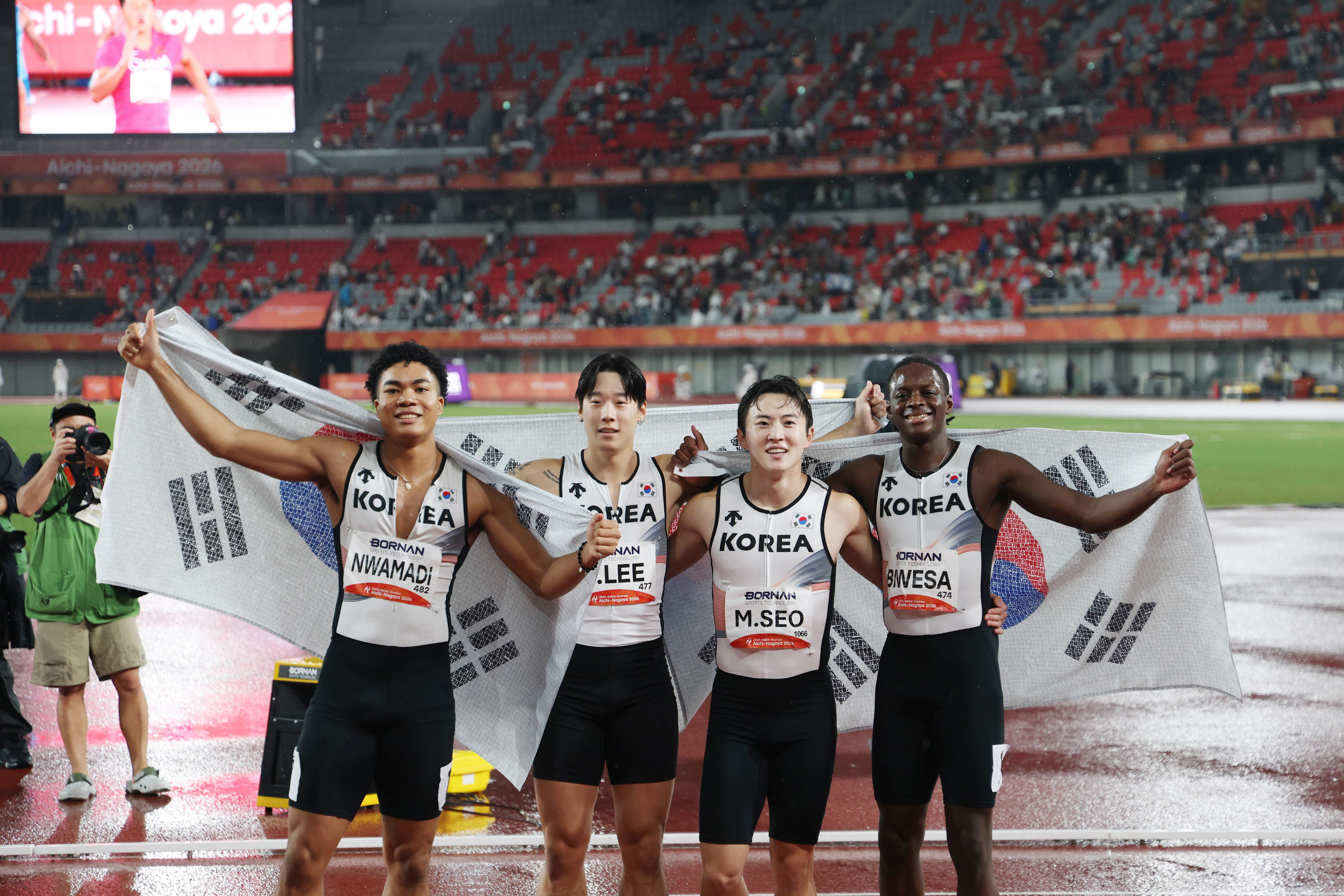
The South Korean men’s 400m relay team, who faced a disqualification scare during the semifinals, ultimately secured a spot on the podium. Comprising Seo Min-jun (Seocheon County Office) – Nwamadi Joeljin (Yecheon County Office) – Lee Jae-sung (Gwangju Metropolitan City Government) – Biwesa Daniel Gasama (Ansan City Government), South Korea crossed the finish line in third place with a time of 38.43 seconds in the final of the men’s 400m relay at the 2026 Aichi-Nagoya Asian Games held at Mizuho Park Athletics Stadium in Nagoya, Japan, on September 28. This marked a new Korean national record. The bronze medal ensured South Korea’s second consecutive Asian Games medal in the event, following their achievement at the 2022 Hangzhou Games.
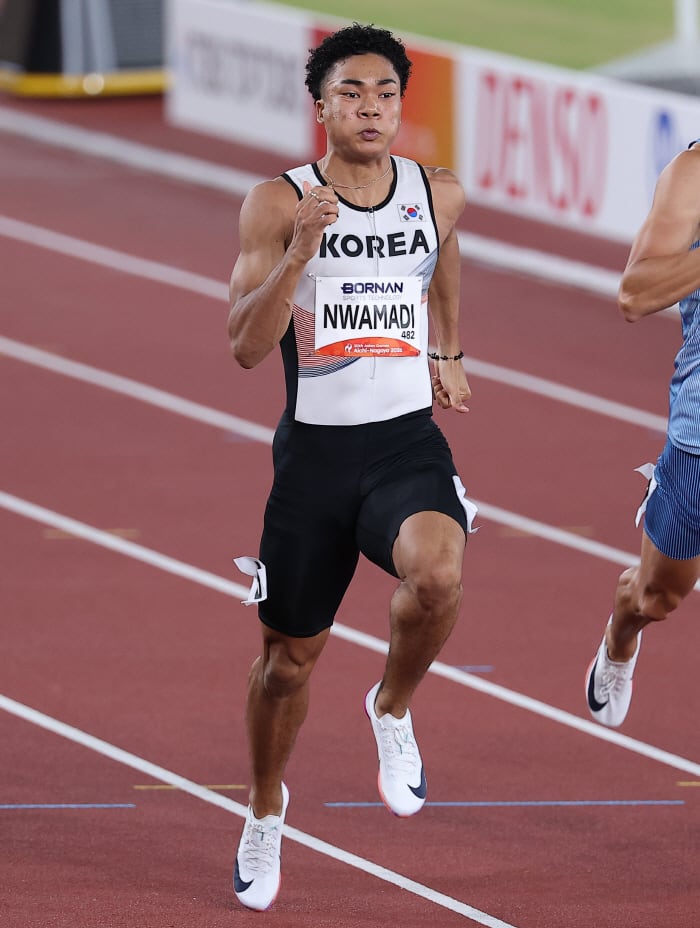
On a rainy track, South Korea started in lane 1, the innermost lane. The first runner, Kim Si-on, broke the start and navigated the curve before handing the baton to Nwamadi, the face of Korean sprinting. Nwamadi accelerated through the rain on the straightaway, and Lee Jae-sung, a member of the Hangzhou Asian Games bronze medal team, maintained momentum as the third runner. Biwesa, receiving the final baton, sprinted to the finish line.
As recently as the previous day, South Korea’s advancement to the final was uncertain. In the semifinals, running in the same order, they recorded 39.33 seconds, ranking seventh overall, but were disqualified for stepping out of the exchange zone during the first baton handoff from Kim Si-on to Nwamadi. The team immediately reviewed the video and appealed, and the judges accepted it, allowing them to dramatically regain their spot in the final.
However, after the race, confusion over whether South Korea had secured the bronze medal persisted for some time. Immediately after the race, the scoreboard and on-site records showed South Korea finishing third with 38.43 seconds, but later the official website displayed ‘DQ (Disqualified)’ for the South Korean team and awarded the bronze to Thailand. However, the official results still showed ‘Protested’ and the final standings remained undecided.
The South Korean athletes and the Korea Association of Athletics Federations were busy trying to clarify the situation. A source from the federation said, “We are first confirming whether South Korea was actually disqualified or if it was a labeling error.” When South Korean athletes directly informed the coach that “the official website shows us as disqualified,” the team began a full investigation into the judgment process.
As the judgment was not finalized, the medalists’ press conference could not proceed normally. Only the names of the gold and silver medalists were posted, leaving the bronze medal spot empty, and it was reported to be postponed until the results were confirmed. Although South Korea had crossed the finish line in third place, the subsequent protests and confusion in result announcements made it difficult to confirm the bronze medal for some time. Eventually, after about an hour of chaos, they confirmed the bronze medal.
The athletes, who had once missed their chance but seized it again, answered with results in the final. The South Korean men’s 400m relay has been on a steep upward trajectory recently. At the 2025 World Relay Championships, they set new Korean records with 38.56 and 38.51 seconds, and at the Gumi Asian Championships, they again broke the national record with 38.49 seconds, claiming their first-ever title. Two months later, they also won the German Rhine-Ruhr U Games with 38.50 seconds.
This relay team has been evaluated as the strongest in history in terms of individual capabilities. Nwamadi and Biwesa placed fourth and fifth, respectively, in the men’s 100m final at these Games with 10.17 and 10.19 seconds. Both athletes share a personal best of 10.13 seconds, ranking them second in Korean history behind coach Kim Kook-young’s national record of 10.07 seconds. Kim Si-on, strong in starts and curve running, and Lee Jae-sung, experienced as the third runner, complemented them.
South Korea had previously won medals in the men’s 400m relay at the Asian Games only twice: a bronze at the 1986 Seoul Games and another bronze at the 2023 Hangzhou Games.


Leave a comment