
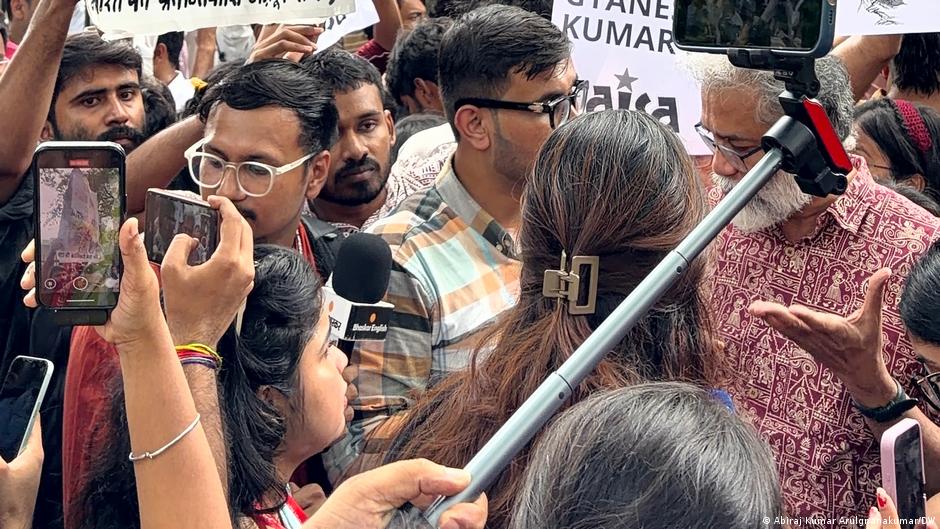
After helping force the resignation of India’s education minister, a youth-led protest movement is now taking on the election commission amid controversy over voter rolls. New protests are planned for this weekend.
India’s youth-led Cockroach Janta Party (CJP) and opposition parties have demanded the resignation of Chief Election Commissioner (CEC) Gyanesh Kumar after a newspaper investigation alleged impropriety during a large-scale voter-roll revision.
According to the probe, published in The Indian Express newspaper, some key decisions linked to the so-called Special Intensive Revision (SIR) of voter rolls that began last year were likely taken without the approval of two of the three election commissioners.
The Indian Express said that fellow Election Commissioners Sukhbir Singh Sandhu and Vivek Joshi had raised at least 14 formal objections over 10 months to decisions concerning voter registrations, deletions and restorations, as well as control of electoral-roll data.
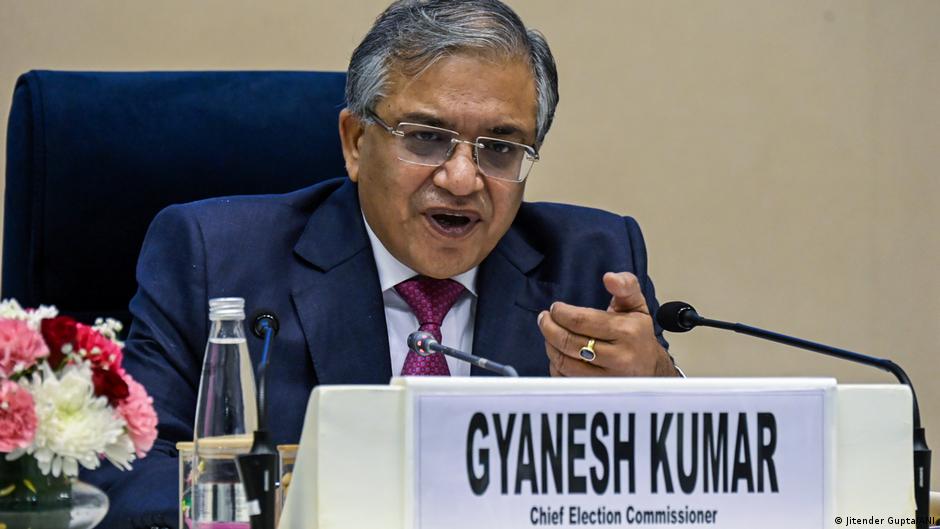
In one of the objections, Sandhu complained that the Election Commission of India (ECI) acted against the written advice of two commissioners and claimed its action was “unauthorized and illegal.”
The allegations presented “only one part of the picture,” and “differing views” were a routine “part of decision-making,” the ECI said in a statement cited by local media.
‘Cockroach’ movement founder calls for demonstrations
Speaking at a press conference on Thursday, CJP founder Abhijeet Dipke called Kumar “the biggest threat to India’s democracy” and demanded his resignation.
Dipke threatened to launch nationwide protests, beginning in Mumbai on October 2, the birthday of India’s founding father Mahatma Gandhi, if Kumar did not quit by Saturday.
The Saturday deadline passed without Kumar stepping down.
After Mumbai police denied permission for the planned October 2 protest, Dipke posted on X calling on supporters to submit to mass arrests rather than comply with the ban.
Supporters staged protests on Friday and pledged to continue mobilizing despite the restrictions.
Opposition parties echoed the CJP’s criticism of Kumar and the Election Commission.
Pawan Khera of the main opposition Congress party said that “Gyanesh Kumar has done nothing short of treason.”
“If decisions relating to the SIR were taken without the knowledge or approval of two of the three election commissioners… then those decisions and the entire SIR exercise are legally invalid,” Khera said on social media.
Congress and other opposition parties have accused the ECI of colluding with India’s ruling Bharatiya Janata Party (BJP) to manipulate voter lists and win state elections in recent years, charges both the commission and the BJP have denied.
What are the demands of India’s CJP movement?
The ‘Cockroach’ movement, which has millions of followers on social media, forced Education Minister Dharmendra Pradhan to resign in July following widespread student-led street protests.
The group has laid out three demands: Kumar’s resignation and criminal proceedings against him, a freeze on the SIR and the suspension of all upcoming elections, and the repeal of the 2023 law on the appointment of the election commissioners of India.
Civil rights activist Amrita Johri said the CJP’s decision to target the poll panel reflects wider concerns over the lack of transparency surrounding the SIR.
“There is an absence of public consultation or a clear explanation for launching the exercise, as well as the findings of the newspaper that the two election commissioners had raised repeated objections to key decisions,” Johri told .
“Restoring public confidence will require Kumar’s removal, stopping the SIR and an independent review of the millions of names excluded from the draft rolls.”
From education protests to electoral politics
Political activist Sudheendra Kulkarni sees the CJP’s latest campaign as that of a pressure group rather than an emerging standalone political force.
“I do not see any separate political future for the CJP. It may remain as a pressure group for some time. But as the next parliamentary election approaches, it will have to align itself with the opposition alliance,” Kulkarni told .
Others see greater weight in the CJP’s shift.
Political analyst and commentator Radhika Ramaseshan said the CJP widening its focus will not weaken what it started.
“I don’t think if the CJP enlarged the ambit of its concerns and built protests around [them], it would take away from the salience and power of the first issue it highlighted,” Ramaseshan told . “Voter rights and enfranchisement is fundamental to a citizen’s existence, to upholding the sanctity of the Indian constitution.”
“These are not abstractions or procedural matters. They impinge on the lives of first-time voters who make up the bulk of the CJP,” she added.
What happens now?
With Kumar refusing to resign, attention will now turn to the CJP’s promise of street protests starting in Mumbai on October 2.
But a protest group alone cannot simply remove a CEC. Under India’s constitution, the CEC can be removed only through a process requiring action by both houses of Parliament and a special majority, on grounds of proved misbehavior or incapacity.
“The CJP’s significance would be in increasing pressure and forcing scrutiny of the ECI’s functioning,” former Chief Election Commissioner S Y Quraishi’s told .
He argues that the reported unilateral decisions are the more serious issue and should be subjected to an independent legal and technical audit.
“The practical route is judicial scrutiny, not street removal. The decisions taken unilaterally by the CEC in a three-member commission could be challenged as invalid, with the Supreme Court potentially needed to intervene,” he said.
“Where the commission will not act, the Supreme Court will have to step in,” added Quraishi.
The CJP’s latest campaign puts it directly into one of India’s most contentious disputes over electoral administration.
Whether it can sustain that momentum against the Election Commission will be a very different test for a movement that is still trying to define its place in Indian politics.
Edited by: Keith Walker
Author: Murali Krishnan (in New Delhi)



Leave a comment