
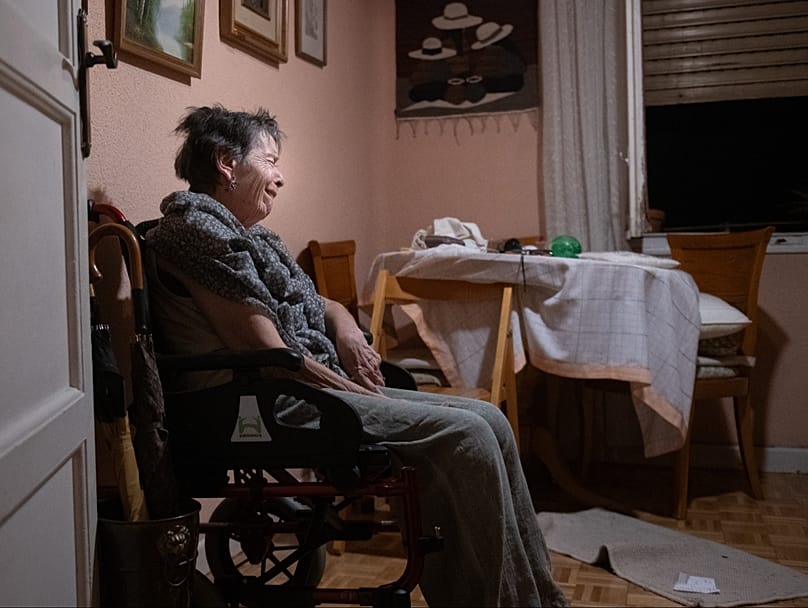
Images of María del Carmen Abascal, known as Maricarmen, being evicted from her home in Madrid have become the latest symbol of Spain’s housing access crisis.
The 87-year-old had been renting the property for around 70 years. According to the Sindicato de Inquilinas de Madrid, after a change of ownership a rent rise was proposed, from about 500 euros to 2,650 euros a month, later cut to 1,650.
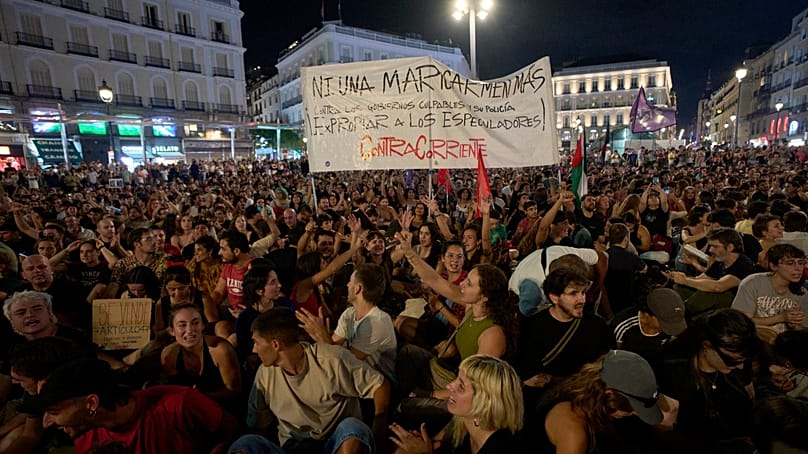
After several attempts to halt the eviction, Maricarmen was removed from the property and later taken to hospital. The case triggered protests that quickly spread beyond Madrid.
Yet the scale of the reaction is hard to understand if you look only at this eviction. Maricarmen’s case comes at a time when access to housing has become one of the main economic pressures on many Spanish households.
How much have house prices risen in Spain?
Purchase prices are currently rising at double-digit rates. The Housing Price Index of the National Statistics Institute (INE) recorded a 12.2% year-on-year increase in the second quarter of 2026.
Second-hand homes, which make up most of the Spanish market, rose even more, by 12.9%, while new-build properties increased by 7.4%. Compared with just the previous quarter, prices went up by another 3.4%.
The problem does not only affect people wanting to buy. The average advertised rent reached 15.1 euros per square metre in August 2026, according to Idealista, 5.8% more than a year earlier. And these increases come on top of the rises recorded in recent years.
As a result, housing costs absorb a large share of many households’ income, especially among renters.
INE data show that in 2024, 28.1% of people renting a home at market rates were spending more than 40% of their disposable income on housing costs. The European Union average was 19.2%.
So the affordability problem is not simply that homes are more expensive. For a significant share of tenants, maintaining a home eats up a very high proportion of their income.
Why have prices and rents risen so much?
Experts stress that there is no single explanation, but a fundamental imbalance lies behind the current situation: in the places where most people want or need to live, not enough housing is being created to absorb demand.
Spain continues to gain population and create new households, while housebuilding remains far below the levels seen before the financial crisis.
The Bank of Spain has repeatedly pointed to this supply shortfall as one of the main factors putting pressure on the market, especially in the most economically dynamic areas, where both population and employment have grown fastest.
This makes an important distinction necessary. Spain does not literally lack homes across its entire territory. There are municipalities with stagnant populations and empty properties. The problem is where those homes are.
Pressure is concentrated above all in Madrid, Barcelona, the islands, much of the Mediterranean coast and other major urban and tourist centres. An empty home in a town with little economic activity does not solve the shortage of flats in Madrid, Málaga, Barcelona or Palma.
Why doesn’t Spain simply build more homes?
Part of the answer lies in the consequences of the previous property crisis. Before 2008, Spain went through a huge construction boom fuelled by cheap credit. When the bubble burst, many developers disappeared, the banking system ran into trouble and building activity collapsed.
Residential construction later recovered, but never returned to those levels. This also helps explain why today’s market looks very different from the one that preceded the financial crisis. The Bank of Spain notes that the production of new housing remains far more moderate than in previous expansionary cycles and that the supply deficit is especially concentrated in certain areas.
On top of that, building housing takes time. Rezoning land, securing planning permission, obtaining finance and putting up a building can take years. The supply of homes therefore responds slowly when a city’s population rises rapidly, and that slow response has consequences for prices.
If tens of thousands of people need additional housing in a given area but the housing stock barely grows, competition for the existing properties intensifies.
What role do investment funds and large landlords play?
Ownership of rental housing is also more concentrated than the familiar image of the small landlord with a single let flat might suggest.
According to a report drawn up by the Ministerio de Consumo in collaboration with the CSIC, only 39% of regular rental homes are owned by individuals who have a single property for rent. The remaining 61% belong to individual multi-landlords (owners with two or more homes for rent), legal entities, including companies and funds, and public bodies.
The same concentration is seen if only private landlords are considered. Some 52.8% of the homes rented out by individuals belong to owners who have two or more properties on the rental market.
The phenomenon is especially visible in some of the cities where housing is most expensive. Among homes rented out by individuals, those held by multi-landlords account for 60.8% in Barcelona, 56.4% in Madrid and 55% in Valencia.
The stock held by multi-landlords has also grown faster. Between 2016 and 2023, the number of homes rented out by individuals with two or more properties increased by 39.9%, compared with 30.4% among landlords with just one rental home.
But who owns the housing is only one part of the equation. The other is how many people and households are competing for a supply that is growing more slowly.
What role is population growth playing?
Spain is approaching 50 million inhabitants after several years of strong demographic growth, driven mainly by immigration. That growth has positive economic effects: it increases the working-age population, consumption and the number of people in work.
But it also increases the need for housing. And to understand the property market, both the number of inhabitants and the number of households matter. A couple who split up and then need two homes, young people leaving the parental home or workers moving to another city all create new households even if the overall population barely changes.
When the number of households grows faster than the available housing stock, competition for homes intensifies. This is particularly evident in major employment centres such as Madrid, where new residents, workers, students, families and young people seeking to move out on their own compete for limited supply.
What about foreign buyers and holiday rentals?
Both factors play a role, but their weight varies enormously depending on location. Holiday rentals can reduce the supply available for long-term residential letting in neighbourhoods with strong visitor demand, especially in big cities, the islands and some coastal destinations.
International demand is also a significant force in the sales market. According to the Colegio de Registradores, foreign buyers accounted for 15.98% of housing sales in Spain in the second quarter of 2026, the highest share recorded to date. Their presence is particularly strong in the Balearic Islands, where they made up 32.27% of transactions, and in the Valencia region, with 31.03%.
But speaking of “foreign buyers” covers very different realities. The nationalities most present across the Spanish market are still mainly European and Moroccan. Data from the Registradores for 2025 put Britons, Germans, Dutch, Moroccans, Romanians, French and Italians among the main nationalities of foreign buyers.
Latin American demand is also present, though its weight is smaller than that of European buyers. According to the Colegio de Registradores, buyers from South America represented 5% of purchases made by foreigners in the first quarter of 2025. Their presence can also be more significant in certain local markets.
The small stock of social housing
There is another key feature of the Spanish market: the stock of social rental housing is very small compared with other European countries.
According to the Bank of Spain, in 2023 there were around 300,000 social rental homes, equivalent to 1.5% of primary residences, while the average for European economies stood at about 7% of the housing stock.
This means that a larger share of low and middle income households depends directly on the private market. In countries with a bigger social housing stock, more of the population can access rentals whose price does not depend solely on market conditions.
In Spain, when private rents rise rapidly, the public housing stock able to absorb households who can no longer afford them is relatively small.
Young people show another side of the problem
One of the clearest indicators of the difficulties in accessing housing lies, paradoxically, outside the property market itself: many young people simply never manage to enter it. In 2025, 44.3% of Spaniards aged between 26 and 34 were still living with their parents, one of the highest proportions in Europe.
Almost half of them (47.3%) cited as the main reason that they could not afford to buy or rent a home. And among people of all ages who had looked for another home but ultimately did not move, nearly seven in ten pointed to excessive prices as the main obstacle.
This helps explain why the debate over housing affects very different generations. Young people struggle to move out. Tenants face high rents. Families compete for larger homes. And some older tenants can find themselves in vulnerable situations when the ownership or contractual conditions of their homes change.
Why has Maricarmen’s case sparked so much mobilisation?
Maricarmen’s story brings many of these tensions together in a single case. It is not about a young person trying to access the housing market for the first time, but about an 87-year-old woman who had spent roughly seven decades living in the same home.
Her eviction has therefore thrown a spotlight on another dimension of the housing crisis: residential insecurity does not only affect people looking for a flat or trying to become independent, but also tenants who have lived in the same property for decades, when ownership or contract terms change.
The specific circumstances of the case have also sparked a political dispute. The central government, the Madrid regional administration, the city council, the owner and tenants’ organisations have disagreed over where responsibility lies and what measures could have been taken to prevent the eviction.
Amnesty International has argued that evicting Maricarmen without providing her with suitable alternative housing violated her rights, while the different authorities have blamed one another for what happened.
But the protests have gone beyond Maricarmen’s individual case. Her eviction has come at a time when buying a home is increasingly expensive, rents keep rising and a significant share of households are struggling to meet these costs.
The demonstrations have turned an individual case into a symbol of a collective problem. Maricarmen’s circumstances are exceptional, as few people spend seven decades in the same rented home, but the wider context in which her eviction has taken place is not.
This text was translated with the help of artificial intelligence. Report a problem : [feedback-articles-en@].





Leave a comment