

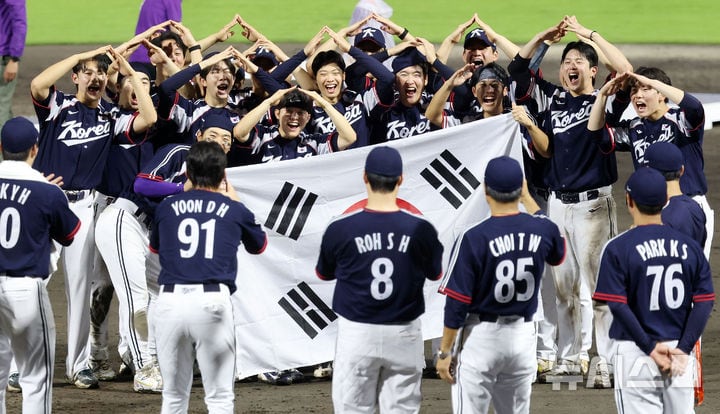
On the night of the 27th, at the Asian Games baseball final held at Toyohashi Civic Stadium in Aichi Prefecture, Japan, the South Korean national baseball team players unfurled the national flag after narrowly defeating a Japanese social baseball team 3–1. Sixteen players who received military service exemptions through the gold medal celebrated their victory with a ceremony symbolizing the Chinese character for “gold” (金). Despite their lackluster performance, their faces were filled with smiles.
Watching that scene, the word “military service” came to mind before “gold medal.” Out of the 24 players on this team, 16 received military service exemptions through the gold medal. Seven players—Kwak Bin, Park Young-hyun, Moon Bo-gyeong, Roh Si-hwan, Kim Joo-won, Kim Ji-chan, and Yoon Dong-hee—had already benefited from the gold medal at the Hangzhou Asian Games. Only Jo Byeong-hyeon completed his military service independently, having served in the Army Sports Corps (Sangmu).
The Asian Games national team has become a “broker” for professional baseball players to resolve their military service issues. The roots of this system trace back to 1973, when the state focused on nurturing elite sports. It was strongly characterized as a national reward for “enhancing national prestige.”
However, I couldn’t help but think: What kind of national prestige is it to have professionals defeat amateurs? The team suffered a 0–5 defeat in the Korea-Japan match on the 25th during Chuseok and swung futile bats in the rain-soaked final. If the Japanese social baseball team’s third baseman had cleanly caught Kim Do-yeong’s game-winning hit, the result might have been different.
For professional players, 1 year and 6 months of military service is a significant gap in their careers, affecting salaries, free agency, and overseas opportunities. It’s natural that granting military exemptions to gold medalists serves as motivation.
The problem lies in how national team members are selected. The principle should be simple: pick the best players to build the strongest team. However, to avoid disrupting the KBO League, we allocated player quotas by team. The logic was to avoid over-drafting starters from specific teams, considering league competition. Coach Ryu Ji-hyun also explained that team balance was considered when finalizing the roster.
Yet, last year’s Rookie of the Year Ahn Hyun-min and this year’s 20-home-run catcher Heo In-seo were excluded. The reasons given were injury for Ahn Hyun-min and team balance for Heo In-seo. These are weak excuses. Everyone knows Ahn Hyun-min is an active-duty soldier, and Heo In-seo already resolved his military service through Sangmu.
Naturally, the next question arises: Wasn’t taking Kim Do-yeong, who hit 40 home runs, a loss for KIA’s strength? He injured his nasal bone just before the tournament—was he fit to play? But no questions need to be asked; the word “military service” explains everything. This is why the baseball team earned the nickname “Kim Do-yeong Military Exemption Special Forces.”
Team captain Roh Si-hwan said, “We won the gold medal anyway.” Those words sounded like, “Sixteen people avoided military service.” If winning a gold medal is all that matters, we’ll have to endure this embarrassment again in four years. When the national team roster is announced, fans will first count how many have completed military service. Watching the team celebrate defeating Taiwan and Japan’s social baseball team, my face grew hot with shame again.




Leave a comment