
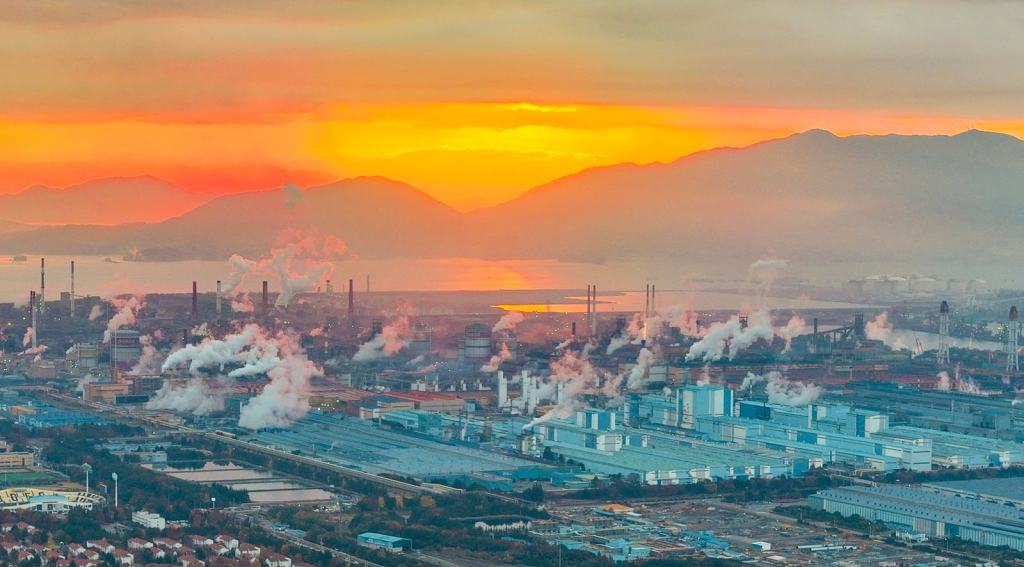
POSCO is reportedly discussing with the government a plan to present the necessity of private sector investment in nuclear power at a government-level Green Transition (GX) public report session in early October. Instead of funding nuclear power plant construction, the company is seeking a long-term supply of low-cost electricity. POSCO is said to be internally reviewing various business structures, including establishing a joint venture with Korea Hydro & Nuclear Power, the nuclear power operator.
POSCO is pushing to adopt eco-friendly hydrogen reduction steelmaking, which uses hydrogen instead of coal to extract iron from iron ore. Producing hydrogen by electrolyzing water and melting reduced iron requires massive amounts of electricity. According to industry sources, a single 2.5 million-ton-per-annum hydrogen reduction steelmaking facility requires 1.7 gigawatts (GW) of power. If POSCO converts its entire 2025 domestic steel production of 34.5 million tons to hydrogen reduction steelmaking, the required power capacity would reach 24 GW, equivalent to the capacity of approximately 17 large nuclear reactors.
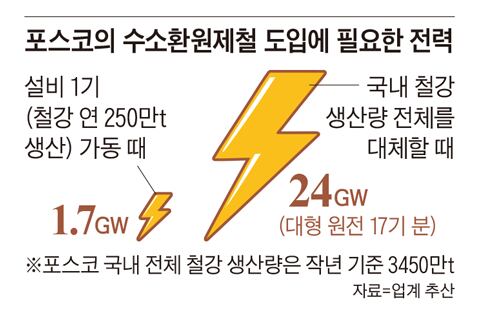
Currently, POSCO generates about 90% of its required electricity by utilizing by-product gas from the steelmaking process. Annual electricity costs are around 500 billion Korean won. However, switching to hydrogen reduction steelmaking would reduce coal usage, leading to decreased by-product gas power generation. The amount of external electricity needed for hydrogen production and steelmaking processes would surge. Internally, POSCO estimates that annual electricity costs could jump to 10 times the current level, reaching 5 trillion Korean won.
POSCO believes that intermittent solar and wind power alone cannot stably supply electricity to steelmaking plants operating 24/7. Therefore, the company has proposed to the government not only large-scale new nuclear reactors but also investments in small modular reactors (SMRs). If POSCO’s proposal is accepted, demands for private sector nuclear power investment could spread to other power-intensive industries such as semiconductors and petrochemicals. POSCO is reported to have recently met with Samsung Electronics to discuss measures for securing carbon-free power, including the use of private nuclear power.
POSCO has reportedly been conveying various private nuclear power investment ideas to the government for over a year since the Lee Jae Myung administration took office in June of last year. A representative proposal involves the company bearing the costs of renovating the suspended Wolsong Unit 1 and purchasing power from the restarted reactor on a long-term basis. However, as the government expressed reservations due to safety concerns, POSCO expanded its proposals to include privately invested large-scale nuclear reactors and SMRs.
However, for nuclear power investments to lead to actual electricity cost reductions, the power trading system must also change. Currently, there is no institutional mechanism allowing companies to purchase nuclear power at fixed prices for long periods. Former Korea Power Exchange Chairman Cho Young-tak stated, “POSCO must feel a sense of urgency that without securing low-cost carbon-free power, it will struggle to maintain price competitiveness after decarbonization, especially while competing with low-cost Chinese steel.” He added, “There is a need to allow large power-consuming companies to directly secure the power sources they require.”





Leave a comment