
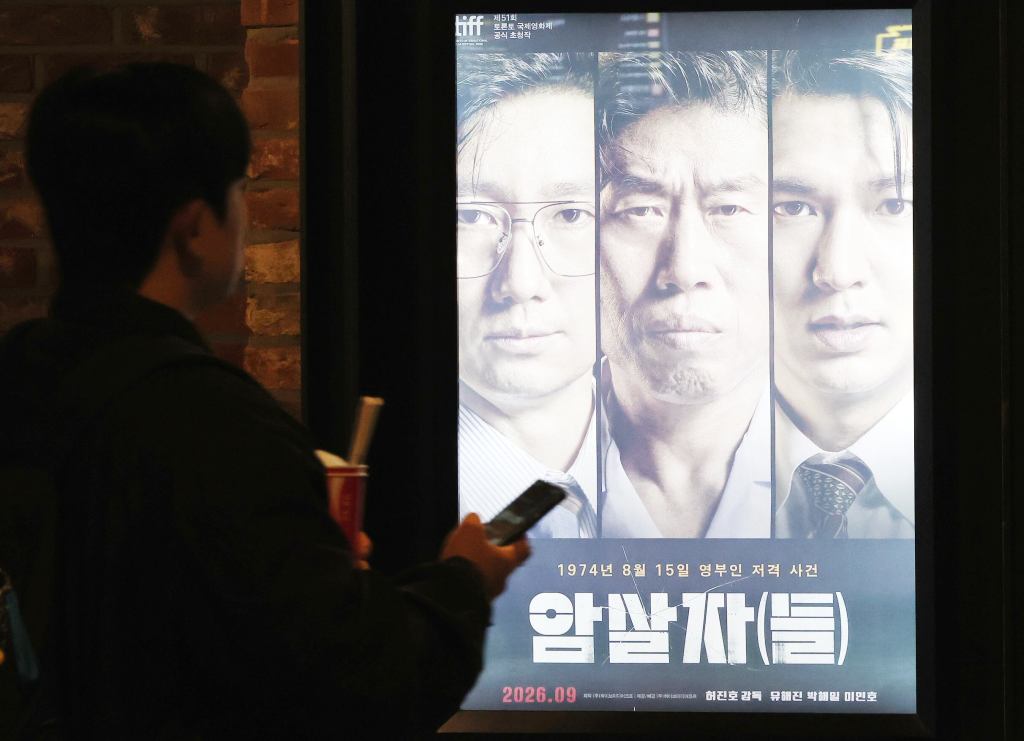
Amid escalating controversy over historical distortion surrounding the film “The Assassin(s),” which depicts the 1974 shooting of the late First Lady Yuk Young-soo, the production team has been criminally reported to police on charges including defamation of the deceased.
Lee Jong-bae, a former Seoul Metropolitan Council member, held a press conference in front of the Seoul Metropolitan Police Agency on the morning of the 29th and announced that he had filed a criminal complaint against four individuals—Kim Won-guk, CEO of Hive Media Corp, the film’s producer; director Heo Jin-ho; and screenwriters Kwon Ki-jun and Lee Ji-min—on charges of defamation through false statements.
“The Assassin(s),” directed by Heo Jin-ho and released on September 23, centers on the 1974 shooting of Yuk Young-soo during the August 15 National Liberation Day ceremony. At the time, investigators concluded that Mun Se-gwang, acting under orders from North Korea and the Pro-North Korea Federation of Korean Residents in Japan, attempted to assassinate former President Park Chung-hee but failed, resulting in Yuk’s death from gunfire.
However, the film raises questions about the origin of the bullet that struck Yuk and the event’s background, prompting Lee to strongly condemn it as “an insult to the deceased and a distortion of history.”
According to the complaint, “the film’s title itself, using the plural form ‘The Assassin(s)’ instead of the singular ‘The Assassin,’ implies the possibility of additional perpetrators beyond Mun Se-gwang. Scenes suggesting the involvement of power institutions were sequentially arranged to lead audiences to perceive that former President Park Chung-hee was either behind the crime or at least involved.”
It further states, “The false statements about the deceased have lowered the social value and reputation of the bereaved family, constituting a separate defamation charge against them.”
Lee also criticized ruling party lawmakers who defended the film, asking, “Would they defend a film made with the same speculative imagination about former President Roh Moo-hyun or the 1980 Gwangju Democratic Uprising?”
Meanwhile, as the controversy intensified, the production team issued a statement the previous day denying political intent, asserting, “The film was not made to deny or distort existing facts.”





Leave a comment