
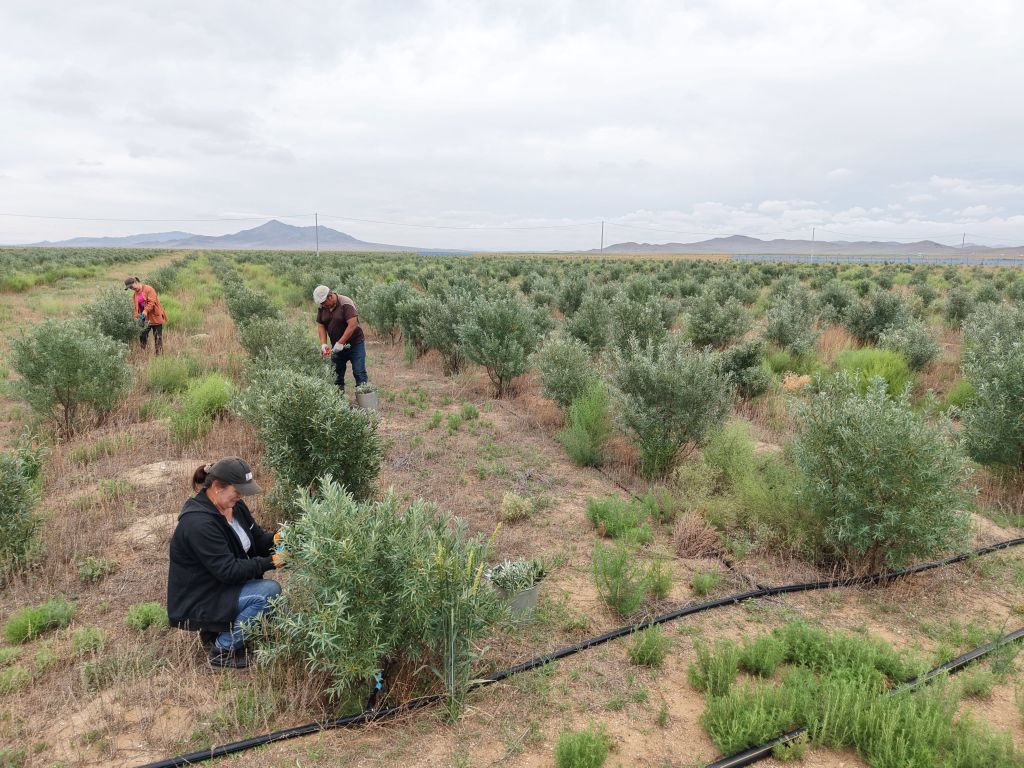
On September 15, the Bayankhongor som (basic local government), located approximately 110 km west of Ulaanbaatar, Mongolia’s capital. Along the road leading from the capital to this area, bare mountains stretched endlessly. The final 6 km stretch off the paved road into the village was a sandy expanse. When occasional gusts of wind blew up clouds of dust, visibility dropped to near zero. This is a small village with a population of approximately 1,700 people. Resident Bodjav Chengeleasehang, 65 years old, said, “After moving here around age 20, I spent nearly 40 years without seeing a single tree. Buildings are low, and without trees, yellow dust storms would routinely engulf the village.”
Now, however, all villagers know the word “forest.” Since 2022, South Korea’s Forest Service, Korea Forestry Promotion Institute, and the domestic environmental NGO Green Asia have planted approximately 70,000 trees across 1 million square meters (approximately 300,000 pyeong) near the village. Behind a sign written in Korean reading ‘Coexistence Forest,’ rows of 1–2-meter-tall trees stood. There were also vinyl house facilities for nurturing saplings. Bayankhongor Deputy Mayor Myagmarjavdorj, 44 years old, said, “At first, I was puzzled when people from Korea came to create a forest, but many residents now say, ‘The sandstorms have lessened compared to before.’”
Mongolia, with a population of approximately 3.5 million people, is called the “frontline of climate change.” Its land area is roughly 15 times that of South Korea, but as a naturally arid inland region, rapid desertification has accelerated due to rising temperatures and droughts. According to Mongolian government surveys, only 18% of the country remains unaffected by desertification and land degradation. Between 1941 and last year, Mongolia’s average annual temperature rose by approximately 2.5 degrees Celsius. Oyunsanaa, Commissioner of Mongolia’s Forest Agency, said, “Temperatures began noticeably rising in the 1970s. More residents are experiencing water shortages and land degradation.” Over 1,100 lakes disappeared between 1990 and 2020. In Mongolia, where livestock farming is a major industry, summer droughts left cattle unable to graze properly, and many perished during harsh winters or extreme weather. In 2024, approximately 7.4 million head of livestock died.
Mongolia’s desertification is also a crisis for South Korea. According to the Korea Meteorological Administration, 81% of the yellow dust affecting South Korea originates from the Gobi Desert and the Inner Mongolian Plateau, which span Mongolia and China. To address this, Green Asia (established in 1998) began tree-planting projects in Mongolia in 2000. Including Bayankhongor, they planted approximately 1 million trees—such as poplar, which purifies air and soil, and vitamin trees, which bear tart, vitamin-rich fruit—across 10 regions totaling approximately 3 million pyeong. In 2007, they established a permanent branch in Mongolia. They educated residents on trees’ air-purifying effects and paid them to plant and manage the trees. Citizens and employees from South Korean government agencies, local governments, and companies also volunteered to plant trees on-site. Green Asia is currently conducting a “Paperless” project with convenience stores like CU and 7-Eleven, using funds saved from customers opting out of paper receipts to plant trees.
Amid efforts by South Korean organizations and businesses, the Mongolian government has also rolled up its sleeves for tree-planting. Mongolia is carrying out a project to plant 1 billion trees nationwide by 2030. Oyunsanaa said, “We will continue cooperation with South Korea in forestry and apply South Korea’s tree-planting experience and achievements to Mongolian government policies to combat desertification.”




Leave a comment