
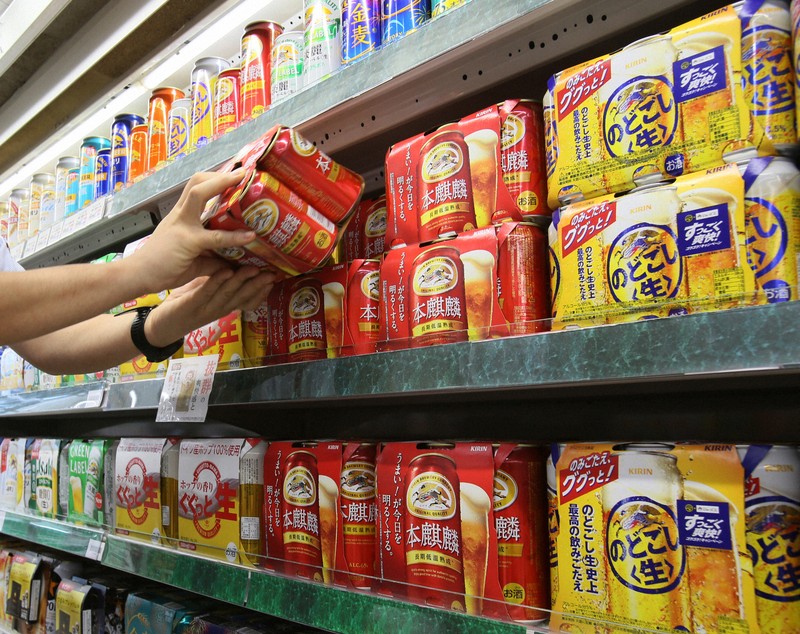
TOKYO — Liquor tax changes taking effect Oct. 1 will unify Japan’s tax rates for beer, “happoshu” low-malt beer and beer-like drinks known as “third-category” beer, intensifying what the industry has dubbed the “Reiwa beer war,” referring to Japan’s current Imperial era, which began in 2019.
Until the end of September, the liquor tax on a standard 350-milliliter can of beer stood at about 63 yen (roughly 40 cents). The tax on happoshu and third-category beer was approximately 47 yen (around 30 cents). Following the reform, all three will be taxed at a uniform rate of around 54 yen (about 34 cents).
The change will reduce the tax on beer by roughly 9 yen, allowing brewers to cut prices. Happoshu and third-category beer, however, will face a tax increase of about 7 yen, putting pressure on manufacturers to pass the additional cost on to consumers.
The increase represents a headwind for happoshu and third-category beer, which have capitalized on their low prices to attract consumers seeking affordable drinks for everyday consumption at home. To retain price-conscious customers, Japan’s major brewers are rushing to roll out new products.
This summer, Suntory Spirits Ltd. held a series of tasting events for a beer it plans to launch in October.
“The brand name will remain the same, but the product itself will be reborn as a full-fledged beer,” said 42-year-old Kayo Saito, a section manager responsible for sales promotion of Suntory’s Kinmugi brand.
What, then, distinguishes beer, happoshu and third-category beer?
The difference lies in the proportion of malt used. Under Japan’s Liquor Tax Act, a product with a malt content of 50% or more is classified as beer. A beverage is classified as happoshu if its malt content is below 50%, or if it contains ingredients not permitted in beer.
Third-category beer is made either with ingredients such as peas or soybeans in place of malt, or by blending happoshu with a grain-derived distilled spirit. It is known for its clean, light taste.
Suntory, which began as a wine producer, long ranked fourth in Japan’s beer-type beverage market, trailing companies including Asahi Breweries Ltd. and Kirin Brewery Co. Kinmugi was instrumental in helping Suntory overtake Sapporo Breweries Ltd. and move into third place in this category.
Launched in 2007, Kinmugi has attracted consumers with its low price and refreshing taste. It now leads the third-category beer market with a share of just over 30%.
However, Kinmugi has repeatedly been buffeted by revisions to the Liquor Tax Act. Under the previous revision in October 2023, the tax on a 350-milliliter can of beer was reduced from 70 yen to approximately 63 yen. By contrast, the tax on third-category beer rose from around 38 yen to approximately 47 yen, the same rate as happoshu.
The latest reform will put further pressure on Suntory to increase prices.
Japan is currently grappling with rising prices. If Suntory passes the additional tax burden on to consumers at a time when they are particularly price-sensitive, some may switch to cheaper canned alcoholic drinks, such as “chuhai.”
Suntory is therefore hoping to turn the headwind created by the October liquor tax reform into an opportunity.
“This is a battle we absolutely cannot afford to lose,” Saito said firmly, holding up the new product.
(Japanese original by Yuhi Sugiyama, Business News Department)





Leave a comment