
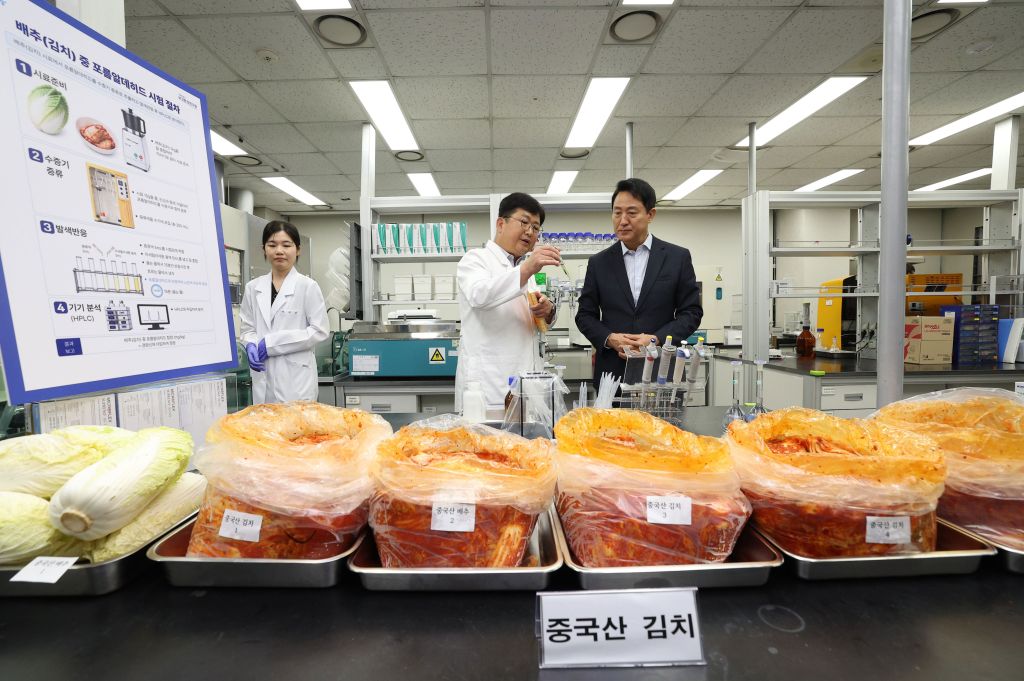
The Seoul Metropolitan Government announced on October 1 that no harmful substances, including formaldehyde, were detected in Chinese cabbages and kimchi following the controversy over “Chinese carcinogenic cabbages.”
The inspection began in August after reports emerged that cabbage sellers in Zhangjiakou City, Hebei Province, China, had used formaldehyde solution to prevent spoilage. Formaldehyde is classified as a Group 1 carcinogen by the International Agency for Research on Cancer. As public anxiety grew, the Seoul Metropolitan Government initiated safety checks on Chinese kimchi and imported agricultural products.
The Seoul Metropolitan Government Research Institute of Public Health and Environment tested 13 cases of Chinese cabbages and 48 cases of kimchi in circulation, finding no formaldehyde. Tar pigments and other harmful substances were also undetected in 6 cases of Chinese mustard greens and 24 cases of processed mustard green products. Safety tests on 192 cases of imported agricultural and fishery products—including residual pesticides, heavy metals, and radioactivity—showed no abnormalities.
Since August 27, the Seoul Metropolitan Government has been inspecting the origin labeling and hygiene management of approximately 9,500 general restaurants, traditional markets, and kimchi manufacturing and sales establishments. By September 23, 6,365 locations were inspected, with six traditional market vendors cited for failing to display origin information. The competent district offices imposed administrative penalties, including fines. Hygiene management and origin labeling at 563 food manufacturing and processing facilities handling kimchi met all standards.
The Ministry of Food and Drug Safety also found no formaldehyde in Chinese cabbages and kimchi during import and customs inspections. No kimchi manufacturers were found to have used cabbages from regions where formaldehyde use was reported.
Cho Young-chang, Director of Citizen Health for the Seoul Metropolitan Government, stated, “We will swiftly conclude the ongoing inspections of kimchi-handling businesses by mid-October and immediately include newly identified overseas hazardous foods in inspection targets.”






Leave a comment