
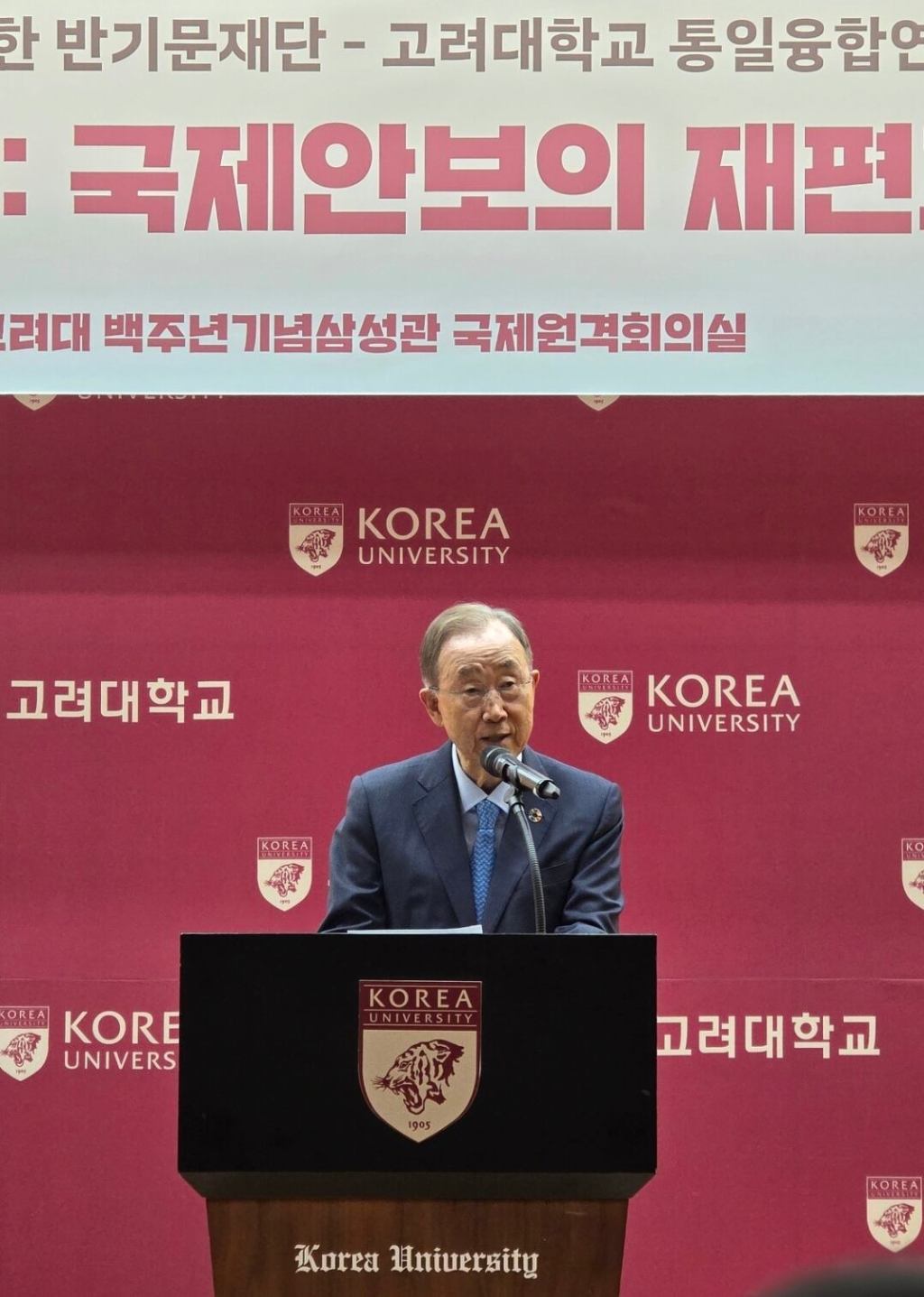
On September 29, the 4th symposium co-hosted by the Ban Ki-moon Foundation and Korea University’s Institute for Unification and Convergence was held at the university’s Centennial Samsung Hall. The theme was “Order After Order: Reorganization of International Security and Peace on the Korean Peninsula.”
I attended the event at the invitation of Lee Shin-hwa, director of the Institute for Unification and Convergence, and was particularly interested in the first session. The session, titled “Cascading Geopolitical Conflicts and Peace on the Korean Peninsula,” featured presentations by In Nam-sik, professor at the Korea National Diplomatic Academy, on the complexification of Middle East wars and the reorganization of the international order, and Park Young-jun, director of the Institute for National Security Studies at the Korea National Defense University, on cascading crises in the international order and conditions for peace on the Korean Peninsula.
Keynote Speech by Former UN Secretary-General Ban Ki-moon
Following a welcome address by Korea University President Kim Dong-won, Ban Ki-moon, the 8th UN Secretary-General, began his keynote speech. I listened to his remarks with relative ease, but the atmosphere shifted when he addressed issues related to the Korean Peninsula. His words caught my attention:
“Even if US-North Korea dialogue resumes, the goal must be clear: it should be the complete denuclearization of North Korea (CVID).” He continued, “For US-North Korea summits to achieve results, preemptive engagement by South Korea is essential, and measures that weaken the ROK-US alliance—such as reducing or withdrawing US troops from South Korea or abolishing joint exercises and training—must never be on the agenda.”
My ears perked up. His tone was stronger than usual, and I judged that he was addressing Presidents Lee Jae Myung and Donald Trump. I immediately began taking notes.
Ban Ki-moon stated, “The most important thing is whether any agreement in the process of denuclearization can substantially reduce not only the threat from the US but also threats to South Korea and Northeast Asia as a whole.” He added, “Therefore, I believe directly linking North Korea’s suspension of nuclear and missile development to the lifting of sanctions is extremely dangerous.”
At that moment, I could not help but recall President Lee Jae Myung’s remarks in a New York Times interview a week earlier. The president had said, “Exchanging additional nuclear weapons and ICBM technology development suspensions for sanctions with little practical effect has considerable value.” This was a direct response to that statement. At the time, President Lee had added, “If we aim for denuclearization under the current circumstances, we will achieve nothing.”
Since the inception of the Lee Jae Myung government, there have been occasional calls for partial sanctions relief, but this was the first time the president explicitly mentioned the ineffectiveness of sanctions and their lifting. The following day, on September 22, in his UN General Assembly keynote speech, President Lee presented a three-stage approach and avoided using the term “North Korean denuclearization” in the final phase, instead using the expression “nuclear-free Korean Peninsula.”
Ban Ki-moon pointed out that directly linking sanctions to the suspension of North Korea’s nuclear and missile development would ultimately “tolerate the approximately 60 nuclear weapons North Korea has already developed, thereby strengthening Pyongyang’s claim to be a ‘nuclear state.’”
“Once Sanctions Are Lifted, Restoring Them Is Impossible”
Ban Ki-moon has generally refrained from expressing his views on diplomatic issues. Therefore, his remarks on this occasion were exceptional.
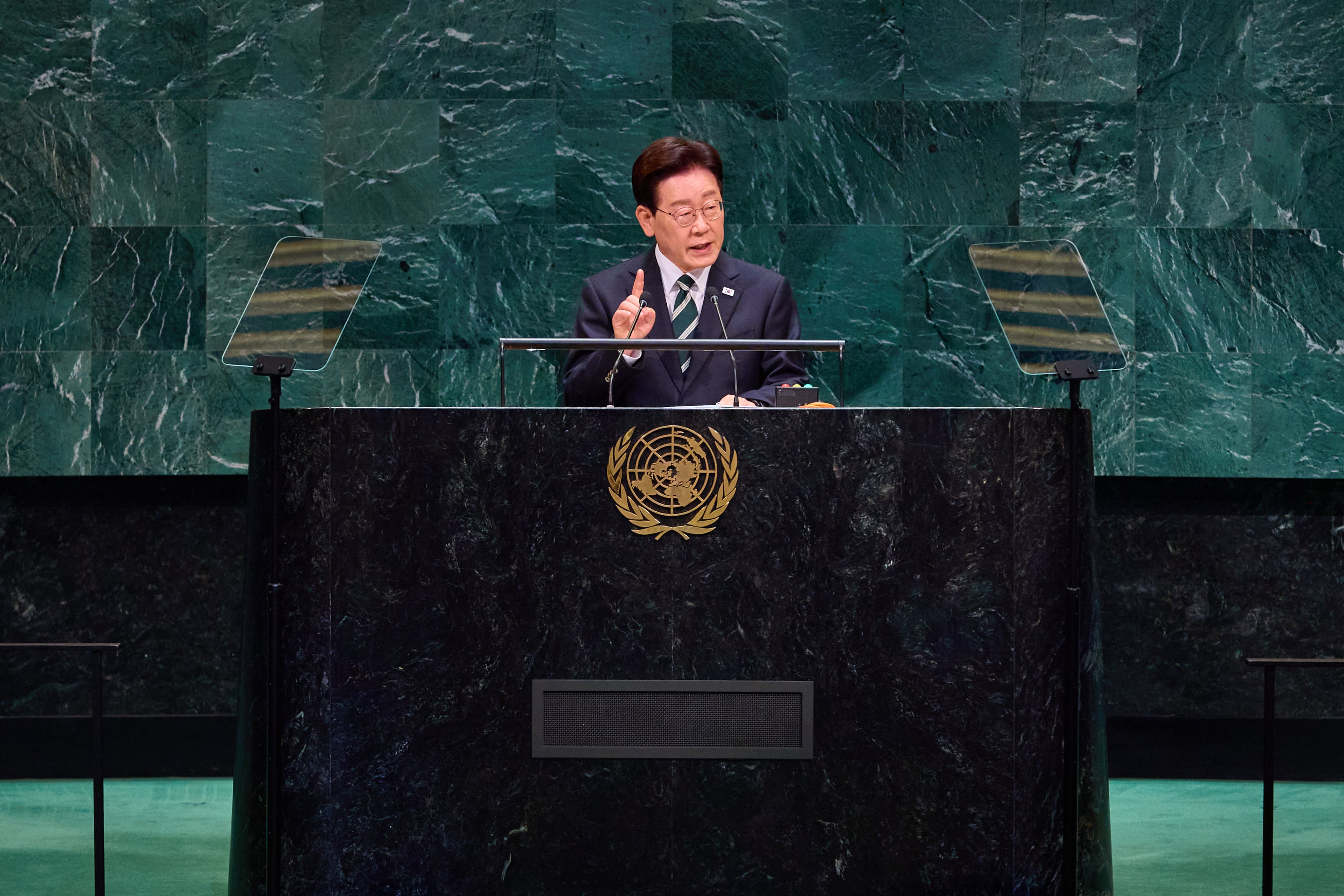
Ban Ki-moon disagreed with President Lee’s assertion that sanctions are ineffective. He said, “Sanctions on North Korea are clearly effective. North Korea depends on China for 95% of its trade, which is also due to international sanctions.” He added, “If sanctions are lifted and North Korea, as it has done in the past, withdraws from the denuclearization process, it would be almost impossible to reimpose sanctions under the current UN Security Council governance structure.” Given the structure of the UN Security Council and the international situation, it would be nearly impossible to reimpose sanctions on North Korea.
Ban Ki-moon emphasized, “We must not let go of the pressure and sanctions on North Korea’s nuclear capabilities, and we must also address the issue of North Korean human rights head-on.” His voice grew more resolute as he delved into issues related to the Korean Peninsula.
Ban Ki-moon did not mention President Lee Jae Myung’s name once during his keynote speech. However, considering the timing and content of his remarks, it was clear that he had President Lee’s North Korea policy, announced a week earlier, in mind.
Underlined and Highlighted Keynote Speech Manuscript
After descending from the podium following his keynote speech, I approached Ban Ki-moon and asked, “Did you strongly criticize President Lee’s North Korea policy?” He briefly replied, “I made it as weak as possible.”
Looking at Ban Ki-moon’s 12-page speech manuscript, I noticed it was filled with fluorescent highlights and underlines. The section stating, “Directly linking North Korea’s suspension of nuclear and missile development to the lifting of sanctions is extremely dangerous,” was marked in red fluorescent pen. It appeared he had carefully chosen each word and practiced multiple times before delivering the speech with determination.
He also stated during the speech, “The expression ‘order after order’ does not mean chaos. Even if competition among major powers intensifies, international law and norms must be upheld. Even if technological competition heats up, space for international cooperation must be maintained. And even if the security environment on the Korean Peninsula changes, the goals of denuclearization and peaceful unification of the Korean Peninsula must not waver.”
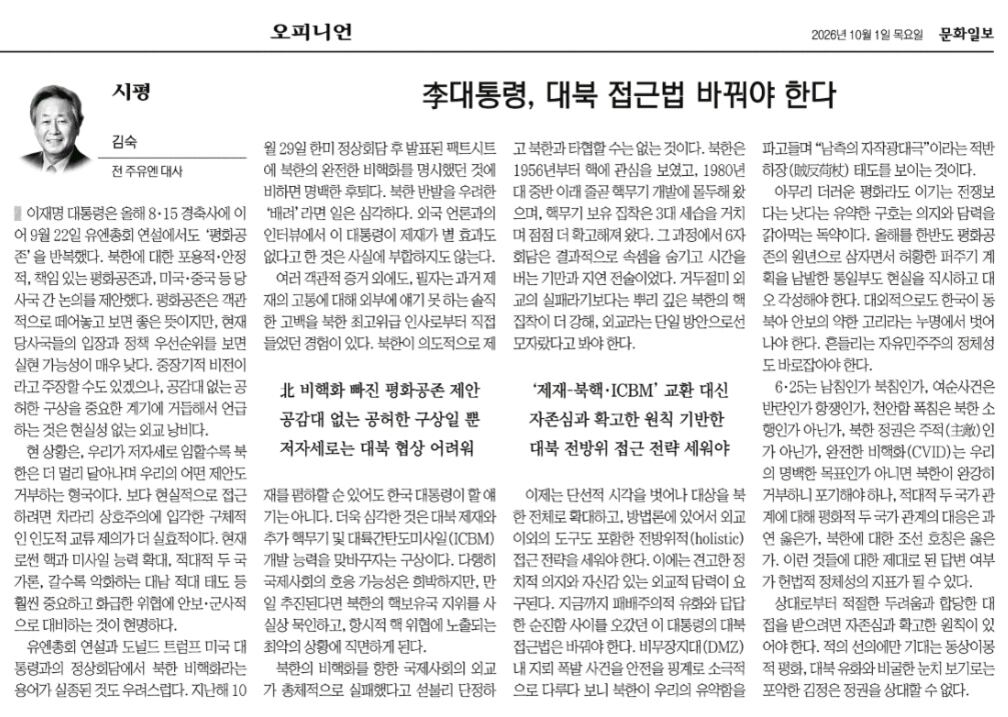
Former Ambassador Kim Suk Criticizes President Lee by Name
Two days later, an event occurred that further concretized Ban Ki-moon’s message to President Lee. Kim Suk, former UN ambassador and head of the Ban Ki-moon Foundation, criticized President Lee by name in a column for the Munhwa Ilbo on October 1. In her column titled “President Lee, Change Your Approach to North Korea,” Kim Suk pointed out, “President Lee’s claim in a foreign media interview that sanctions have little effect does not align with facts.” Based on her own experience, she specifically criticized President Lee’s assertion about the ineffectiveness of sanctions.
“Beyond various objective evidence, I have personally heard candid confessions from high-ranking North Korean officials about the pain of sanctions. North Korea may intentionally downplay sanctions, but it is not something a South Korean president should say. More seriously, the idea of exchanging additional nuclear weapons and ICBM development capabilities for sanctions relief is dangerous. Although the international community is unlikely to respond positively, if pursued, it would tacitly acknowledge North Korea’s status as a nuclear state and lead to constant nuclear threats—a worst-case scenario.”
Kim Suk, who served as head of the Peace Negotiations Office for the Korean Peninsula and as first vice director of the National Intelligence Service, was involved in North Korea nuclear negotiations and inter-Korean contacts. In 2010, during the Cheonan sinking and the subsequent May 24 measures, she served as first vice director of the NIS and engaged in discussions with Ryu Kyung, deputy director of North Korea’s State Security Department, regarding exit strategies for inter-Korean relations and summit meetings. It is presumed that during this time, she directly assessed the pressure and pain sanctions inflicted on North Korea.
Kim Suk also noted, “President Lee repeated the term ‘peaceful coexistence’ in his August 15 speech and again in his September 22 UN General Assembly speech.” She criticized, “While it could be argued as a long-term vision, repeatedly mentioning an empty idea without consensus at critical moments is a waste of diplomacy lacking practicality.” She added, “The weak slogan that even a ‘dirty peace’ is better than a victorious war is a poison that erodes will and courage,” directly criticizing President Lee’s ‘dirty peace’ theory.
Kim Suk concluded, “President Lee’s approach to North Korea, which has oscillated between defeatist appeasement and naive simplicity, must change.”
Discussing Current Issues Daily in the Foundation Office
At the Ban Ki-moon Foundation, Ban Ki-moon and Kim Suk’s offices are adjacent. The two meet daily to analyze and discuss domestic and international issues and often travel together on important overseas trips. Their strong statements appear to stem from a shared judgment that President Lee’s North Korea policy must not continue in its current direction. While Ban Ki-moon criticized broadly without mentioning President Lee by name, Kim Suk specifically named him and pointed out concrete issues.
A former high-ranking Ministry of Foreign Affairs official who knows Ban Ki-moon well interpreted, “Ban Ki-moon, who served as both foreign minister and UN secretary-general, likely judged that he could not remain silent about President Lee’s remarks questioning the effectiveness of UN Security Council sanctions.” Another former high-ranking Ministry of Foreign Affairs official said, “I understand that Ban Ki-moon regrets that National Security Adviser Wi Sung-lac failed to restrain President Lee’s remarks on sanctions beforehand.”
It is unusual for Ban Ki-moon, who has generally refrained from directly commenting on specific issues related to the current government, to voice such a clear opinion on North Korea sanctions. As someone who led international sanctions against North Korea during his tenure as UN secretary-general, his public criticism will draw attention to how it might influence the Lee Jae Myung government’s North Korea policy and its stance on sanctions.


Leave a comment