
German Chancellor Friedrich Merz made a surprise visit to Kyiv on the 4th (local time) and announced a large-scale additional support package reaffirming Germany’s support for Ukraine, according to reports by AP, AFP, and other news agencies. Russia broke its precedent of refraining from airstrikes when European leaders visit Kyiv, retaliating with drone attacks on the city center.
Merz, who arrived in Kyiv by train early that morning, stated in a German government-released statement, “I visited Kyiv today because Ukraine will need our full support over the coming weeks. If we fail to stop Russia, their war machine will soon be targeting us.”
The unannounced visit included German Economics Minister Katharina Haje and 10 executives from German defense and energy companies, as reported by German media. Merz emphasized that the cooperation between Germany and Ukraine is not one-sided, stating, “German and Ukrainian companies are jointly developing technologies that benefit both nations, making us safer and stronger.”
After meeting with Ukrainian President Volodymyr Zelenskyy, Merz announced an additional support package totaling 1.3 billion euros (approximately 2 trillion Korean won). Of this, 1 billion euros (approximately 1.5 trillion Korean won) will fund military aid, including long-range strike weapons, combat drones, and satellite technology. The remaining 350 million euros (approximately 530 billion Korean won) will support energy infrastructure repairs, such as power plants and substations, ahead of winter.
Zelenskyy described Merz’s visit as “a crucial signal of support for Ukraine and the courage of Germany and Europe as a whole.” He also revealed on social media that Germany and Ukraine had signed 15 agreements worth approximately 8.5 billion euros (approximately 12.9 trillion Korean won), focusing on security cooperation, weapon production and procurement, and expanded joint drone response efforts.
Merz noted that joint production funding would target intercepting Russia’s jet-propelled drones, with recent technical breakthroughs accelerating production. Zelenskyy added that Russia had launched 900 such drones this week alone, with Ukraine managing to shoot down roughly half.
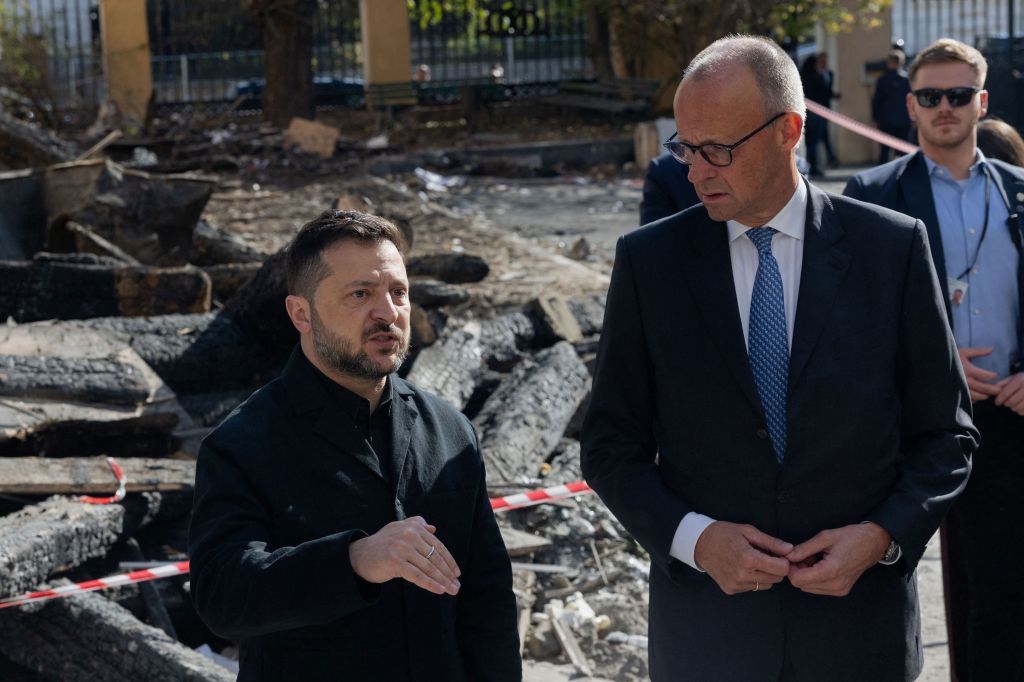
The two leaders inspected the National Academy of Sciences building in Kyiv, damaged in a Russian airstrike last month. Air raid sirens repeatedly sounded during Merz’s stay, heightening tensions. Earlier that morning, a bridge over the Dnipro River in Kyiv was attacked by Russian drones.
At the academy site, Merz condemned the “barbaric attacks on Ukrainian civilians” and addressed Vladimir Putin directly, stating, “We are ready to talk.”
Merz’s visit came a day after Russia warned of “large-scale” airstrikes on Kyiv and urged foreigners and diplomats to evacuate. In recent days, Russia has intensified attacks on bridges across the Dnipro River and energy infrastructure in the Ukrainian capital.
On social media, Merz called the coming weeks “decisive” for Ukraine, explaining it was why he chose to visit and demonstrate support. “Germany’s security also depends on the outcome of this war,” he said. “We are helping Ukraine because it is a vital interest for us.”



Leave a comment