
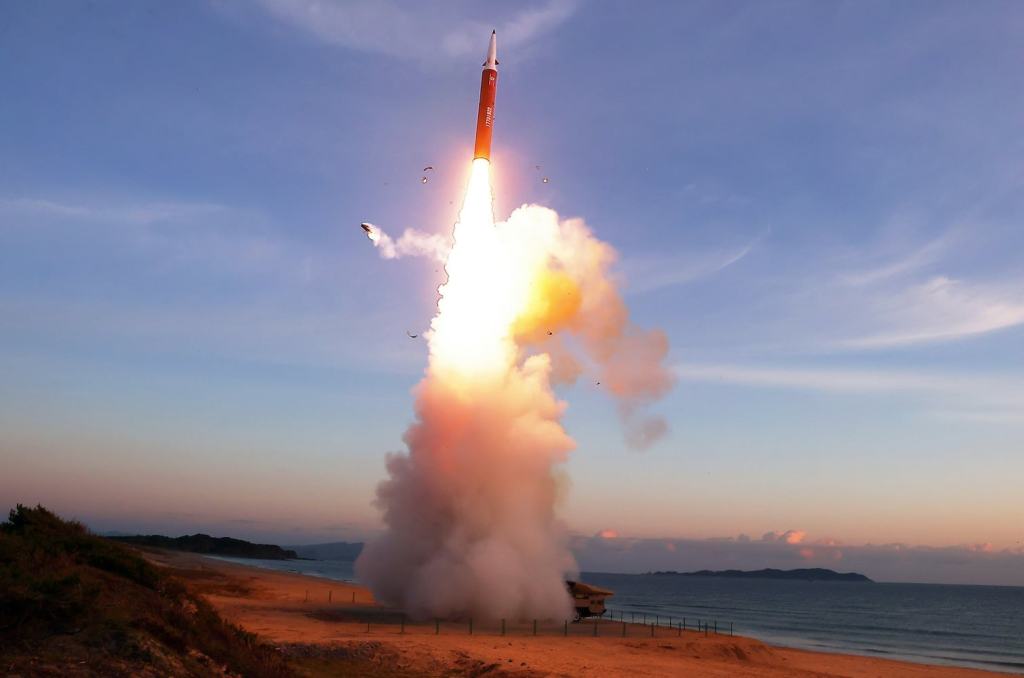
Without acknowledging or apologizing for planting mines in our side of the Demilitarized Zone (DMZ) south of the Military Demarcation Line (MDL), North Korea launched a ballistic missile applying hypersonic technology on October 3. The Joint Chiefs of Staff detected a ballistic missile launched from Wonsan, North Korea, to the East Sea around 6:30 a.m. that day and stated that the missile “flew over 700 km.”
However, North Korea announced on the same day under the name of Kim Yo-jong, a party vice department director, that it had launched an “intermediate-range strategic missile,” stating that it could gauge the “limitations of the enemies’ detection capabilities.” In reality, it flew over 1,000 km, and due to the characteristics of hypersonic missiles that move irregularly in the final flight stage, South Korea and Japan failed to properly track it, according to the claim. Kim Yo-jong then threatened, “There is practically no way to avoid this strike.”
The Ministry of National Defense refuted on October 4, stating, “We detected and tracked the missile immediately after launch and accurately identified the launch origin.” The ministry also stated, “We assess that the missiles recently launched by North Korea are at a level that can be sufficiently detected and intercepted by the defense assets possessed by South Korea and the U.S.”
◇Kim Yo-jong Mocks “700 km Flight? Limitations in South Korea-Japan Detection Capabilities”… Military Says “No Issues with Interception”
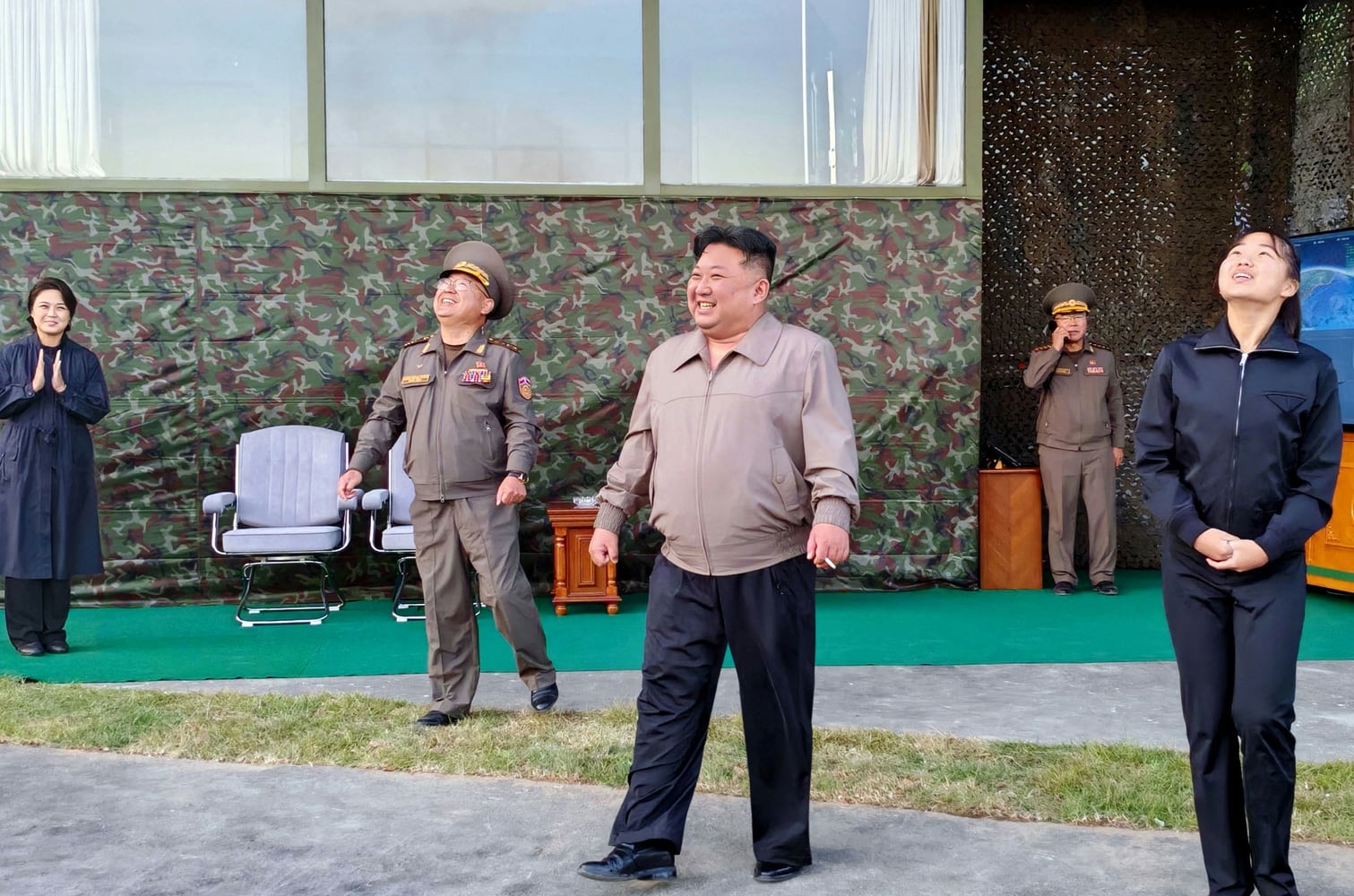
North Korea’s hypersonic missile launch on October 3 came right after it emphasized that there is no willingness for inter-Korean dialogue, calling the discovery of North Korean military mines in the southern DMZ a “self-staged farce.” Kim Jong-un, who watched the missile launch with his daughter Ju-ae and wife Ri Sol-ju, stated, “Such activities are clearly aimed at further advancing the country’s nuclear war deterrence capability,” adding, “There can be no change in our views and policies.” North Korea also released clear photos of the entire missile from the Hwasong-16na-type series, which is equipped with a conical glide warhead on a solid-fuel propulsion system.
Meanwhile, President Lee Jae Myung stated in a commemorative speech, read by Vice Minister of Unification Kim Nam-jung, at the 19th anniversary of the October 4th inter-Korean summit declaration on October 4, “The journey to resolve the Korean Peninsula issues and solidify peace will never be easy. Still, it is clear that this is the path we must take.”
◇Kim Yo-jong “Enemies Have Limitations in Detection Capabilities”
North Korea publicly announced on October 3 under the name of Kim Yo-jong that it had launched an “intermediate-range strategic missile.” This was an unusual “same-day announcement” deviating from the practice of disclosing missile launches the next day or not disclosing them at all.
Kim Yo-jong claimed that South Korea and Japan had incorrectly estimated the flight distance of the missile launched that day to be around 680–700 km, stating, “We have already witnessed similar cases four times.” The implication is that South Korea and Japan frequently misestimate the impact points and flight distances of North Korean missiles. Following this, on October 4, North Korean media disclosed the latitude and longitude of the impact point in the public waters west of Hokkaido, Japan, stating that the launched missile flew “1,000 km over the East Sea.” Missiles with a range of less than 1,000 km are classified as “short-range ballistic missiles,” but if they flew over 1,000 km, they could be classified as medium-range or intermediate-range ballistic missiles.
Regarding the differing calculations, Kim Yo-jong stated, “Every time we apply a wave-like flight trajectory method, the enemies lose track of the target after the first jump point,” adding, “In other words, this means there is practically no way to avoid this strike.” Hypersonic missiles perform “irregular maneuvers” by suddenly changing direction up, down, left, or right in the final flight stage. The claim is that South Korea and Japan fail to properly detect this and thus cannot intercept North Korean missiles.
Hong Min, a senior research fellow at the Korea Institute for National Unification, stated, “Following the launch of a short-range hypersonic missile on September 20, the consecutive launch of a medium-range missile this time appears to be a show of force demonstrating that they have means to evade interception across any range band,” adding, “We should closely monitor whether they conduct additional launches or disclose actual hardware ahead of the Workers’ Party founding day on the 10th, which marks the 81st anniversary.”
◇Ministry of National Defense “Closely Monitoring from Preparation Stage”
It is true that South Korea and Japan have limitations in tracking the final flight stage of missiles launched by North Korea toward the northeast. This is because when tracking missiles with ground-based radar, there is a blind spot where the low-altitude flight in the terminal phase, the final segment of flight, cannot be tracked once the missile falls beyond the curved surface of the Earth. Regarding this, Kim Yo-jong stated, “The enemies always make the pitiful excuse that their detection capabilities are limited due to the Earth’s curvature.”
However, the Ministry of National Defense stated, “The South Korean military has closely monitored North Korea’s recent consecutive missile launches from the preparation stage,” adding, “We assess that the missiles recently launched by North Korea are at a level that can be sufficiently detected and intercepted by the defense assets possessed by South Korea and the U.S.” Experts also explain that if North Korea launches a missile toward our side, the blind spot that makes terminal-phase detection difficult does not occur at all.
Lim Cheol-gyun, a research fellow at the Korea Research Institute for Strategy, stated, “The Earth curvature effect mentioned by Kim Yo-jong is negligible given the surveillance and reconnaissance capabilities of South Korea, the U.S., and Japan,” adding, “We cannot simply believe North Korea’s claims.” The missile launched by North Korea on October 3 was equipped with a conical glide warhead lacking sufficient lift. If this missile attempted a pull-up, an irregular maneuver involving a sudden ascent, the possibility of it having a range exceeding 1,000 km is low.
Jeong Kyung-un, a research fellow at the Korea Research Institute for Strategy, stated, “There are many questions regarding Kim Yo-jong’s announcement that it was a ‘launch training,’ as this was the first flight test of a missile equipped with a conical glide warhead on a new solid-fuel propulsion system,” adding, “Since North Korea unusually did not disclose details such as flight speed, first and second apex altitudes, and target hit photos, there are limitations in determining whether it was successful.”





Leave a comment