
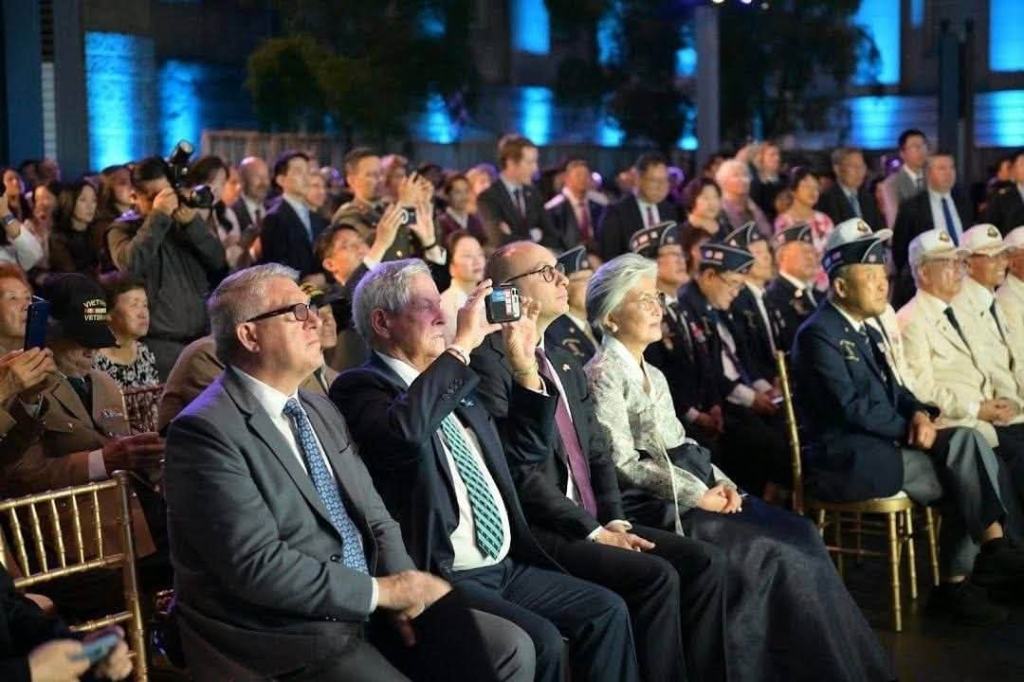
The South Korea-U.S. alliance has shown signs of strain due to delayed U.S. investments, issues surrounding Coupang and the Jeongtongmang Law, and Unification Minister Chung Dong-young’s disclosure of North Korea’s uranium enrichment facilities. Consequently, it was reported that, unlike in previous years, few U.S. government officials attended the “National Foundation Day and Armed Forces Day reception” hosted by the South Korean Embassy in Washington, D.C., on September 29.
A Washington source stated on October 7, “When South Korea-U.S. relations were strong, U.S. government officials would line up to deliver congratulatory remarks, but this year, aside from a few working-level staff, almost no one came. I felt the crisis in the alliance firsthand.” Another diplomatic source added, “Intelligence agencies like the CIA used to attend the reception annually as an opportunity to consult with our side, but this year, intelligence officials collectively did not attend due to the shaken cooperation between the NIS and the U.S.”
The National Foundation Day and Armed Forces Day reception is an annual diplomatic event held every autumn by South Korean embassies and consulates abroad, inviting high-ranking officials from host governments, business leaders, and local diplomatic corps. The level of attendees from the host government reflects the smoothness of relations with the partner country.
This year’s reception, hosted by Ambassador Kang Kyung-wha at the Smithsonian American Art Museum on September 29, lacked congratulatory remarks from high-ranking Trump administration officials. In Congress, Senators Andy Kim and Joe Wilson attended, but from the U.S. administration, only David Wilezol, Deputy Assistant Secretary for East Asian and Pacific Affairs at the State Department (director-level), and Gentry Stevens, Assistant Secretary for International Affairs at the Department of the Air Force, delivered remarks.
Last year, when Ambassador Kang hosted the reception at the Andrew Mellon Auditorium in November, Trump administration officials such as Elbridge Colby, Undersecretary of Defense for Policy; Christopher Mahoney, Vice Chairman of the Joint Chiefs of Staff; and Michael DeSombre, Deputy Assistant Secretary for East Asian and Pacific Affairs at the State Department, delivered remarks. John Knauss, nominee for Assistant Secretary of Defense for Indo-Pacific Security Affairs, and Michael Boyle, Chief of Staff of the Navy, also attended. The number of attendees, as compiled by the embassy, decreased from over 1,600 last year to around 1,300 this year.
While last year saw more U.S. government attendees due to it being the first year of the Lee Jae Myung government, even compared to previous administrations, this year’s U.S. government speakers were of lower rank. At the 2024 October reception hosted by then-Ambassador Cho Hyun-dong, Carlos Del Toro, Secretary of the Navy, and John Bass, Acting Undersecretary of State for Political Affairs, delivered remarks, with Erica Moritsugu, Deputy Assistant to the President, in attendance. The 2023 October reception at the Kennedy Center, coinciding with the 70th anniversary of the South Korea-U.S. alliance, featured General Charles Brown, Chairman of the Joint Chiefs of Staff; Kurt Campbell, White House NSC Coordinator for Indo-Pacific Affairs; and Daniel Kritenbrink, Assistant Secretary of State for East Asian and Pacific Affairs.
A diplomatic source remarked, “The National Foundation Day reception is akin to a ‘birthday party’ for South Korea, so the lack of high-ranking U.S. government officials to celebrate it raises questions.” When this newspaper asked the Ministry of Foreign Affairs about the reasons for the reduced attendance and lower-ranking U.S. officials at this year’s reception, it did not respond by the time of publication.



Leave a comment