
“If subcontract union workers go on strike, does that mean original contract employees can no longer take over their duties?”
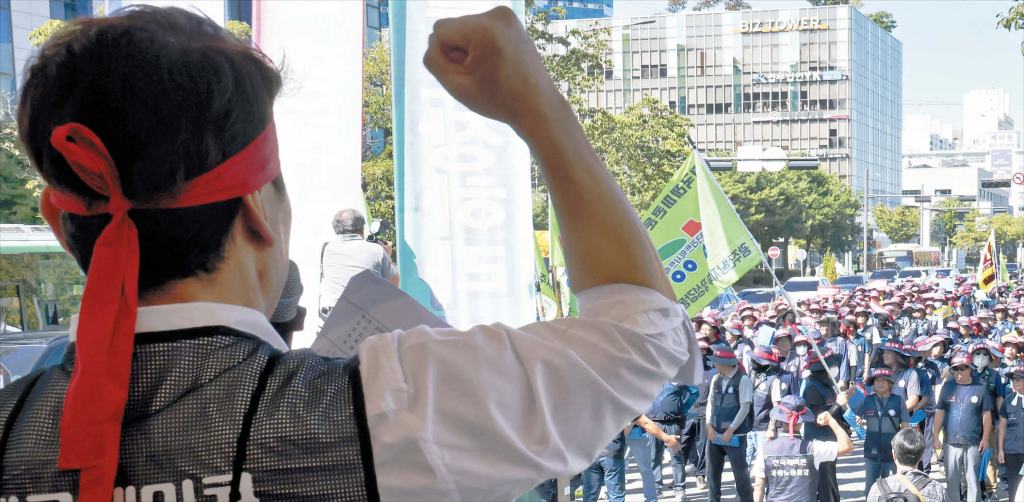
Since the implementation of the **yellow envelop act**, labor-management conflicts have escalated over whether original contract employees or third-party workers can perform duties during subcontract union strikes (substitute labor). For six months after the law’s enforcement in March, disputes centered on whether original contractors were considered employers of subcontractors. Now, a second round of debate has begun: to what extent can original contractors, now recognized as employers, respond to subcontract strikes?
Substitute labor has historically been a tool for companies to counter strikes. When subcontract unions struck, original contractors deployed their own employees or workers from other partners to fill in. While measures like workplace closures exist, they risk operational halts and significant losses, making them less practical. However, the **yellow envelop act** may now block substitute labor.
Current Article 43 of the Labor Union Act states, “Employers cannot hire or replace individuals unrelated to the business with halted operations due to labor disputes, nor can they outsource such tasks.” Before the **yellow envelop act**, original contractors were not recognized as subcontract employers, exempting them from this clause and allowing substitute labor. Now, as original contractors are deemed employers, they fall under this provision. The dispute hinges on whether original and subcontract operations constitute a single “relevant business” or separate entities.
This conflict is already materializing. LG Uplus and its union are clashing over whether 250 original contract employees qualify as “individuals unrelated to the business” under labor laws. The company prepared an “emergency operations plan” to deploy these workers as substitutes if subcontractors handling home internet and IPTV installations strike. LG Uplus has already been recognized as the employer of 1,200 subcontract workers in its non-regular union. If original and subcontract operations are viewed as one, substitutes are permissible. If separate, original employees would be “unrelated,” barring their deployment.
Controversy extends further. Labor groups claim original contractors at Hyundai Glovis, LX Hausys, and Eco Plastic deployed substitutes during subcontract strikes this year, violating labor laws. As subcontract strikes intensify, disputes over deploying original or other subcontract workers will likely grow.
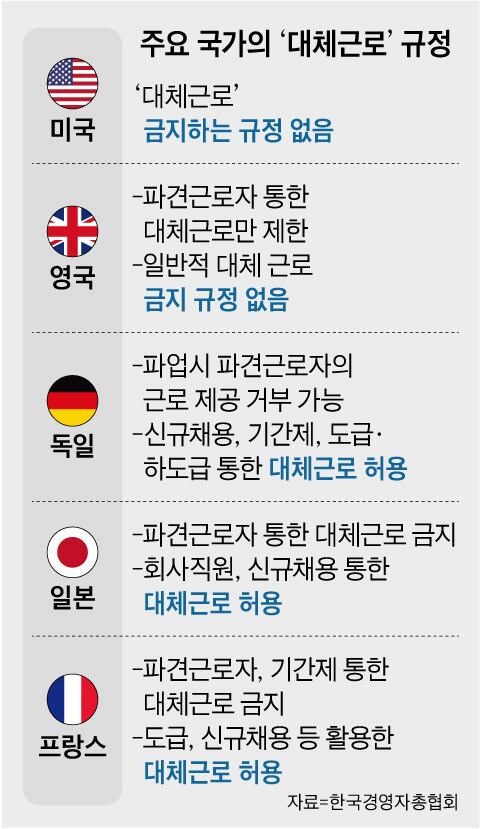
Management argues substitutes—whether original employees or other subcontractors—are permissible. “If original contractors are recognized as employers, they and subcontractors form a single labor-management relationship. Why treat substitute labor differently?” said the Korea Enterprises Federation. “If original contractors are deemed employers for collective bargaining, the entire supply chain becomes one business. Deploying original or other subcontract workers as substitutes is logical.” Major countries like the U.S. (no substitute labor bans), the UK, and Japan (restrictions only on temporary agency workers) permit broad substitute labor. France allows it via outsourcing or new hires.
Labor disagrees. Permitting substitutes would cripple unions’ bargaining power. Most substitutes, they argue, perform different tasks from subcontract workers, making them “unrelated to the business.” A labor source noted, “At LG Uplus, original technical staff handle cell tower or dedicated line installations, while subcontractors manage home internet/TV setups—distinct roles.”
Academics warned of substitute labor issues even before the **yellow envelop act**. While the law expanded the definition of “employer,” it left Article 43 unchanged, creating contradictions. “Existing labor laws assumed direct contracts, but the new law ignored clashes with old provisions,” said Park Ji-sun, a professor at Korea University Law School. “The chaos from the **yellow envelop act** has only just begun.”
☞’Substitute Labor’
This refers to employers deploying non-striking workers to maintain operations during labor disputes. It is a key tool for management to defend operational control against union actions.





Leave a comment