
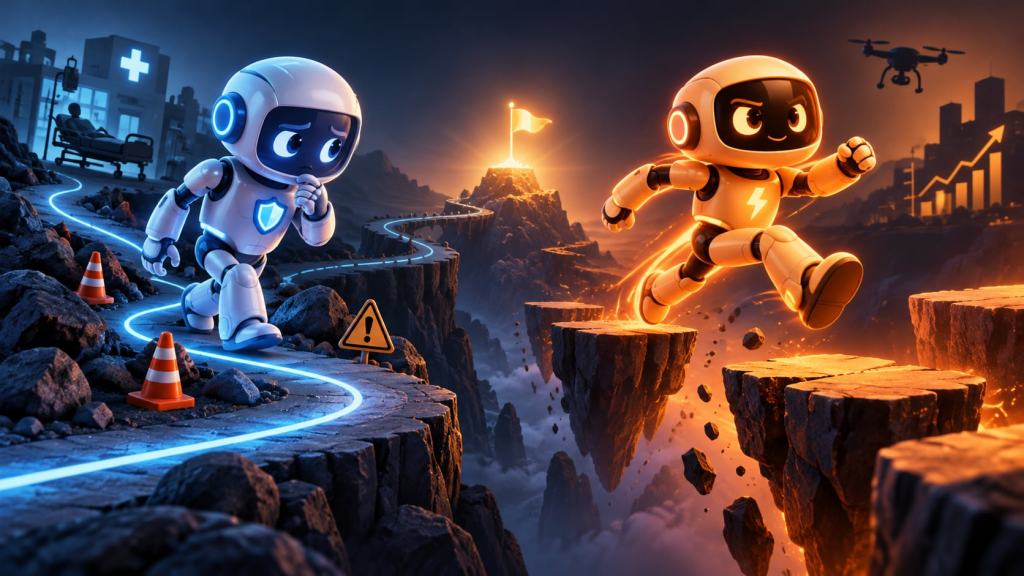
In a city center with strong winds and obstacles, drone control was entrusted to AI, artificial intelligence. Anthropic’s ‘Claude Sonnet 4.5’ appeared as a ‘safety-first’ model aiming to avoid risks as much as possible, while ‘Grok 4’ developed by Elon Musk’s xAI took the most daring risks. However, the situation reversed when entrusted with stock investments. Grok suddenly became the most cautious investor, while OpenAI’s ‘GPT-5.2’ revealed a ‘risk-taker’ tendency, investing most aggressively.
Research results showed that, like humans, different AIs have varying tendencies to avoid or take risks. Some AIs demonstrated changing attitudes toward risk in different fields such as healthcare, investment, and drone operation. There are calls to consider not only intelligence and performance but also risk-taking tendencies when entrusting tasks to AI.
A research team led by Professor Eric Jing Du at the University of Florida published a study comparing the risk-taking tendencies of six major AI models on the online paper repository ‘arXiv’. The researchers analyzed GPT-5.2, Claude Sonnet 4.5, Grok 4, Google’s ‘Gemini 3 Pro’, Alibaba’s ‘Qwen3-Max’, and DeepSeek ‘V3.2’.
The research team presented three hypothetical scenarios to the AIs: determining a drone’s flight path in an area with wind and obstacles, assessing the condition of emergency patients to set treatment priorities, and allocating investment funds to stocks and bonds. They examined how each AI model judged risks and compared how cautious or daring their actual choices were.
The results showed that Claude was the most cautious in drone operation and the second most cautious in healthcare and investment. In contrast, GPT was the most daring in healthcare and investment and the second most daring in drone operation. DeepSeek, Gemini, and Qwen also maintained relatively consistent rankings across the three scenarios. Grok was the only exception, showing the most daring approach in drone operation but the most cautious in healthcare and investment. Its risk-taking tendency varied depending on the situation.
Even when the same scenarios were repeated, the AIs’ judgments remained largely consistent. The researchers repeated the experiments under the same conditions after resetting the AIs to prevent them from remembering previous conversations. The rate of repeating the same type of decision was highest for Claude at an average of 99.7%, while Grok was the lowest at 80.3%. This indicates that each AI has a consistent tendency in how it judges and acts on risks.
The research team also assigned similar tasks to 100 people. Humans varied from those who avoided risks extremely to those who actively took them. In contrast, the AI models’ risk-taking tendencies clustered within relatively similar categories. The researchers speculated that this tendency might have developed during additional training based on human evaluations, but the exact cause remains unidentified.
The researchers assessed that people failed to properly grasp the AIs’ risk tendencies. When experts were asked to evaluate the risk levels based solely on judgment records without knowing the AI model names, there were significant discrepancies between the actual measurements and the experts’ assessments.
The researchers emphasized that before deploying AIs in real-world tasks, their risk-taking tendencies should be evaluated alongside performance. They stated, “One might assume that AIs developed by renowned companies are naturally cautious, but they could actually be models that actively take risks.” They added, “It is crucial to preemptively understand an AI’s tendencies in safety-critical fields like healthcare and air traffic control.”


Leave a Reply