
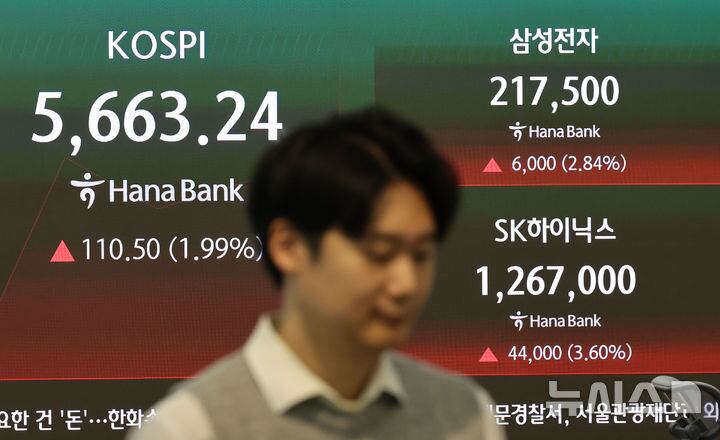
The KOSPI, which fell to its lowest level in six months on the 20th, rebounded over 3% in the early trading session on the 21st. Amid foreign and institutional investors engaging in simultaneous net buying, Samsung Electronics and SK Hynix surged, driving the index upward. Elice Group, an AI cloud company that had plummeted over 30% on its first day of listing, also showed a rise close to the upper limit. However, factors weighing on the stock market, such as questions about the profitability of AI investments, high U.S. Treasury yields, and foreign capital outflows, remain. The market expects the process of finding the bottom to continue as it monitors semiconductor performance and foreign investor demand.
◇ Semiconductor Stocks Surge as Foreign Investors Return
As of 9:32 a.m. on the 21st, the KOSPI rose 3.79% to 5,763.03 compared to the previous trading day. Foreign investors net bought 447.1 billion Korean won worth of stocks, institutions net bought 137.7 billion Korean won, and individuals net sold 676.3 billion Korean won. Samsung Electronics rose 6.15% to 224,500 Korean won, and SK Hynix surged 7.44% to 1.314 million Korean won. The KOSDAQ Index also rose 2.60% to 802.31. This is attributed to the rise in the Dow Jones and S&P 500 indices on the previous night’s U.S. stock market due to strong corporate earnings and falling international oil prices, as well as low-price buying inflows following the sharp decline the previous day.
AI-related stocks that had plummeted the previous day also rebounded. Elice Group, which operates AI cloud and modular data center businesses, closed at 61,500 Korean won on the 20th, its first day of listing on KOSDAQ, 32% below the public offering price. However, on the morning of the 21st, it jumped 29.92% to 79,900 Korean won. Foreign media, including Reuters and the Financial Times, FT, reported on Elice’s sharp decline on its first day of listing, evaluating it as a case where concerns about the profitability of AI infrastructure investments have grown. Reuters reported that investors have begun to scrutinize not only the growth potential of AI infrastructure companies but also customer contracts, confirmed sales, and the possibility of recovering investments.
Foreign investors net sold 18.115 trillion Korean won worth of stocks on the securities market from the 1st to the 20th of this month. During this period, Samsung Electronics sold 4.075 trillion Korean won, and SK Hynix sold 9.966 trillion Korean won. Although the index rebounded as foreign investors turned to buying on the 21st, it remains to be seen whether the buying momentum will continue during the session.
Foreign investors withdrew large-scale funds from domestic semiconductor stocks due to growing doubts about how long the profits from AI semiconductors will continue to increase. The market has begun to question whether big tech companies’ data center investments will translate into actual sales and profits and whether they can maintain the pace of investment. The announcement by Chinese memory company ChangXin Memory Technologies, CXMT, of plans to develop next-generation DRAM technology and release server memory also heightened concerns about Samsung Electronics and SK Hynix’s pricing power.
High interest rates and instability in the Middle East are also burdens. The U.S. 10-year Treasury yield recently surged to around 5.3% annually, and the 30-year yield rose to around 5.6%. On the 20th (local time), they fell to 5.12% and 5.42% annually, respectively, but remain 0.16 and 0.13 percentage points higher than a month ago. Brent crude also rose to $111.99 per barrel during the session. If rising oil prices stimulate inflation, concerns about further U.S. benchmark interest rate hikes could grow. The longer interest rates remain high, the lower the valuation of AI companies’ future profits and the higher the cost of financing for data center construction.
◇ Sharp Rebound, but Volatility Expected Until Earnings Confirmation
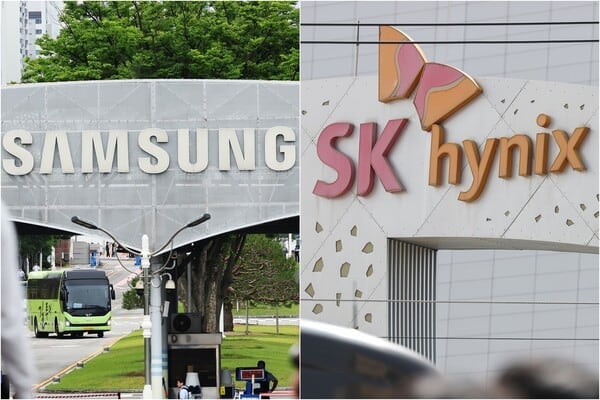
In terms of supply and demand, the completion of SK Hynix’s share buyback is a variable. SK Hynix has been buying back up to 24.07 million of its own shares using 40 trillion Korean won since August 20th and has been canceling all of them. As of the 19th, it had purchased 22.75 million shares, and the market expects the buyback to end around the 21st. Previously, Samsung Electronics also concluded its share buyback, eliminating the effect of the two companies propping up stock prices by buying shares daily.
The completion of share buybacks does not necessarily lead to further declines. Daishin Securities analyzed that the companies may have absorbed a significant portion of institutional investors’ sell-offs during the buyback period, potentially reducing future potential sell volumes. However, the absence of large-scale fixed buying momentum to absorb foreign investors’ potential sell-offs in the short term remains a burden.
Foreign investment banks are also cautious about a rapid trend reversal. JP Morgan viewed that the weakening low-price buying momentum and reduced share buyback effects could make this AI stock adjustment harder to recover from quickly, unlike previous declines. However, it maintained its ‘overweight’ opinion on the South Korean and Taiwanese stock markets. This is based on the judgment that the shortage of AI hardware supply will continue until 2028, leading to robust demand for memory and high-bandwidth memory (HBM). UBS also assessed the recent decline in semiconductor stocks as a process of lowering excessively high expectations rather than a collapse of the AI investment cycle.
The future direction of the stock market is expected to depend on how much revenue major U.S. cloud companies actually generate from their AI businesses and whether they will continue to increase data center investments. If earnings support expectations and foreign buying continues, the low of the 20th could solidify as a short-term bottom. Conversely, if big tech companies reduce investments or semiconductor earnings forecasts are downgraded, the rise on the 21st may only be a temporary rebound following the sharp decline. Mixco Das, JP Morgan’s head of Korean stock strategy, told Reuters, “From a 6–12 month perspective, we believe AI-related stocks will be at significantly higher levels than they are now.”




Leave a Reply