
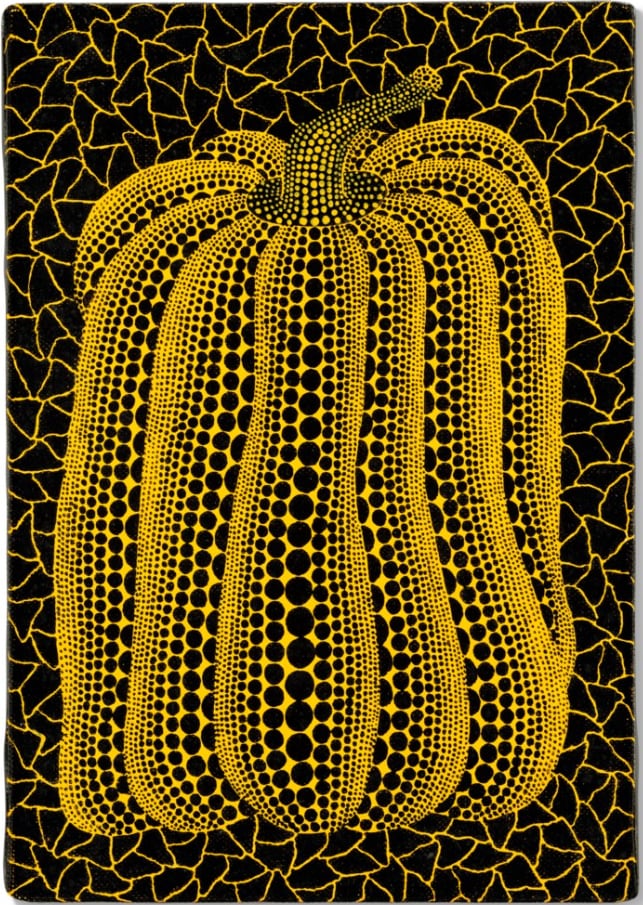
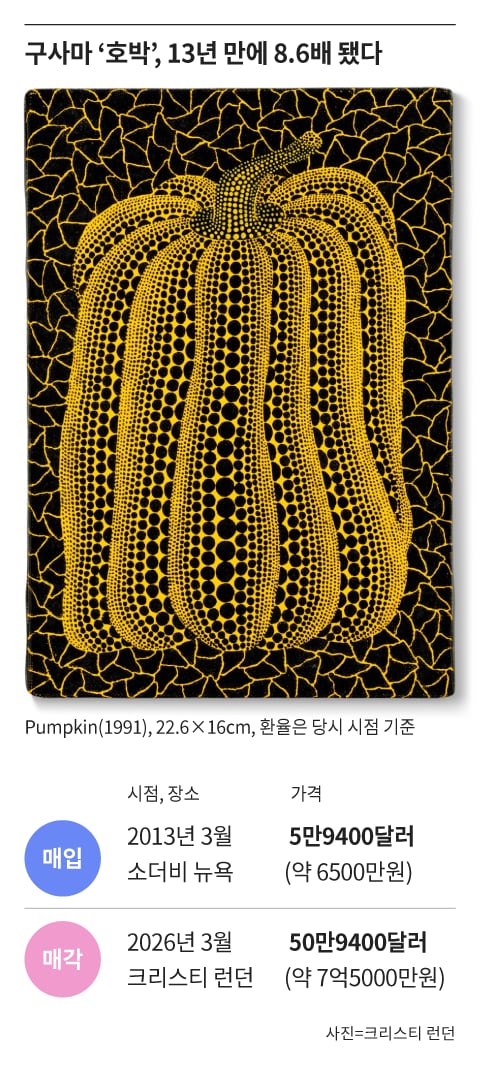
In March of this year, Yayoi Kusama’s 1991 work *Pumpkin* was sold for $509,400 at a Christie’s auction in London, UK. The consignor was a collector who purchased the piece for $59,400 at a Sotheby’s auction in New York, US, in March 2013 and held it for 13 years.
Although the small painting, measuring the size of two postcards (22.6×16 cm), its price surged approximately 8.6 times, resulting in a return rate of 758%. This even exceeded the Nasdaq’s growth rate (590%) during the same period.
The investment appeal of Kusama’s works is also recognized among market experts. At the *Art Academy* held for VIP clients by Hanwha Investment & Securities PLUS Asset Strategy Team on September 29 of this year, it was evaluated that Kusama’s works have the thickest domestic demand layer among overseas artists and are also in the top tier in terms of liquidity. With Kusama passing away last August, the suspension of new work supply is expected to further enhance the scarcity value in the future.
Who are the domestic and international artists gaining attention in the art market, and what should be considered when investing? The following are three checkpoints for art investment summarized based on the lecture held that day.
◇ Liquidity: Choose works with solid demand
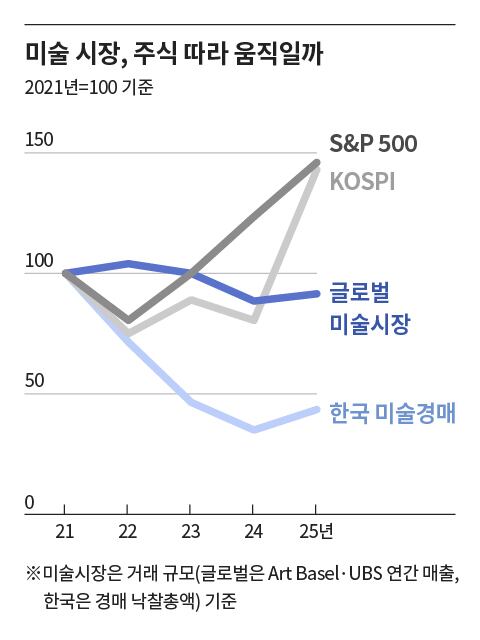
The key in art investment is whether the work can be sold. Even if the price rises, profits remain on paper if there are no buyers. While the total winning bid amount in South Korea’s art auction market increased to 110.8 billion Korean won in the first half of this year (January–June), double the figure from the same period last year, the number of submitted works decreased by 11%. This growth is attributed to high-value transactions.
According to data presented in the lecture, the top 10 domestic modern and contemporary artists dominate the winning bid amounts in South Korean auctions. These include deceased masters such as Kim Whan-ki, Yu Young-kuk, Yun Hyong-keun, Kim Tschang-yeul, Park Seo-bo, Paik Nam-june, and Chung Sang-hwa, as well as surviving senior artists Lee U-fan and Ha Chong-hyun, and mid-career surviving artist Lee Bae.
In particular, monochrome painters Park Seo-bo, Yun Hyong-keun, Chung Sang-hwa, and Ha Chong-hyun gained heightened attention in the international art market around 2013–2015. Investors should assess how consistently a work is traded in domestic and international markets and whether actual demand supports it to reduce liquidity risks.
◇ Overseas masters dominate… Kusama’s annual compound growth at 20%
The top overseas artists by winning bid amount in South Korean auctions are Yayoi Kusama, Yoshitomo Nara, George Condo, Banksy, Gerhard Richter, Alex Katz, Andy Warhol, David Hockney, Damien Hirst, and KAWS.
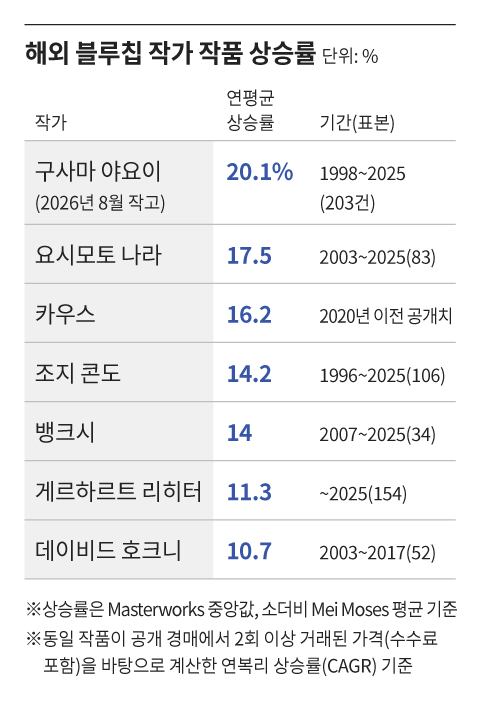
Among these 10 blue-chip artists, Kusama recorded the highest annual compound return rate of 20.1%, calculated from prices of the same works sold in auctions at least twice. Yoshitomo Nara followed at 17.5%, KAWS at 16.2%, George Condo at 14.2%, and Banksy at 14%.
Due to the high price threshold for Kusama’s original paintings, many investors start with her print market, which is relatively accessible. However, even prints should not be underestimated. Popular *Pumpkin* series prints or large-sized editions often exceed 100 million Korean won, showing price increases comparable to originals. The fewer the total editions, the higher the scarcity and potential price growth.
Overseas blue-chip artists continue to set record prices in South Korea’s art auction market. The lecture noted that these works are recognized domestically for their value, as global markets have established price benchmarks.
For example, Yoshitomo Nara’s large-scale painting *Nothing About It* (2016) was sold for 15 billion Korean won at a Seoul Auction in March. In the same auction, Kusama’s 100-ho size *Pumpkin* fetched 10.45 billion Korean won, setting a new record for her works in South Korean auctions.
◇ Tax: Domestic surviving artists are tax-exempt
Tax is a critical factor in art investment. Profits from selling artworks are taxed as miscellaneous income, not capital gains, and are subject to a single 22% tax rate including local income tax.
However, not all transactions are taxable. Works sold for less than 60 million Korean won per piece are tax-exempt. Additionally, works by domestic artists who are alive at the time of sale are tax-exempt regardless of price. This exemption applies only to domestic artists. Overseas artists’ works, such as Kusama’s, are taxed if the sale price exceeds 60 million Korean won, regardless of the artist’s survival status.
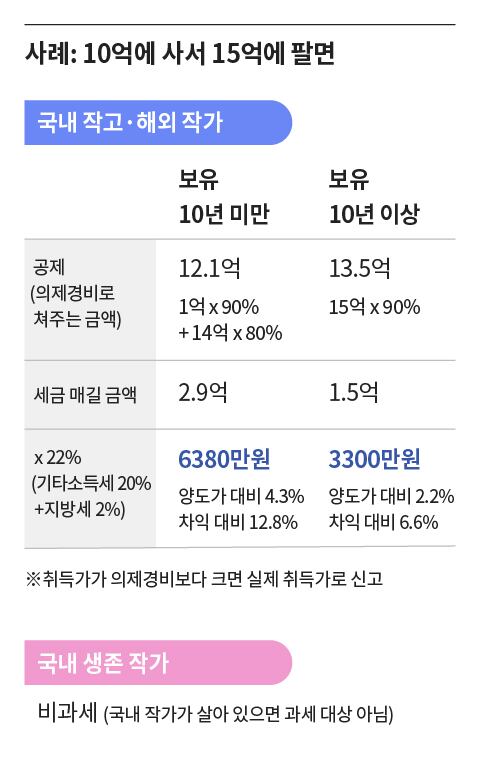
Tax calculations differ from general income. Instead of deducting the actual purchase price, a percentage of the sale price is recognized as necessary expenses: 90% for amounts up to 100 million Korean won and 80% for amounts exceeding 100 million Korean won. If the holding period exceeds 10 years, the excess over 100 million Korean won is also recognized at 90%.
For instance, if a painting bought for 1 billion Korean won is sold for 1.5 billion Korean won, the necessary expenses are 1.21 billion Korean won (tax: 63.8 million Korean won) if held for less than 10 years. If held for over 10 years, necessary expenses rise to 1.35 billion Korean won, reducing the tax to 33 million Korean won.
Gifts or inheritances do not receive tax exemptions and are assessed like general assets. As tax authorities now scrutinize art transaction records and funding sources, maintaining proper documentation from the start is advisable.
◇ Guide to exclusive financial technology special lectures for Chosun Membership members
Chosun Membership members are invited to a free financial technology class hosted by the *Wanggaemi Research Institute*. The session will cover next year’s investment outlook and targeted asset recommendations. Applications are open for those eager to enhance their financial knowledge.


Leave a Reply