
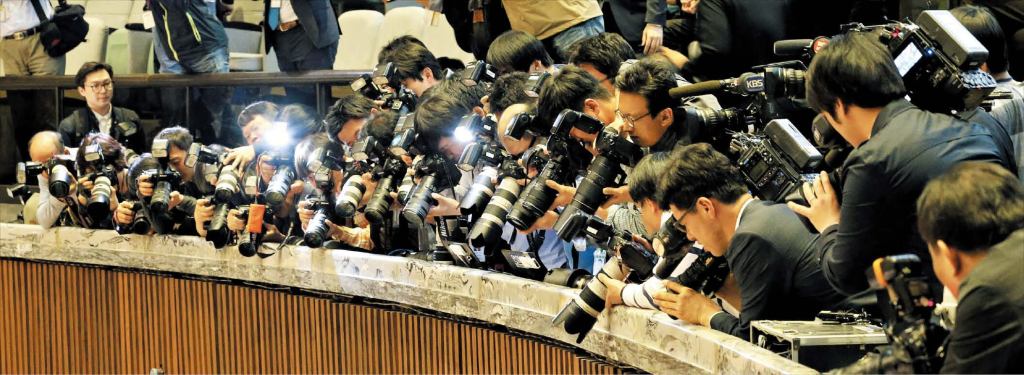
A single photo taken in the National Assembly plenary session hall has forced an acting party leader to step down and a presidential secretary to resign. State secrets about North Korea, concealed by the government, were exposed to the public, and a lawmaker who briefly opened a stock account was effectively expelled from the party he had belonged to for decades and faced trial. A few words scribbled in a party leader’s notebook also sparked controversy. A “long-range camera” (telephoto camera) capturing the backs of 300 lawmakers’ seats continues to shake the political landscape. Lawmakers keep getting caught—unable to avoid it, or intentionally photographed?
◇Deadly Exposure: The Brutal History of Ruling and Opposition Parties
Last month, Lee Choon-seok, an independent lawmaker, was indicted for stock trading under a borrowed name. The incident began when a media camera captured him trading stocks on his phone in the National Assembly plenary session hall on August 4 last year.
The screen revealed the stock account was under the name of his aide, Cha Mo, not Lee. The Financial Real Name Act prohibits stock trading under borrowed names. Lee, then a four-term veteran and chairman of the National Assembly’s Legislation and Judiciary Committee from the ruling Democratic Party of Korea, left the party the next day.
According to the indictment, Lee conducted 9,018 transactions under his aide’s name from March 2020. A single unintentionally captured photo exposed thousands of illicit stock trades.
Rear cameras also exposed internal power dynamics. A notable example was the July 26, 2022, capture of a Telegram message exchanged between Kweon Seong-dong, then acting leader of the People Power Party, and President Yoon Suk-yeol.
At the time, President Yoon sent a message to Kweon: “Things have changed now that the party leader (current Rep. Lee Jun-seok), who only focused on internal attacks, has been replaced.” The message also included a cherry emoji giving a thumbs-up, leading to the incident being dubbed the “Cherry Thumbs-Up Affair.” Kweon resigned, stating, “It was entirely my fault.”
In the Democratic Party, the term “Hyunji Sister” is still mentioned. On December 2, last year, media cameras captured a Telegram message between Moon Jin-seog, a pro-President Moon faction lawmaker, and Kim Nam-kuk, then presidential secretary for digital communication (now a Democratic Party lawmaker). When Moon mentioned a specific person, saying, “Brother, recommend someone,” Kim replied, “Yes, senior. I’ll recommend to Hunsik and Hyunji Sister!”
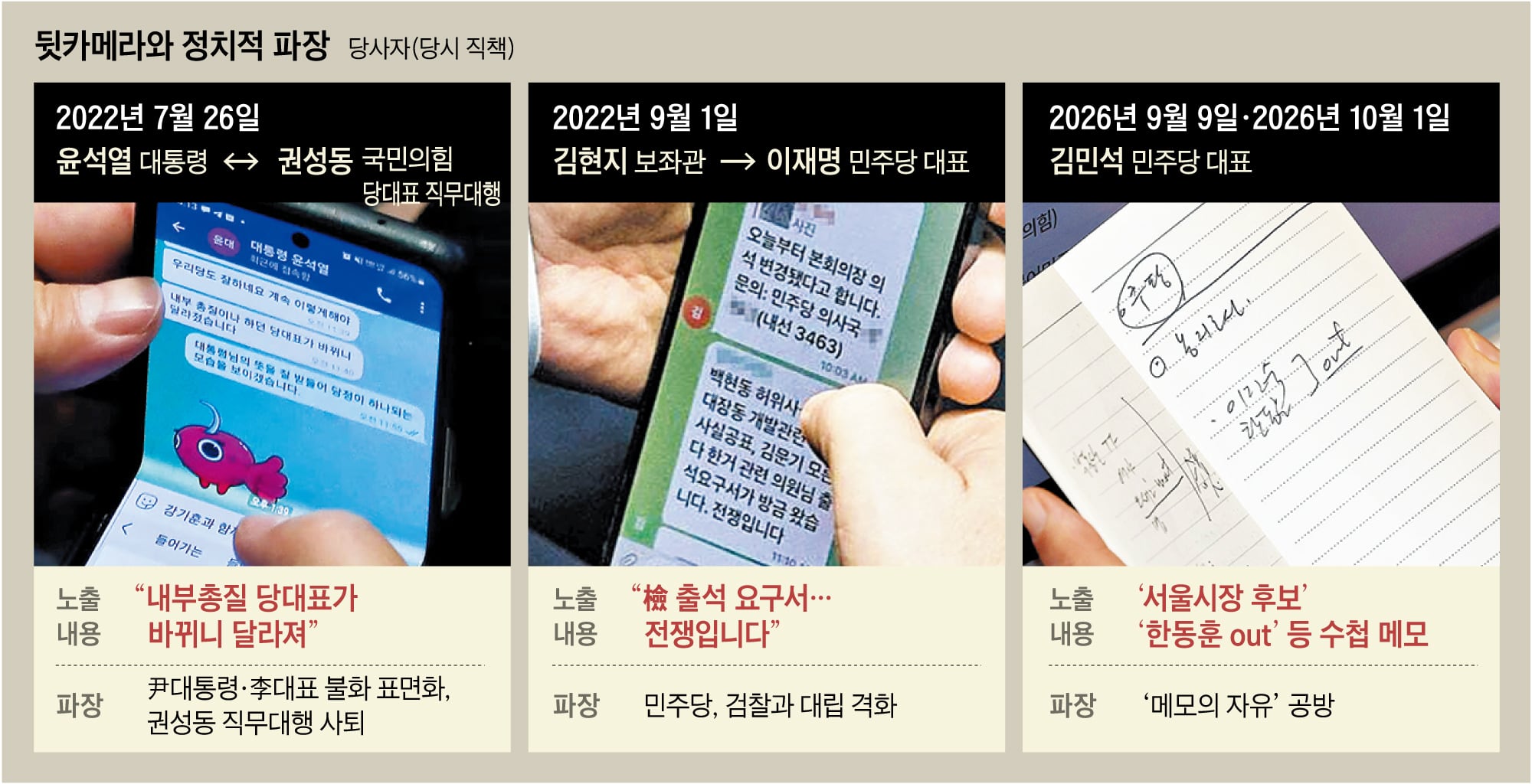
This fueled speculation about Kim Hyun-ji, a presidential secretary, being an unofficial power broker. Though Kim denied it, saying, “I was just collateral damage,” the public began circulating the phrase, “Everything goes through Kim Hyun-ji.”
◇Intentional Exposure? Yet Why Repeat It?
Some interpret rear cameras not just as political blunders. Since taking office in August, Democratic Party leader Kim Min-seok has twice been caught exposing his notebook in the National Assembly plenary session hall.
On September 9, his notebook was photographed with the words “Seoul mayor candidate,” “Hunsik, Wonsik, Chung-rae.” This was speculated to refer to Kang Hoon-sik, former presidential chief of staff; Woo Won-shik, former National Assembly speaker; and Jung Chung-rae, former Democratic Party leader, as potential candidates for the Seoul mayoral by-election. Another page listed “OUT” next to the names of independents Han Dong-hoon and Lee Jin-sook of the People Power Party.
Less than a month later, on October 1, a telephoto lens captured Kim’s notebook again. This time, it contained notes on “wartime operational control,” “Han Dong-hoon file,” and other terms.
Regarding this, Kim appeared on the Democratic Party’s YouTube channel the next day, saying, “There is a certain scope to public matters,” and “If not, I lose the freedom to take notes.” He added, “I don’t need to explain the content,” leaving room for interpretation.
Some lawmakers from both parties reacted, “Kim is playing a strategic game.” Typically, media photographers’ telephoto cameras on the second and third floors of the National Assembly plenary session hall are always aimed downward. A four-term veteran like Kim would not accidentally get photographed, they argued.
A similar controversy arose on September 1, 2022, when a Telegram message from Kim Hyun-ji, then an aide to President Lee Jae Myung (now a presidential secretary), was captured. The message read, “A request for attendance just arrived. It’s war,” sent on the day prosecutors summoned President Lee on charges of false information dissemination.
The message was sent at 11:10 a.m., but the photo was taken around 3:00 p.m. This led to suspicions that President Lee intentionally exposed it to politically declare “war against prosecutors” without directly mentioning it.
In January, messages between Lee Jae Myung’s cabinet members and Democratic Party lawmakers discussing a “secret pact” and “precision strike” regarding the merger between the Democratic Party and the Rebuilding Korea Party were also captured. The merger later fell through.
Choi Chang-ryul, a special professor at Yongin University, said, “Rear cameras are now becoming another communication tool for politicians to send messages to the public,” but added, “It’s not good if politics leans too much on ambiguity and becomes overly technical.”
◇Politicians’ Privacy or the Public’s Right to Know?
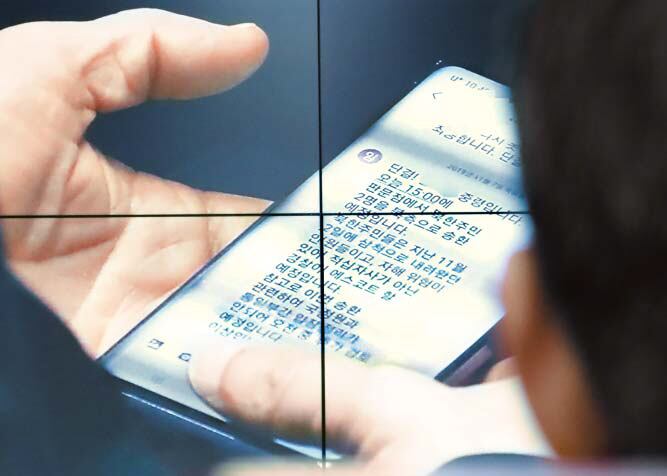
“Today at 3 p.m., we plan to repatriate two North Korean residents through the inter-Korean truce village of Panmunjom.”
On November 7, 2019, during a National Assembly Budget and Accounts Committee meeting, Kim Yu-geun, first deputy director of the Office of National Security, received this message on his phone from an army lieutenant colonel commanding the Joint Security Area (JSA) at Panmunjom. This was the first public exposure of the “forced repatriation of defector fishermen” incident that shook the Moon Jae-in administration.
The incident expanded into an investigation into the administration’s security line. Prosecutors determined that North Korean fishermen who expressed a desire to defect were forcibly repatriated without due process. Consequently, former presidential chief of staff No Young-min, former National Security Adviser Chung Eui-yong, former National Intelligence Service director Suh Hoon, and former Unification Minister Kim Yeon-chul were indicted on charges of abuse of power. The trial continues seven years later.
Politicians’ phones and notebooks are private records, but their content often relates to public authority. How much should their “privacy” be protected? While Kim Min-seok claims “freedom to take notes,” academia argues they are subject to media scrutiny.
Kim Sung-soo, a professor at Hanyang University, said, “The National Assembly plenary session hall is a public space, and lawmakers’ legislative activities are public acts. As they are under media scrutiny, the public’s right to know should not be restricted due to privacy.”
“Block the Rear Cameras”… Lawmakers’ Heartbreaking ‘Phone Crackdown’
Every time the political landscape is shaken by rear cameras, lawmakers from both parties launch security campaigns. Party leaders urge the use of security films on phones, and veteran lawmakers with multiple terms hold “tips sessions.” High-profile politicians also establish their own security principles.
The traditional security rule is “endure without opening.” For example, Democratic Party lawmaker Jung Chung-rae is famous for never opening his phone in the plenary session hall. Independent Han Dong-hoon also avoids opening his phone and sometimes blocks signals in important places.
A basic defense is security film on phones. Joo Ho-young, a six-term People Power Party lawmaker, said at a party retreat, “Our job is to answer calls,” but added, “Since photos are taken in the plenary session hall, everyone should buy and attach security films.”
Security films are not foolproof. A Democratic Party lawmaker said, “I was photographed by a rear camera even after attaching a security film.” National Assembly photographers explained, “Security films can somewhat block side-angle shots, but if shot straight from the front, they are inevitably captured.”
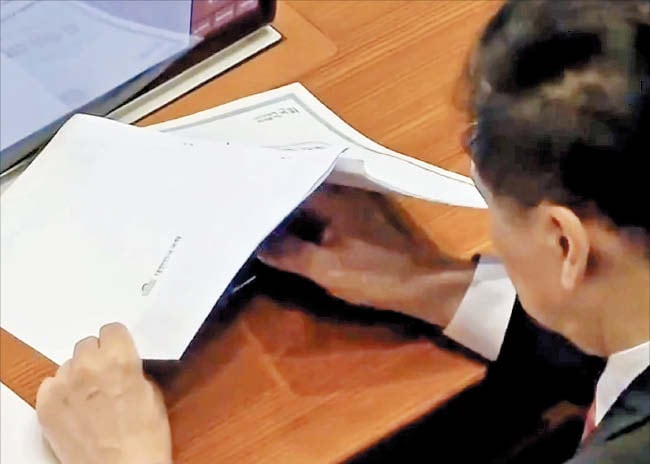
What about when sessions extend late into the night? Some lawmakers wait for calls from their districts or Cheong Wa Dae. In such cases, physical defensive postures emerge. Common methods include bending deeply over the desk or checking phones under the desk. Kim Gi-hyeon of the People Power Party became an online sensation for hiding his phone under an inverted reference book, creating a “triangle tent.” Reform Party leader Lee Jun-seok, a computer engineering graduate, manages messenger messages through his computer.


Leave a Reply