
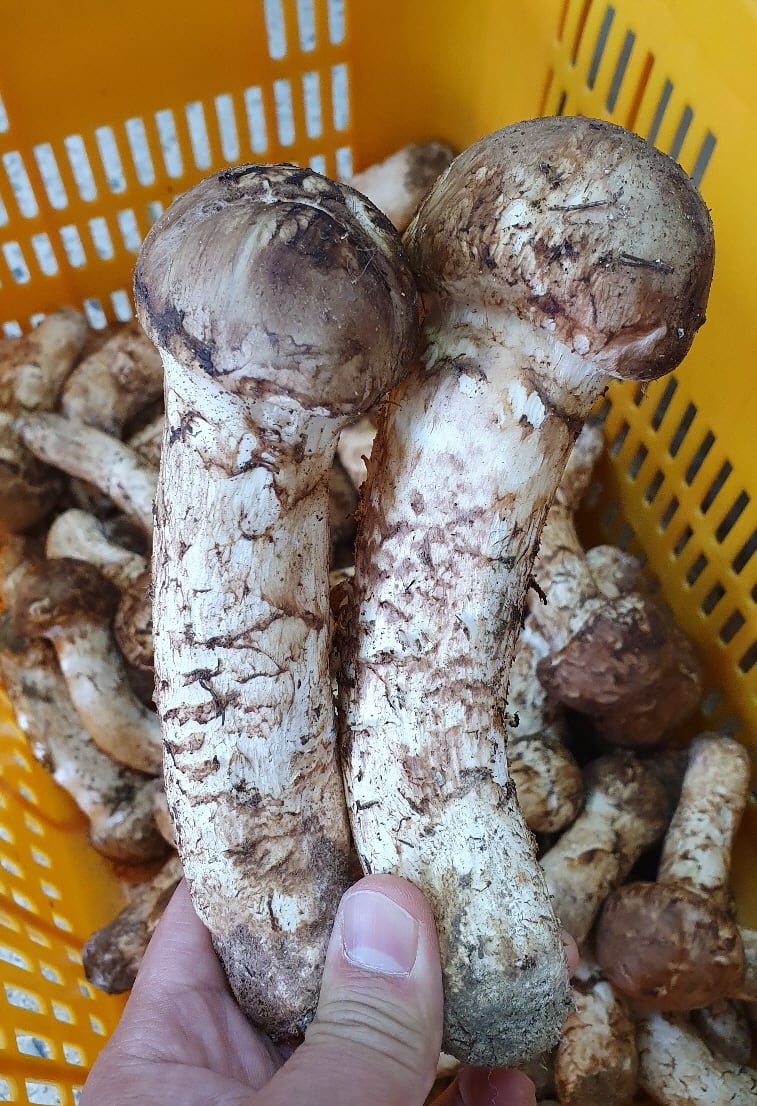
Pine mushrooms, often referred to as the “treasure of autumn mountains,” are expected to experience a historic low harvest this year due to a severe decline in production. The combination of last year’s devastating wildfires, the ongoing spread of pine wilt disease, extreme heatwaves, and prolonged drought has led to nationwide auction volumes dropping to less than 20% of the levels seen during the same period last year.
As reported by the National Forestry Cooperative Federation on the 22nd, up to the 21st, total national auction volume for pine mushrooms reached 17,380 kg, generating 6.7391 billion Korean won in sales. This marks a drop of 83.16% in volume and 67.78% in value compared to the same date last year, when 103,183 kg were auctioned for 20.9178 billion Korean won.
The situation in Yeongdeok, Gyeongbuk Province—the nation’s top pine mushroom-producing region—is particularly bleak. Yeongdeok’s auction volume stood at just 2,008 kg, representing only 15.3% of the 13,125 kg recorded during the same period last year. Bonghwa, another key production hub in Gyeongbuk, is facing an even more critical scenario: its auction volume for this period was 111 kg, down to just 4.4% of last year’s 2,524 kg.
The extensive wildfires that swept through northern Gyeongbuk last March severely impacted vital pine mushroom cultivation areas. Since pine mushrooms typically grow on pine trees between 30 and 40 years old, recovery from such damage is slow and challenging.
The expansion of pine wilt disease has further worsened conditions for pine mushroom growth. Data from the Korea Forest Service and Gyeongbuk Province show that by September, 794,000 pine trees across 21 cities and counties in Gyeongbuk (excluding Ulleungdo) had been affected—accounting for roughly 45.4% of all national damage from the disease.
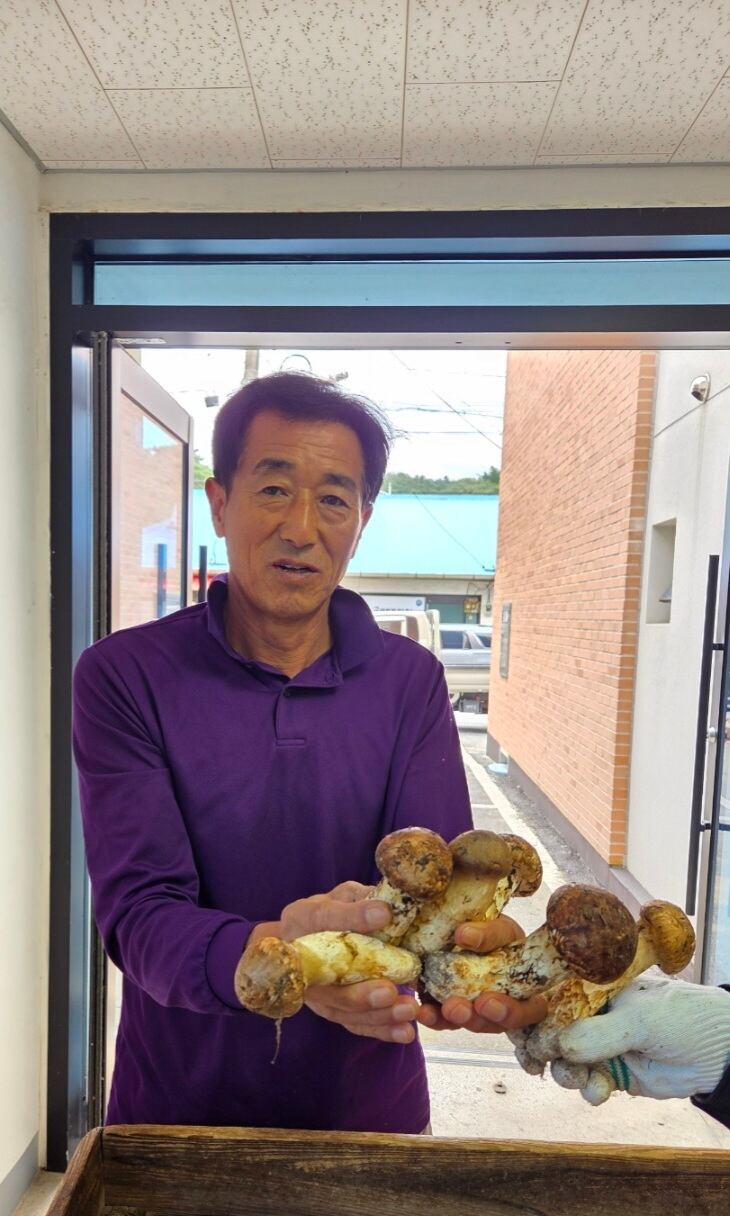
Pine mushrooms are extremely sensitive to temperature and moisture levels. This year’s climate proved exceptionally hostile to their development. According to the Daegu Regional Meteorological Administration, the average summer temperature in Daegu and Gyeongbuk reached 25.9 degrees Celsius—the highest ever recorded—with 39.3 tropical nights, the second-highest number on record. In September, average rainfall was only 21.6 mm, equivalent to just 15.1% of the typical annual rainfall (148.1 mm), and far below last year’s September total of 158.6 mm.
Jeong Young-gi, head of the Bonghwa Forestry Cooperative, stated, “When pine forests burn or pine trees die from pests, the very foundation for pine mushroom growth is undermined. With dwindling harvests, the winning bid price per kilogram has now exceeded 1 million Korean won.”
Indeed, on the 19th, second-grade pine mushrooms in Pohang’s auction fetched a winning bid of 1.6137 million Korean won per kilogram. No first-grade mushrooms were available among the 27.24 kg traded nationwide that day. Even ‘non-grade’ mushrooms—those with open caps or imperfections—rose to 663,000 Korean won per kilogram, more than five times higher than last year’s average of about 130,000 Korean won.
An official from the Gyeongbuk Medicinal and Edible Mushroom Center explained, “The decline in pine mushrooms is mainly caused by recent wildfires, the increasing prevalence of pine wilt disease, extreme temperature fluctuations, and insufficient rainfall, all of which have created unfavorable growing conditions. The reduction in pine trees resulting from wildfire suppression and pest control measures further exacerbates the issue.”






Leave a Reply