
- MORE: The US catastrophes that scientists fear are unavoidable
While most individuals have learned that Earth consists of seven continents, a bold new hypothesis suggests that two of them—despite being separated by ocean—are actually part of a single massive landmass.
This idea is promoted by Dr Jordan Phethean from the University of Derby in the UK, who argues that North America and Europe should be considered one continent, even though they are divided by water.Atlantic Ocean separating them.
Phethean stated: ‘The evidence suggests that the North American and Eurasian tectonic plates have not fully separated, contrary to the long-held belief that this split occurred around 52 million years ago.’
The conventional understanding taught in schools lists seven continents: Africa, Antarctica,AsiaAustralia, Europe, North America, and South America.
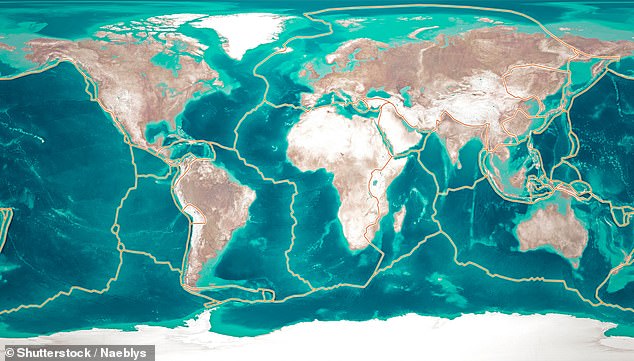
Around 200 to 300 million years ago, all continents were united into a single supercontinent known as Pangea, which slowly fragmented due to heat-driven movements within Earth’s mantle, causing tectonic plates to shift and pull apart.
The theory stems from findings in two of Phethean’s research studies, which propose that the two landmasses—separated by roughly 3,000 miles—are still connected beneath the sea by an underwater ridge stretching from Greenland through Iceland to the Faroe Islands near Scotland.
The North Atlantic bridge studied by Phethean’s team is thought to hold remnants of the original continental crust that failed to fully separate as the continents drifted apart tens of millions of years ago.
His findings revealed sections of the ocean floor significantly thicker than usual, still linked by narrower stretches of continental material in this area—evidence scientists interpret as proof that North America and Europe never completely split apart.
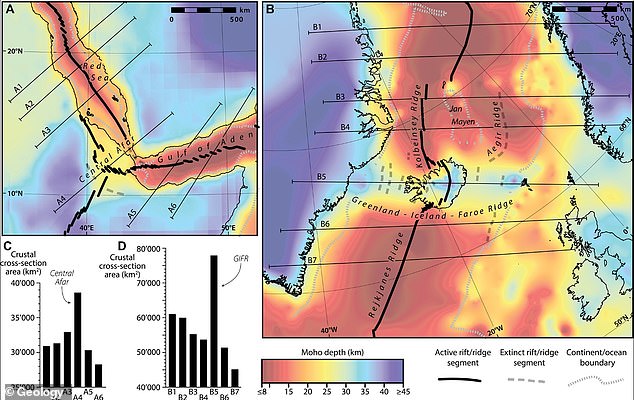
In both studies involving Phethean, researchers assessed the crust’s thickness beneath the seafloor using gravity and seismic data, then used computer models to reconstruct the movement of Earth’s tectonic plates millions of years ago.
They contrasted these findings with cases where continents fully detached, such as the separation between Africa and South America.
The first study, published in the journal GeologyIn July 2024, it was discovered that the actively rifting Central Afar region in East Africa bears strong resemblance to the thick crust found beneath Iceland and the Greenland-Iceland-Faroe Ridge (GIFR).
This similarity stood out because both regions experienced massive volcanic activity early in their development, formed exceptionally thick crusts, and preserved fragments of ancient continental crust within the new volcanic rock.
These parallel features led researchers to suggest that Central Afar serves as a current example of how a unique type of thick underwater plateau develops when continents fail to break apart cleanly.
In September of that year, Phethean’s results were published in the journalGondwana ResearchUncovered a submerged section of thick continental crust situated between Canada and Greenland that remained attached to Greenland instead of fully separating.
This rock formation in the North Atlantic, known as the Davis Strait proto-microcontinent, was discovered to be 12 to 15 miles thick—significantly thicker than typical oceanic crust.
By analyzing geological scans, researchers modeled ancient tectonic movements and determined the microcontinent started detaching between 49 and 58 million years ago, though the separation was incomplete.
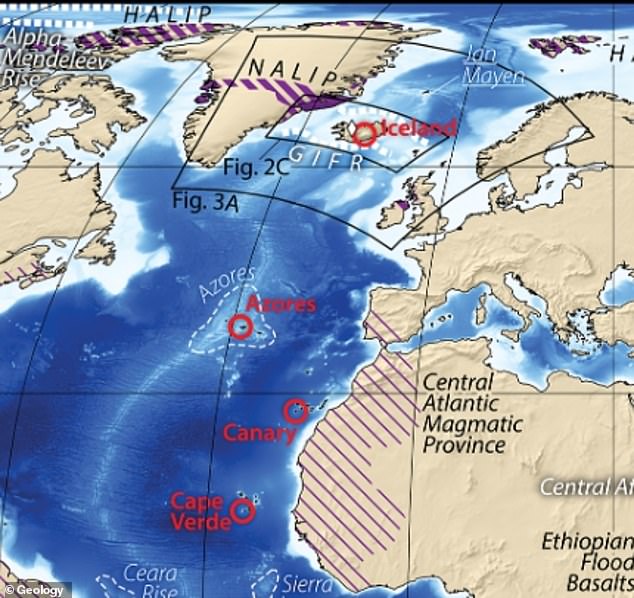
‘It remains debated whether the GIFR holds substantial continental crust, and whether the European and North American tectonic plates have truly finished splitting apart.’Phethean told Earth.com.
A study published in the journalCommunications Earth & Environmentdisputed this view, arguing that the interpretation of the thick underwater rocks between Canada and Europe is flawed.
An international research group concluded that the dense crust beneath Iceland originated from a deep-Earth volcanic hotspot, continuously supplying molten material as the seafloor gradually widened.
The concept of what constitutes a ‘continent’ has always blended geological facts with historical and cultural perspectives. For instance, Asia and Europe are considered distinct despite forming a single landmass known as Eurasia.
The research conducted by Phethean and his colleagues across the US and Europe did not consider the hypothesis that Eurasia ought to be regarded as a single continent.






Leave a Reply