
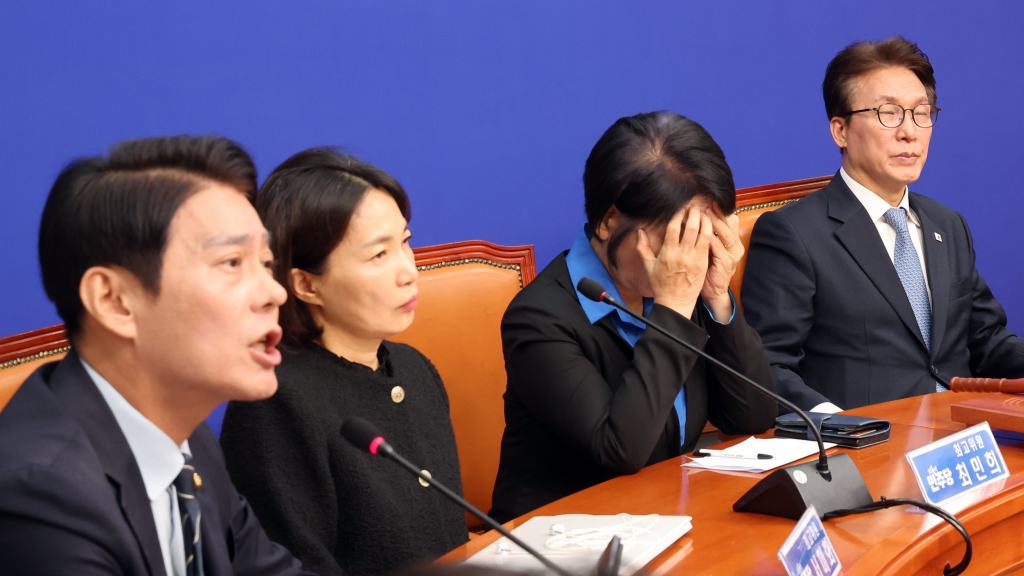
With the parliamentary audit wrapping up this week, the National Assembly is set to launch comprehensive discussions on next year’s budget and legislation aimed at improving livelihoods. Yet the ruling Democratic Party of Korea remains focused on two contentious matters: pursuing impeachment proceedings against Chief Justice Jo Hee-de and advancing a special counsel bill to probe alleged falsified indictments in the president’s cases. Opponents contend that the party is diverting attention from pressing economic concerns such as soaring housing costs, persistent inflation, and instability in the stock market.
The Democratic Party has identified the Chief Justice Jo matter and the special counsel bill as central priorities following the audit. On the 26th, Chief Spokesperson Park Sung-jun announced on the party’s official YouTube channel, “Post-audit, our party faces two major political challenges,” specifically referencing a parliamentary inquiry into Chief Justice Jo and the proposed special counsel legislation targeting fabricated indictments. Livelihood-related issues were conspicuously absent from the statement.
Hardline members within the party continue pushing for Chief Justice Jo’s impeachment, citing his disagreements with the president and controversial judicial appointments. The party leadership intends to summon Jo for questioning during a parliamentary investigation. The special counsel bill centers on allegations of fabricated evidence in President Lee Jae Myung’s Seongnam Daechong case and inter-Korean remittance investigations. Originally introduced in June with a clause allowing indictment cancellation—later scrapped due to public backlash—is now being reintroduced without that provision.
Tensions between the pro-Lee (Myung) and pro-Choi (Kang) factions remain unresolved even after the party convention. After prolonged disputes over prosecutorial authority, the factions are now at odds over claims of Shincheonji’s involvement in the convention, including accusations of suppressed evidence. Senior party figures warn that internal rifts are deepening despite the pro-Lee faction securing leadership. Amid growing economic uncertainty, the ruling party is increasingly perceived as exacerbating political conflict both internally and externally.
Consumer prices rose 2.9% year-on-year last month, while Seoul apartment prices have climbed for 89 straight weeks. On the 26th, the KOSPI closed at 5,469.47, falling 1.46%—its lowest point in nearly seven months.
◇Engaging in external battles with the judiciary, battling internal factionalism… approval ratings keep plummeting
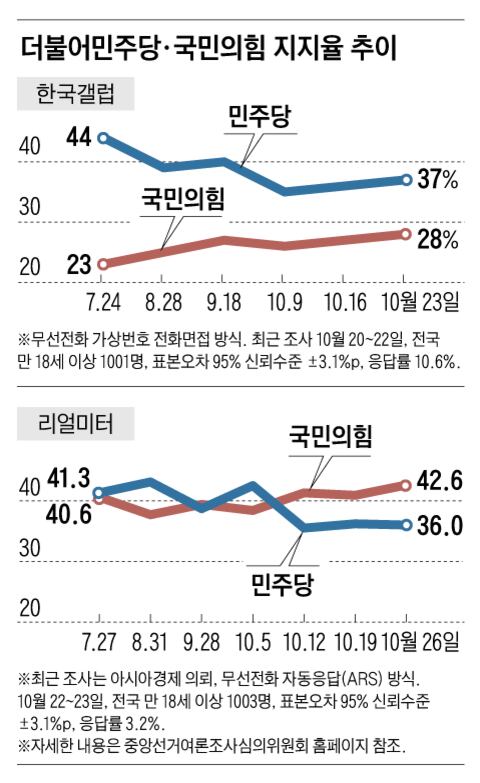
Since Kim Min-seok assumed leadership over two months ago, the Democratic Party has been unable to halt its declining approval ratings. The party’s support, which hovered between 40–50% during President Lee Jae Myung’s inauguration, slipped to the 30% range following the June local elections and the August leadership vote. A Realmeter poll released on the 26th placed the Democratic Party at 36.0%, trailing the People Power Party (42.6%) by 6.6 percentage points—the first time the PPP has led outside the margin of error in nearly four months. Internal calls are mounting: “Reforms cannot succeed without public backing,” underscoring the urgent need for the ruling party to confront public concerns and minimize unintended consequences of its policies.
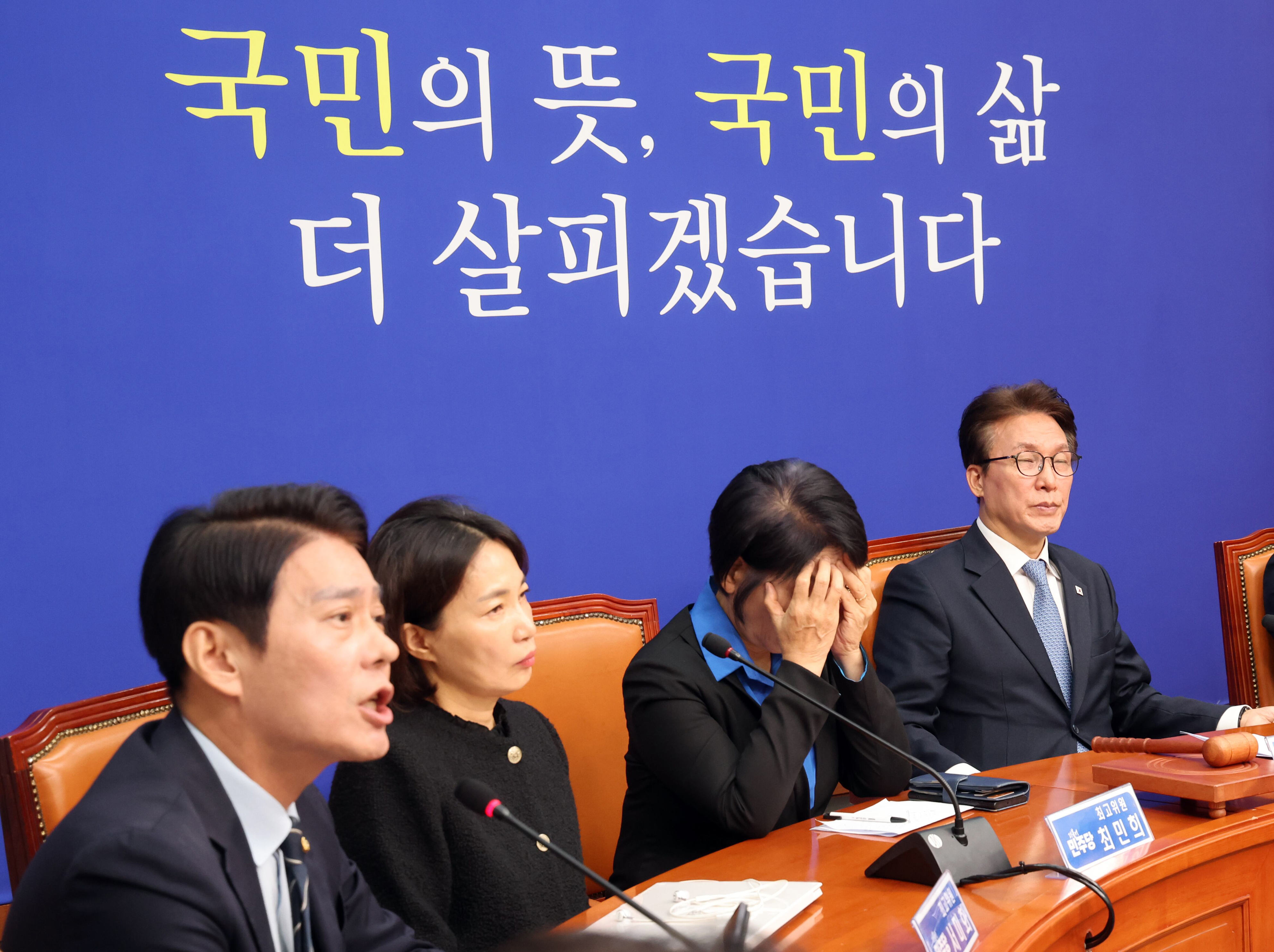
Following the audit, the Democratic Party will concentrate on shaping next year’s budget and tax reform legislation—measures that significantly affect everyday citizens. Yet, recent remarks from party leaders have centered more on frustration toward Chief Justice Jo and resistance to Seoul Mayor Oh Se-hoon’s acquittal in his appeal trial. At the 26th Supreme Council meeting, demands emerged to impeach Chief Justice Jo over the mayor’s verdict, with Supreme Council member Choi Min-hee even suggesting the use of “AI judges” for politically sensitive cases.
During the Legislation and Judiciary Committee review, Democratic Party Supreme Council member Lee Sung-yoon referenced the mayor’s acquittal, asserting, “Impeaching Chief Justice Jo is the sole remedy.” Another party member, Kim Ki-pyo, dismissed the decision as “a total mess.” Despite National Court Administration chief Noh Gyeong-pil emphasizing that “no individual, not even the Chief Justice, may influence lower court rulings,” criticism continued unabated.
The party leadership remains embroiled in disputes over claims of Shincheonji’s involvement in convention interference. Kim Min-seok alleged evidence of coordinated Shincheonji membership, prompting pro-Choi factions to demand substantiation, thereby widening internal divisions. A senior Democratic Party lawmaker observed, “Which ordinary citizen actually cares about Shincheonji? Even if they were involved, isn’t this just attacking ourselves?”
As the ruling party grapples with internal conflicts and external pressures, viable solutions for housing and stock market challenges remain absent. While the government maintains that Seoul property prices will soon decline, public perception strongly disagrees. A Seoul-area lawmaker remarked, “Housing prices aren’t easily managed through loan restrictions or taxes, and government intervention has only made matters worse.”
The KOSPI, which rose above 9,000 points shortly after President Lee’s inauguration, has nearly dropped by half within four months. The Democratic Party has largely overlooked the issue. A party official admitted, “There’s nothing we can do right now—we’re just watching.” Still, spokesperson Cho Gye-won claimed on the 22nd that the KOSPI could surpass 10,000 points next year, citing stable pricing and future growth funds derived from semiconductor tax revenue. However, the index hit a seven-month low on the 26th.
The party also shows hesitation regarding three flagship initiatives: the Honam Semiconductor Cluster, AI Data Center, and Physical AI—presented as central accomplishments of the Lee administration. Business sectors are pushing for legal exemptions from the 52-hour workweek for semiconductor cluster researchers, a position backed by the government. However, facing pushback from labor unions, the Democratic Party introduced two bills—one including and one excluding the exemption. Floor Leader Han Byung-do postponed final decisions, citing the need for further deliberation. Though investment in strategic industries is urgent, the party has yet to settle on legal frameworks.
Since assuming office in August, Kim Min-seok has vowed to reorient the party around livelihood concerns. Internal voices stress the importance of turning government policies into real-world outcomes. Kim Young-bae, head of the Seoul branch, recently said on radio, “Public sentiment in Seoul has deteriorated. People struggling with living costs, inflation, and employment ask, ‘What has the ruling party done to help us?’” A party insider noted, “Kim kept repeating ‘livelihood, livelihood, livelihood’ during a pre-session workshop, but now seems obsessed with ‘impeachment, impeachment, impeachment.’”
Critics claim the party has failed to move beyond its strategies from when it was in opposition. Professor Lee Jae-muk from Hankuk University of Foreign Studies stated, “While the Democratic Party was highly effective in political struggles during its time as the opposition, it should now be judged based on its ability to deliver stable governance and tangible policy results. Engaging in ongoing confrontations with the opposition and the judiciary to strengthen its base contradicts the duties expected of a governing party.”




Leave a Reply