
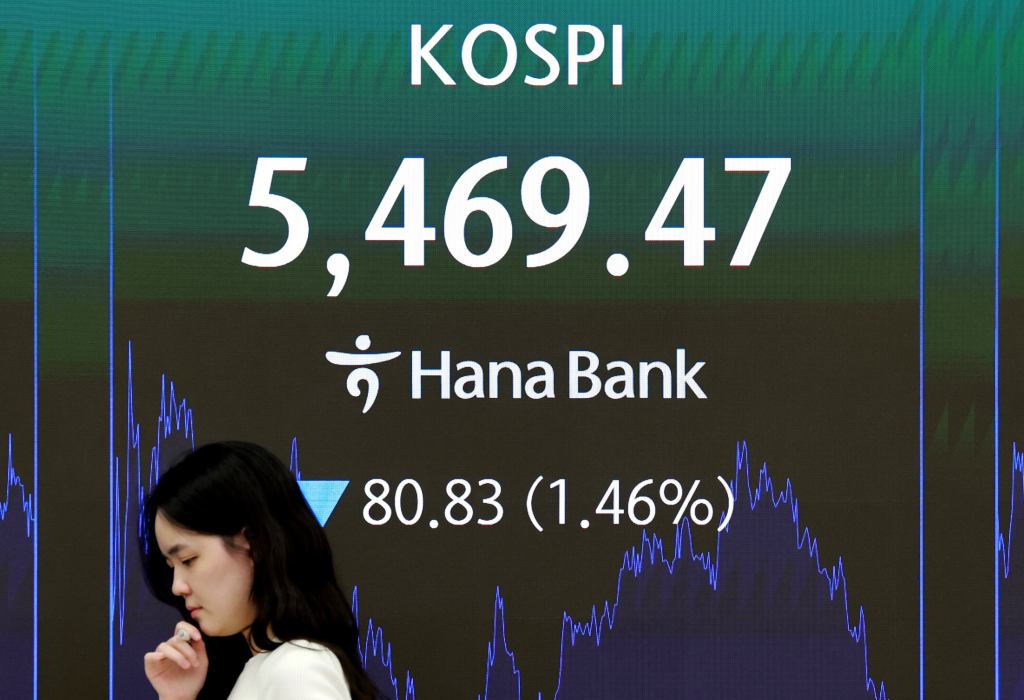
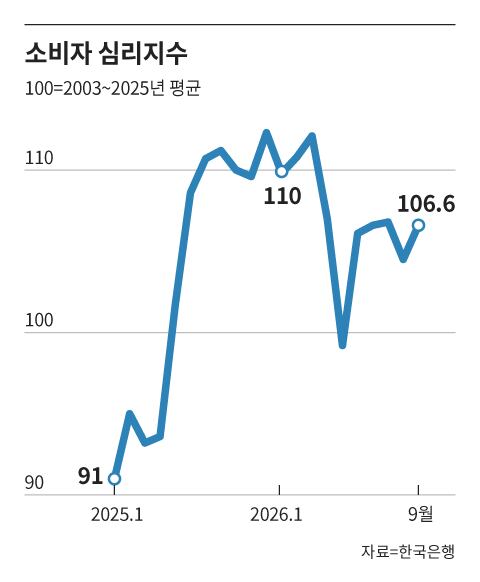
Consumer confidence, which had shown some improvement, dropped again after a month amid a sharp decline in South Korea’s stock market. According to the Bank of Korea’s *Consumer Trend Survey* released on the 27th, the Composite Consumer Sentiment Index (CCSI) for October decreased by 1.2 points to 105.4 from the prior month. Although the index had recovered slightly in September following a drop in August, it reversed course and declined once more.
The CCSI (Composite Consumer Sentiment Index) is a statistical indicator derived from six key components of the Consumer Survey Index (CSI), based on consumer perceptions about the current economic situation and future expectations. An upward trend reflects growing optimism or expectations of rising prices, whereas a downward movement signals increased pessimism or anticipation of price declines. The survey was conducted between the 13th and the 20th.
The Bank of Korea noted, “Concerns over domestic stock market corrections, ongoing conflicts in the Middle East, and possible stagnation in the semiconductor sector have led to a slight rise in negative economic outlooks.” Five out of the six indices that make up the CCSI experienced a decline. The index for future economic expectations dropped the most, by 2 points. Meanwhile, the indices for expected living standards, household income prospects, consumption spending outlook, and current economic conditions each fell by 1 point, while the current living standards index rose by 1 point.
Even as apartment prices continued to climb in non-Gangnam areas of Seoul, Gyeonggi Province, and other parts of the metropolitan region, the Housing Price Outlook CSI declined by 1 point due to government real estate regulations and higher base interest rates. However, this index still stood at 124, well above the 100 threshold indicating a price increase expectation. A reading above 100 means more respondents anticipate rising housing prices than falling ones. The Housing Price Outlook CSI has stayed above 100 for seven consecutive months since April.
The projected inflation rate—forecasting the consumer price increase over the next year—remained unchanged at 2.7% for the fourth straight month since July, exceeding the Bank of Korea’s target of 2%. Park Yong-min, head of the Bank of Korea’s Economic Sentiment Survey Team, said, “Despite the extension of Korea’s petroleum maximum price system and recent base interest rate hikes, the expected inflation rate held steady compared to last month, driven by persistently high international oil prices.”




Leave a Reply