
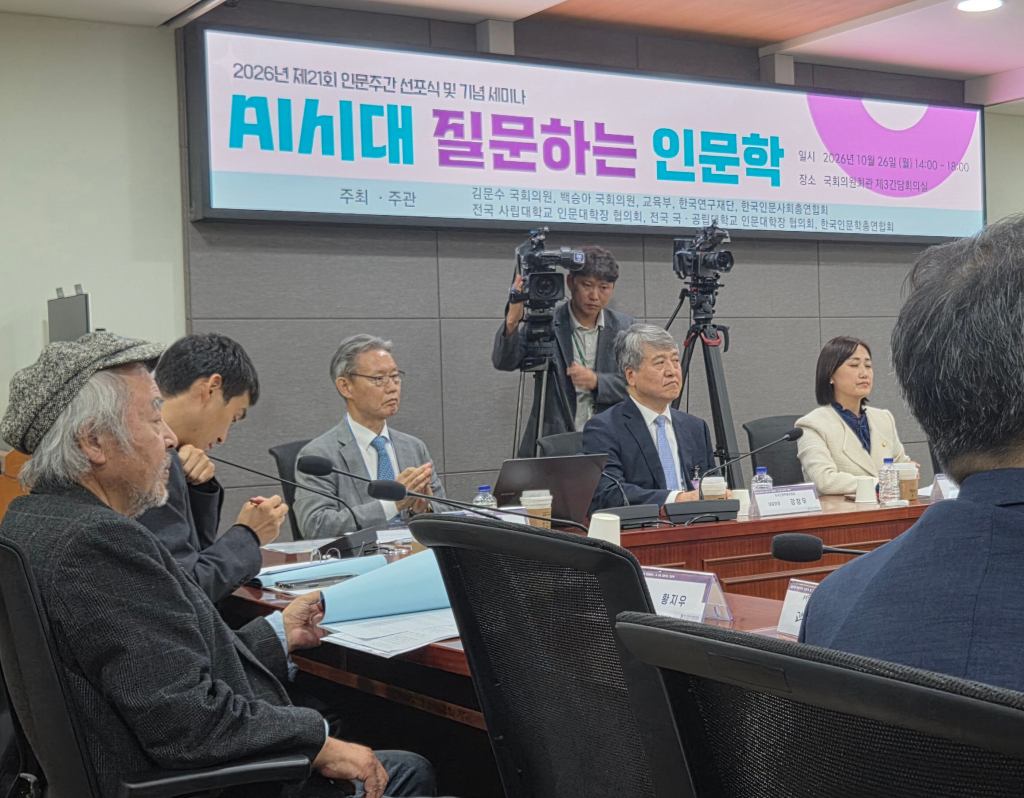
“Struggling to sleep at night, constrained by the limits of expression—pausing, sighing, and finally penning a sentence after prolonged effort, manually writing and erasing with hands. Should we let artificial intelligence (AI) dissolve these deeply human values?” (Poet Hwang Ji-woo)
On the afternoon of the 26th, a seminar marking the 21st Humanities Week declaration took place at the National Assembly Members’ Office in Yeouido. In a keynote dialogue titled “What Does It Mean to Be Human in the AI Era,” Poet Hwang Ji-woo remarked, “AI’s capabilities are advancing to an alarming degree. In an age where AI delivers ‘instant answers,’ we must preserve the ability to think ‘wrongly’—that is, in a distinctly human way.”
Hwang underscored, “The humanities guide us through mistakes, not through correct answers. The essence of humanities lies in giving sentences life—through cracks, pauses, and hesitation—not in polished perfection.” He continued, “Poets deliberately and purposefully misinterpret the world. For example, seeing a crescent moon as ‘my beloved’s graceful eyebrow’—this very error is the strength and gift of being human.”
Hwang cautioned, “Although humans still pose questions to AI, today’s college students and younger generations are losing even the capacity to ask questions, as they receive answers too swiftly from AI.” Drawing a parallel to the fading skill of memorizing phone numbers, he asserted, “Humanities must serve as an immune defense against AI.”
The keynote dialogue was co-hosted by Kim Gi-hyeon, visiting professor at UNIST Graduate School of Natatust and emeritus professor of philosophy at Seoul National University, and Hong Jin-ki, professor of chemical and biological engineering at Yonsei University. Following this, academic presentations included Kim Dong-woo, professor at KAIST’s Digital Humanities and Social Sciences Division, discussing “Why Questioning Humans Matter in an Era Where AI Provides Answers,” and Kim Wol-hwe, professor of Chinese language and literature at Seoul National University, delivering a talk on “Classics Speak to the AI Cultural Era.” Wi Haeng-bok, honorary director of the Korean Federation of Humanities and Social Sciences, addressed “Educational Reform and Humanities Policies in the AI Era.”
Kim Jung-sik, chairman of the Korean Federation of Humanities and Social Sciences (emeritus professor of economics at Yonsei University), emphasized, “In the AI era, it is humanity’s duty to question what values should shape our judgments and what ultimate goals technology should aim for. The power behind such inquiries ultimately arises from the humanities.” Kang Chang-woo, representative chairman of the Korean Humanities Federation (professor of German language and literature at Seoul National University), stated in the Humanities Week declaration, “While dazzling technological progress brings convenience, it also diminishes individuals’ independent thinking. Thus, the need for humanity’s creative and critical reflection—and the ability to envision the future—is more urgent than ever.”
Humanities Week, held annually during the final week of October since 2006 to promote the humanities and disseminate research outcomes, features approximately 190 programs this year, organized by 18 humanities-focused institutions nationwide, offering citizens direct opportunities to experience and engage.



Leave a Reply