
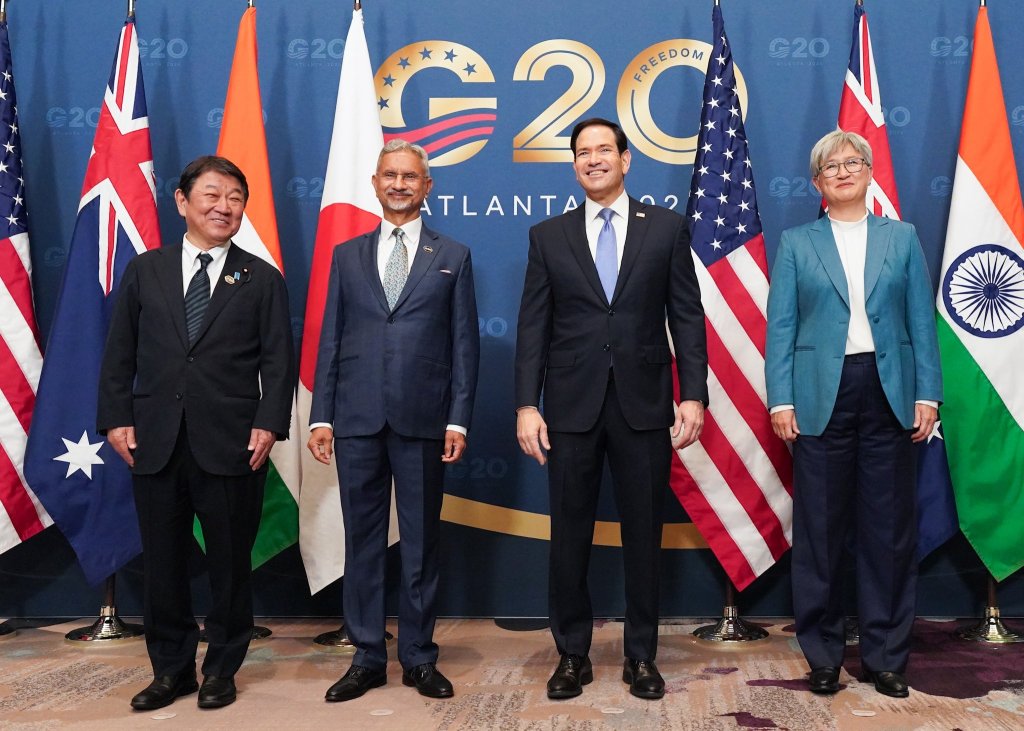
ATLANTA – The leading foreign officials from Japan, the United States, Australia, and India expressed “serious worries” on Saturday about China’s implementation of trade barriers and other actions they consider economically coercive, refraining from explicitly naming the nation.
At a gathering of the so-called Quad alliance in Atlanta, Japanese Foreign Minister Toshimitsu Motegi and his counterparts from the other three nations pledged more than $85 million in technical and financial support to enhance access to reliable artificial intelligence throughout the Indo-Pacific region.
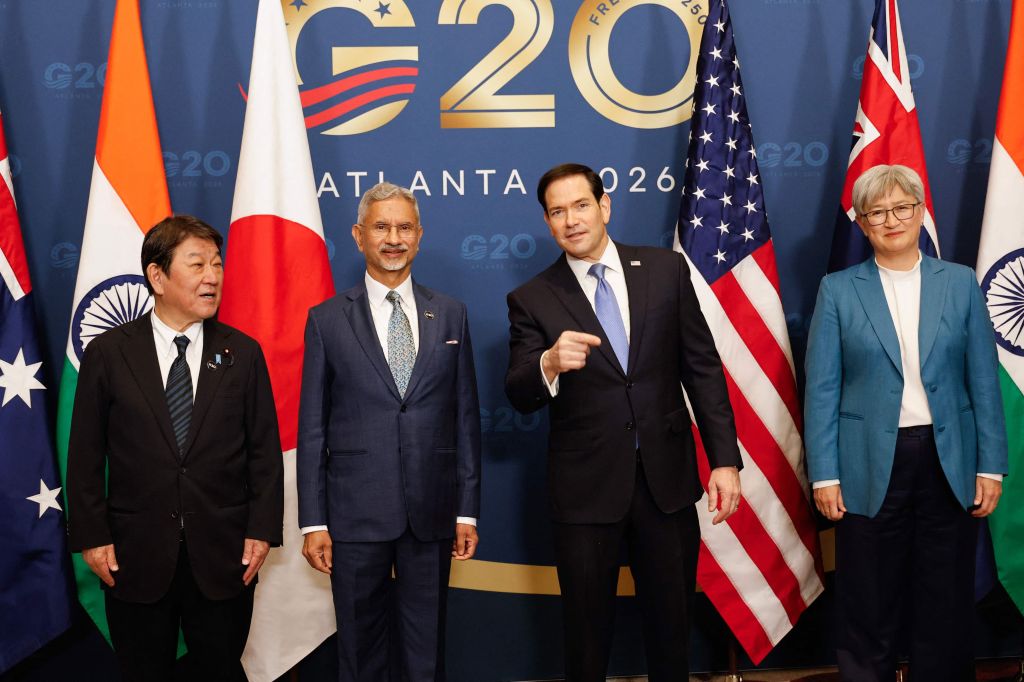
Motegi, U.S. Secretary of State Marco Rubio, Australian Foreign Minister Penny Wong, and Indian External Affairs Minister Subrahmanyam Jaishankar reviewed advancements on ongoing Quad projects during side meetings at the Group of 20 foreign ministers’ forum.
In a joint statement released following their talks, Motegi, Rubio, Wong, and Jaishankar stated they had raised “grave concerns about economic coercion, including arbitrary export controls, as well as non-market policies and practices that lead to overcapacity and disrupt global supply chains in vital sectors.
The senior diplomats convened for the third time this year ahead of a possible Quad summit scheduled for next month in the Philippines.
Leaders from Japan, the United States, Australia, and India are expected to travel to Manila in mid-November for discussions involving the Association of Southeast Asian Nations and its international partners.
The most recent Quad summit took place in September 2024, when Joe Biden was still president. The four nations had previously aimed to host a leaders’ meeting in India last year, but the initiative fell through due to tensions in New Delhi’s diplomatic ties with Washington.
The Quad is widely regarded as a strategic response to China’s expanding influence across the Indo-Pacific.
Although the Quad’s cooperation domains have broadened over recent years—spanning maritime security, critical minerals, public health, and emerging technologies—China has viewed these efforts as attempts to constrain its growing influence in the region.
On Saturday, top diplomats discussed a range of topics, including developments in the Indo-Pacific, particularly in the South and East China Seas, as well as the ongoing situation in the Middle East, according to Japan’s Foreign Ministry.
During the talks, Motegi stated “strong opposition to any unilateral efforts to change the status quo by force or coercion,” with the ministry noting that the four nations reaffirmed their commitment to deepening their partnership in pursuit of a free and open Indo-Pacific.
Rubio emphasized that the Quad is not designed to target any specific nation.
“Where we express concern within the Quad, it’s about actions and conduct—not about any particular country. These patterns of behavior keep recurring from one nation,” Rubio said at a press briefing. “That’s evident to all. But this is not an anti-China or anti-anyone alliance.”
As outlined in the joint statement, to promote “commercial diplomacy,” the senior officials agreed to establish a joint business forum bringing together industry leaders, government representatives, and policy specialists from all four countries to enhance collaboration between their public and private sectors.
As part of this effort, Quad export credit agencies are set to meet in Tokyo on November 18 to explore ways to strengthen economic ties.
In stark contrast to the Quad’s cohesion, the G20’s two-day summit exposed deep divisions among members, especially after Russian Foreign Minister Sergey Lavrov’s participation sparked strong reactions from European officials.
Consequently, leaders from the world’s leading economies—among them China and Russia—were unable to produce a shared declaration following talks on topics including energy security, global supply chains, and geopolitical conflicts.
“I won’t claim today that we’re near agreeing on solutions acceptable to all,” Rubio stated, who presided over the session, as part of preparations for this year’s G20 summit set to take place in Miami in December under Trump’s hosting.
Instead of a joint statement, Rubio issued a chairman’s statement, though it offered little meaningful content.



Leave a Reply