
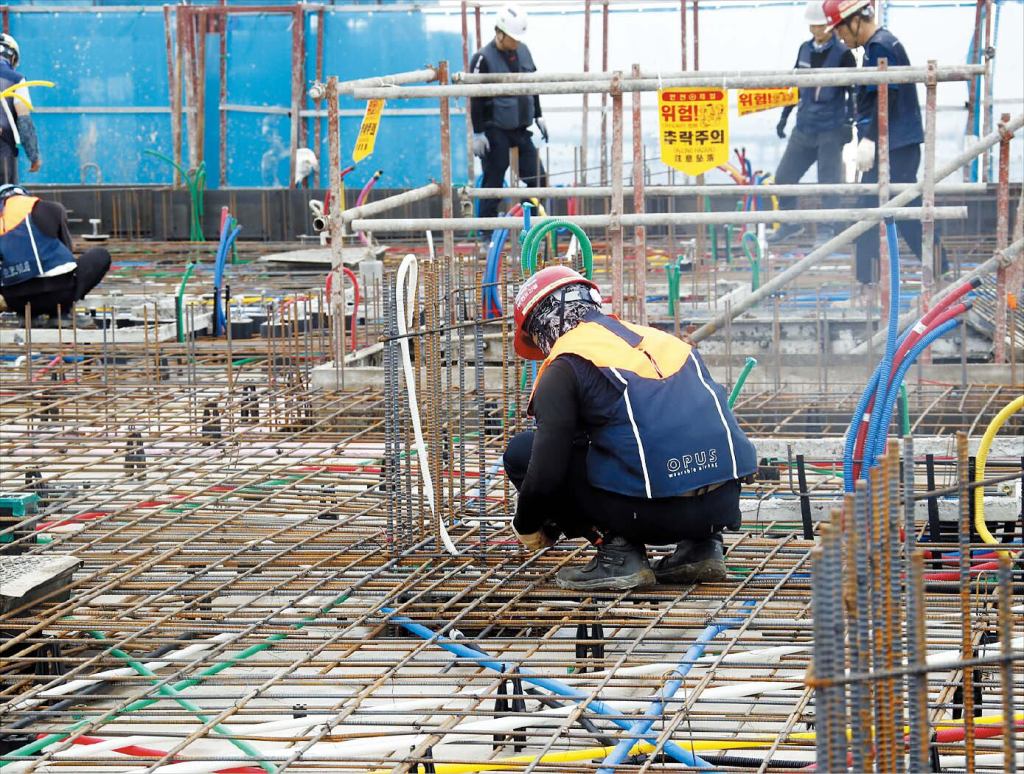
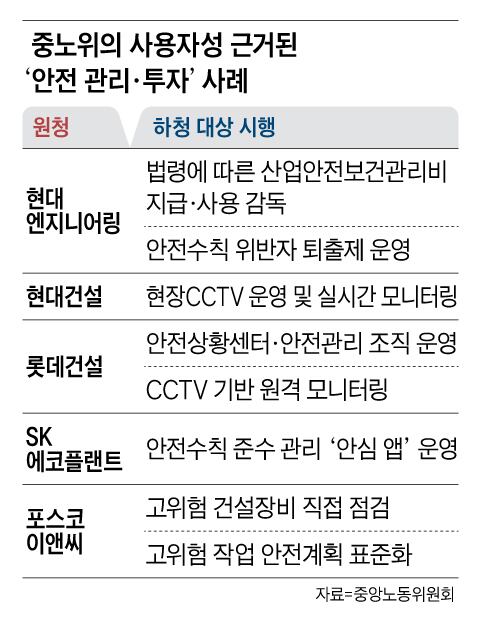
Hyundai Engineering, a local construction firm, was notified in June by the National Labor Relations Commission (NLRC) that it must enter into negotiations with unions representing subcontractors, as it has been classified as the “real employer” under the yellow envelope law. The company had clearly stipulated in its agreements with subcontractors that it oversees and allocates funds for industrial safety and health management in line with the Industrial Safety and Health Act (ISHA), disbursing payments only after receiving usage plans from subcontractors. It also maintained a system to remove subcontracted workers who breached safety protocols and held daily safety briefings. Although these actions were intended to meet statutory safety requirements under ISHA, the NLRC used them as key evidence to establish employer status.
Previously, the government clarified, “Enhancing safety measures—required by law under the ISHA—does not automatically confer employer status” (Minister of Employment and Labor Kim Young-hoon). However, an examination of 17 re-examination decisions issued by the NLRC for the top 30 domestic construction firms (based on construction capacity assessments), obtained by this newspaper on November 2 via Rep. Kim So-hee of the People Power Party, showed that all 17 companies had been designated as employers due to their oversight of on-site safety in compliance with ISHA and other regulations as of October 1. Notably, NLRC Chairman Park Soo-keun—the principal architect behind the yellow envelope act—directly participated in 65% (11 cases) of these rulings. Despite Chairman Park’s recent assertion during a parliamentary hearing that “we evaluate not just legal compliance but also additional factors” when determining employer status, skepticism remains over whether the NLRC is primarily basing its decisions on contractors’ fulfillment of safety duties. This has sparked industry concerns that “the more rigorously we ensure subcontractor safety, the greater the risk of being labeled an employer,” potentially deterring investment in safety initiatives.
NLRC rulings have also identified the introduction of advanced safety equipment and systems as grounds for recognizing primary contractors as employers. For example, Hyundai Engineering & Construction’s automated hazard detection system, which monitors equipment movement and provides real-time CCTV surveillance, and SK Ecoplant’s internally developed “Safety App” for tracking adherence to safety standards, were both cited as indicators of employer status. Similarly, POSCO E&C’s direct inspections of high-risk construction machinery and its evaluation of potential falling object hazards were deemed sufficient evidence to establish employer responsibilities.
The core issue stems from the fact that fulfilling legal safety obligations requires primary contractors to review work plans, stop hazardous activities, or modify subcontractors’ task sequences. While some construction firms argued, “We were simply complying with legal requirements,” the NLRC rejected this defense. Although the NLRC acknowledged employer status based on safety-related actions, it failed to define the boundaries of negotiation with subcontractor unions. The rulings merely stated, “In case disputes emerge during actual negotiations, they may be addressed through remedies for unfair labor practices.”
Consequently, disputes regarding the extent of bargaining between main contractors and subcontractors are intensifying at construction sites. The National Construction Workers’ Union under the Korean Confederation of Trade Unions reportedly submitted 64 demands to certain construction firms, covering wage-related issues such as hazard pay and paid rest periods during extreme heat. Fears that emerged after the introduction of the Yellow Envelope Act—that discussions initially focused on industrial safety might broaden to include wages and working hours—are now becoming reality. Professor Park Ji-sun from Korea University remarked, “If safety standards, which ought to be uniformly enforced by law, become topics for negotiation, protection levels could differ depending on the union present at the same site.” Representative Kim So-hee further emphasized, “To prevent unintended consequences, safety-related issues should be kept separate from employer status decisions, and the scope of negotiations must be strictly defined.”



Leave a Reply