
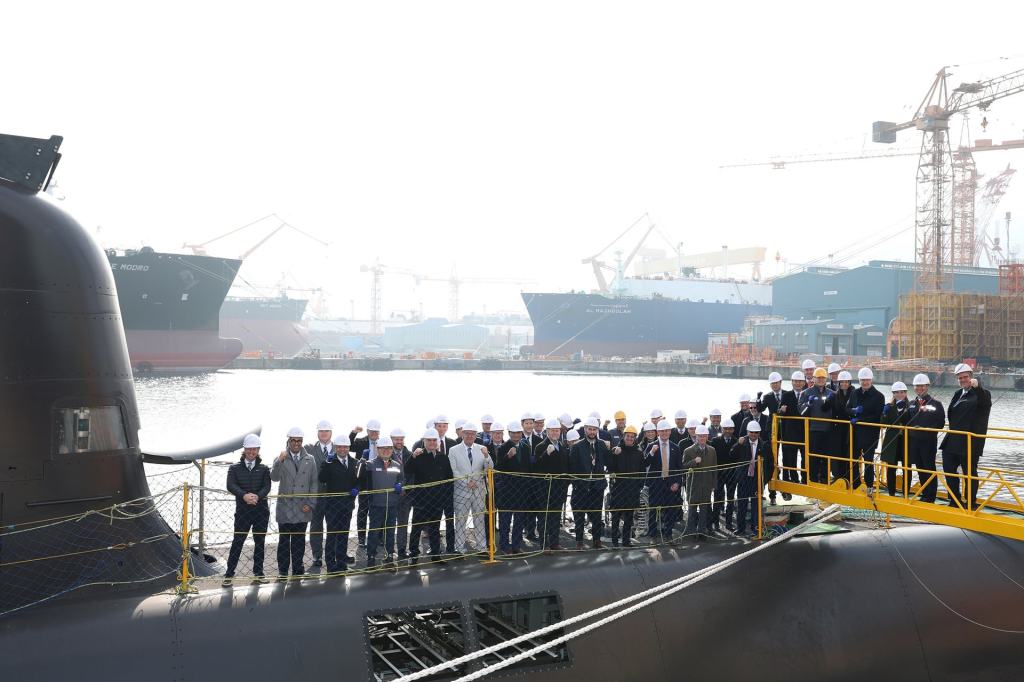
South Korea and Germany are both vying for Canada’s 60 trillion Korean won submarine acquisition project, but now there is the possibility of a “split procurement.” With the Canadian government anticipated to announce its final choice as early as early April, it is reportedly considering an option to purchase six submarines each from South Korea and Germany.
On the 2nd (local time), Hanwha Group, South Korea’s rival in the submarine project, and Germany’s TKMS (ThyssenKrupp Marine Systems) submitted their final bids to the Canadian government for submarine construction contracts. Later that day, the Canadian newspaper *The Globe and Mail*, referencing two senior government officials, reported that Canada is evaluating the possibility of acquiring six Type-212CD submarines from Germany for Atlantic coastal surveillance and six KSS-III Batch-II submarines from South Korea for use along the Pacific coast and the Indo-Pacific area.
The Canadian Navy, aiming to update its outdated submarines, is moving forward with a major initiative to acquire 12 new submarines. South Korea and Germany have joined the competition, showcasing their respective diesel-electric submarine models. The fundamental features and delivery terms offered by both nations are believed to align with previously reported standards.
Hanwha Ocean, a shipbuilding division of the Hanwha Group, focuses on its benefit of a submarine platform that is already active at sea and offers quicker delivery times. On the other hand, TKMS showcases its design tailored for conditions in the North Atlantic and its experience as a member of the NATO alliance, the North Atlantic Treaty Organization.
The rivalry between the two nations has recently highlighted “Canadian investment” as a crucial requirement in addition to submarine capabilities. The Canadian government has openly mentioned that proposals which can generate significant domestic manufacturing investment, particularly within the automotive sector, are essential considerations for the submarine project. The divided procurement assessment is viewed as a response to this situation.
Should split procurement come to fruition, it would benefit Canada by enabling it to draw industrial investments from both nations. Nevertheless, the scenario becomes complicated for the involved countries. Initially, they would need to divide the 60 trillion Korean won “pie” equally. Moreover, worries emerge that managing two separate supply chains and providing post-delivery military support systems might lead to higher costs and lower efficiency.
The circumstances are also challenging for South Korea. If Hanwha Ocean manages to obtain even a portion of the order, it might create an opportunity to enter the NATO defense market. However, as domestic firms such as HD Hyundai have established a “One Team” approach to handle international submarine projects, the allocation of tasks and role modifications could become more intricate.



 jasdooit
Leave a comment