
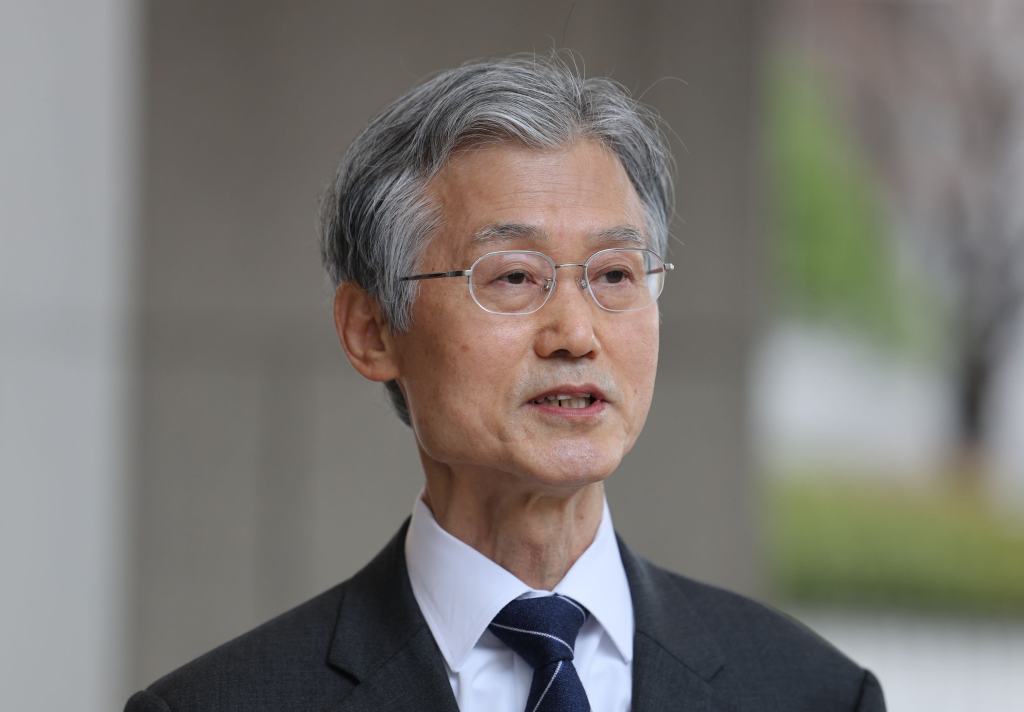
Chief Justice Jo Hee-de expressed on the 3rd his sincere appeal to the public, urging them to thoughtfully consider the matter until the conclusion, following the National Assembly’s approval of the ‘Judicial Three Laws (Introduction of Court Constitutional Review, Establishment of the Crime of Legal Distortion, and Justice Expansion Act).’ On the issue of postponing the recommendation for a replacement for Justice Roh Tae-ak, who is retiring today, he mentioned, “We are still in discussions (with the Presidential Office).”
Chief Justice Jo spoke to reporters as he headed to the Supreme Court on the same day, stating, “No system in the world is flawless, and changes need to be made with the public’s consent,” and noted, “In this context, we fully respect the legislative work of the National Assembly.” He further said, “Nevertheless, I strongly urge the public to reconsider carefully whether these abrupt reforms and changes will genuinely benefit the people or if there could be any negative aspects.” Chief Justice Jo also mentioned, “The judiciary will carry out its constitutional duties regardless of the situation.”
Chief Justice Jo dismissed certain criticisms suggesting that ‘judicial distrust’ prompted conversations about changes to the judicial system. He stated, “It is accurate that we need to work harder to increase public confidence,” but highlighted, “Objective data should also be taken into account.” He noted, “According to a recent Gallup poll, court trust stood at 35% in the U.S., whereas South Korea had 47%,” and added, “While we can’t claim this is high, it’s also not easy to say that trust is low.”
Chief Justice Jo also referenced assessments from the World Bank and other organizations, highlighting that South Korea’s civil court system has consistently been among the best and that the nation ranked 19th in the World Justice Project’s (WJP) Rule of Law Index, which included data from over 140 countries. He mentioned, “Germany has more than 20,000 judges, yet we have received these evaluations with a workforce of just over 3,000,” and emphasized, “When assessing systems, objective accomplishments should be recognized first, then issues can be addressed.” He further stated, “It is not appropriate to unfairly criticize our system or portray judges negatively based on individual cases,” and urged, “I ask the public to make thoughtful judgments.”
In terms of future response strategies, Chief Justice Jo mentioned, “Continuing as we have so far, the Supreme Court will share what it can with the public and strive its best until the very end.” When questioned if he would ask the President to use a veto on the bill, he sidestepped a clear response and remarked, “Judges are diligently working in their respective roles, and we will keep enhancing and addressing any deficiencies.”
Meanwhile, when asked if there were “disagreements with Cheong Wa Dae regarding the recommendation of a Justice,” Chief Justice Jo responded, “As we are in discussions, the Supreme Court cannot make unilateral comments,” and added, “We are continuing our discussions.” Although Justice Roh Tae-ak has completed his six-year term and retired today, the vacancy has become a reality since his successor has not yet been recommended. Considering the time it takes from the Chief Justice’s recommendation to the National Assembly’s confirmation process, the vacancy is expected to last at least a month. Legal experts speculate that the Supreme Court and Cheong Wa Dae may be facing challenges in coordinating behind the scenes in selecting the next Justice candidate.



 jasdooit
Leave a comment