
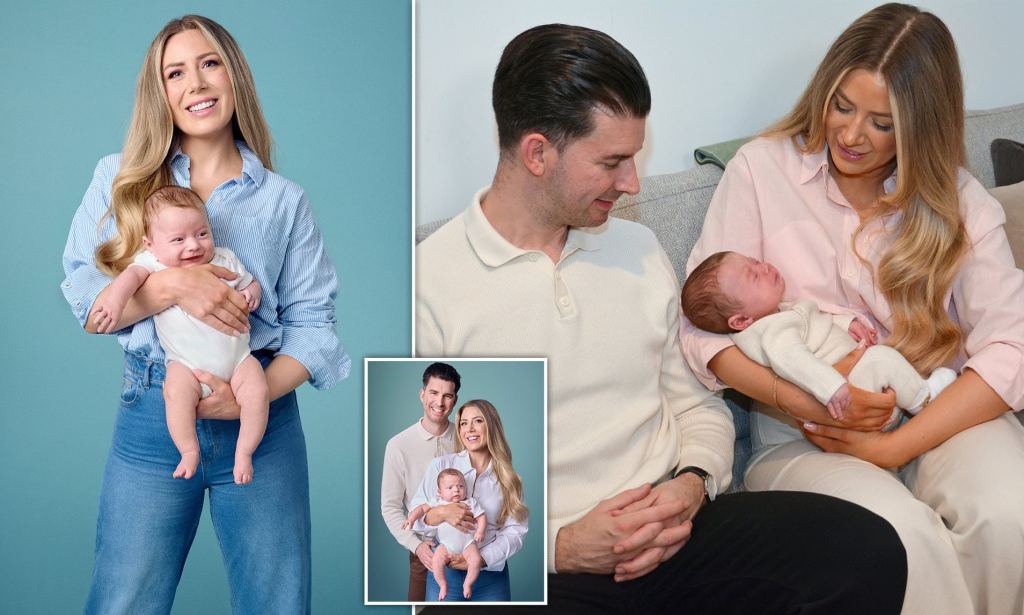
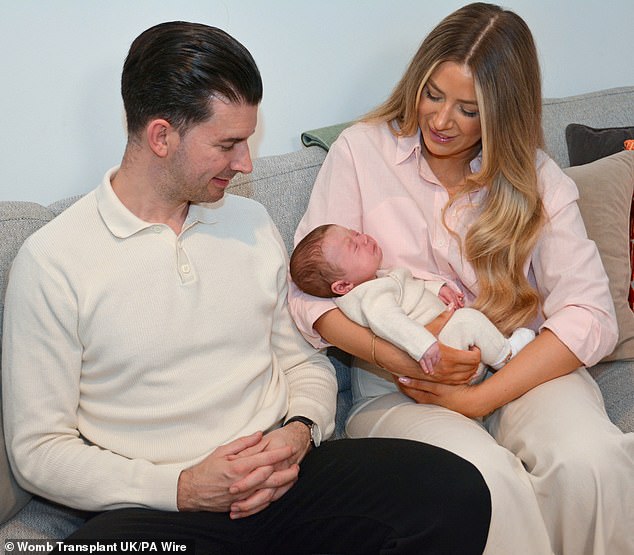
As Grace Bell experienced the moment her newborn son’s small head rested against her chest, tears streamed down her face: “I love you so much,” she whispered to him. “I have been waiting for you for a long time.”
Just moments before, when baby Hugo began to cry before he had completely come out during the C-section, Grace automatically tried to soothe him – and the surgeons had to softly move her hands away from the sterile zone where they were working.
Her eagerness to see her son is reasonable – as Grace, 32, a senior IT manager, was born without a working womb.
And it’s solely due to remarkable developments in medical science that she was able to have a child.
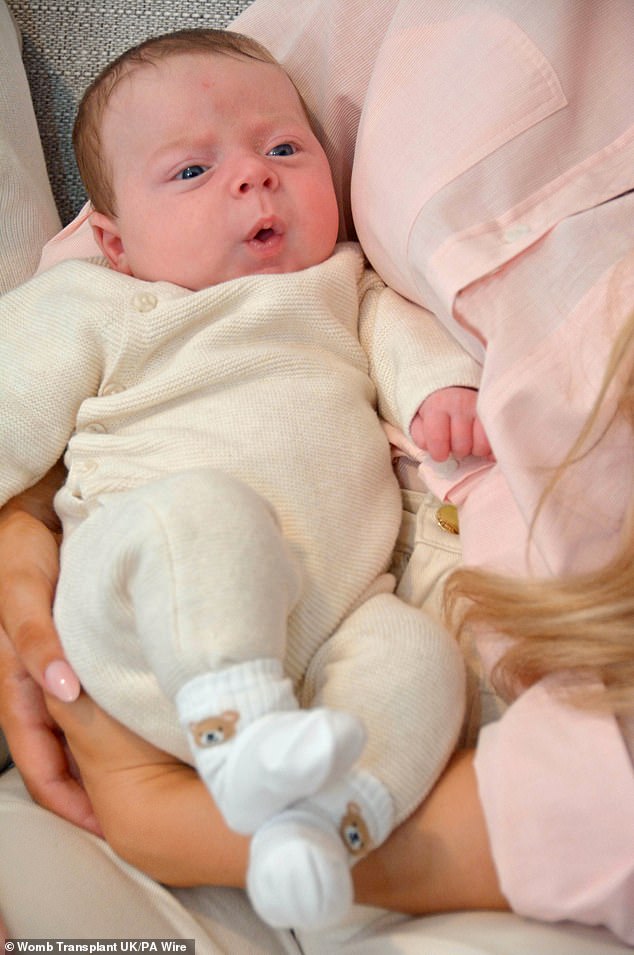
At around 5pm on December 10 of last year, Hugo Richard Norman Powell was born at Queen Charlotte’s & Chelsea Hospital inLondonweighing 6 pounds 13 ounces (3.09kg), Grace was the first female from Britain to deliver a baby following a uterus transplant from a deceased donor.
The delivery was not without complications. Hugo was born just under 36 weeks into the pregnancy, arriving earlier than expected because Grace had developed pre-eclampsia, a rapid onset of high blood pressure that can be life-threatening for both mother and child.
Important members of the medical team, who had to be present in the operating room for the birth in case the transplanted uterus required immediate removal, were urgently called from Glasgow, where they were participating in a conference. They arrived in the operating room just in time.
Grace, residing in Kent with her partner of six years, Steve Powell, 37, who is employed in the finance sector, remained unaware of the chaos.
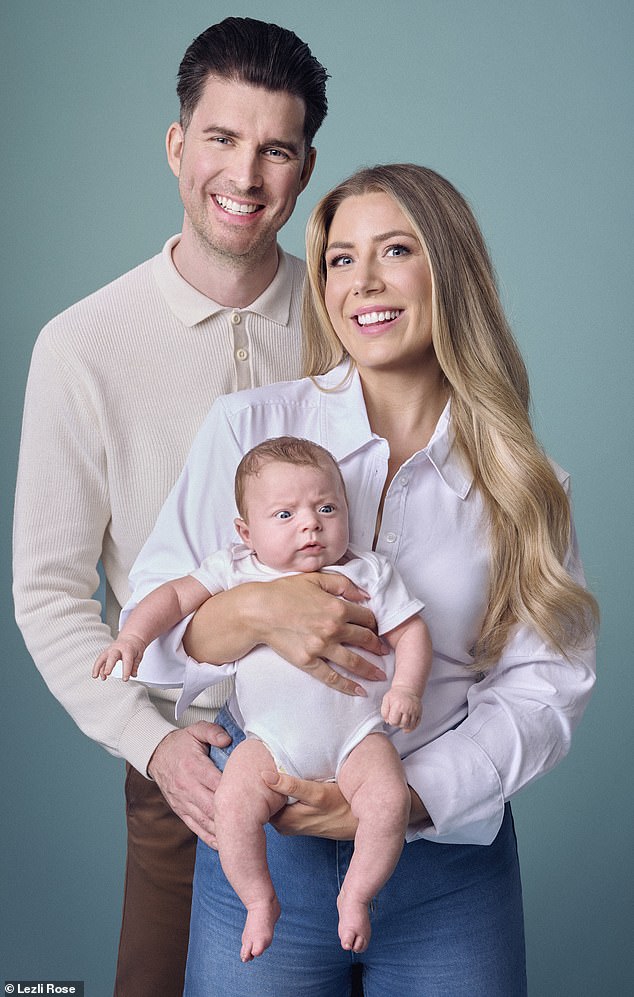
“Something miraculous was happening for me, and after years of hoping for this moment, I couldn’t believe I was finally going to hold my own child,” says Grace.
“I never thought I could be as happy as I was that day. And Steve was in disbelief—he couldn’t believe this was actually taking place,” she adds.
He has made an effort to remain strong for me during this period, and it hasn’t always been simple – there have been moments when I required a great deal of assistance.
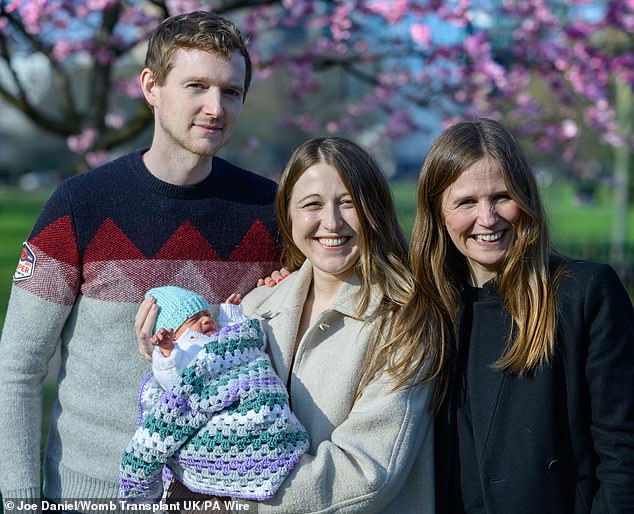
Grace is among the few women in the UK to havebrought a baby into the world after undergoing a uterine transplant, the first one being Grace Davidson, who gave birth last year following the receipt of her older sister’s uterus.
The two women met unexpectedly when Grace was in the last phase of her pregnancy, and she saw Grace Davidson and baby Amy from across the room during a medical appointment. ‘It was like seeing a celebrity to me, I recognized her from newspaper photos,’ she remembers.
‘It was incredible to speak with her since no one else had experienced what I was going through, except for her.’ The women exchanged contact details, and Grace has been ‘an incredible source of support’.
However, naturally, their experience differs in a crucial way: Hugo’s birth was only possible due to someone going through a terrible loss.
Grace’s understanding of their suffering is clear. As she speaks about it, she doesn’t just weep; her body is convulsed by deep sobs.
“I often think about the donor and her family, and occasionally it really hits me how much pain they must have experienced,” she says.
The donor’s family has asked for confidentiality, and Grace is unaware of the woman’s identity. However, she understands that the family had to provide explicit consent for the womb to be donated, as it is not one of the organs automatically eligible for transplantation.
Grace states: “I have numerous questions that still don’t have answers – who she was and what occurred – but I’m extremely thankful that, during a period of unimaginable sorrow, that family chose to assist others. It’s amazing.”
Not all people endorse womb transplants – they claim that while the Womb Transplant UK charity provides funding for the £30,000 procedures, these are not life-saving, unlike most other types of transplants.
“But the critics haven’t sat down and spoken with these women who lack a functional womb and whose lives have been devastated by their desire for a child,” says Professor Richard Smith, a gynaecological surgeon at Imperial College Healthcare NHS Trust, who established Womb Transplant UK and co-led the transplant procedures.
If you possess any empathy, you are unable to avoid comprehending the reasons behind our actions.
Grace personally faced intense depression due to her inability to bear a child, which was occasionally too much to handle.
At the age of 16, when her periods did not begin, a scan showed that Grace has Mayer-Rokitansky-Kuster-Hauser (MRKH) syndrome, a condition that affects approximately 15,000 women in the UK, resulting in an underdeveloped uterus or no uterus at all, though they do develop ovaries. She was informed at that time that she would never be able to carry a child.
Grace, from a family of three, says: “My whole life changed that day. I locked myself in the bathroom and felt as though the weight of the world was on me.”
I had what they refer to as ‘remnants’ of a womb – two sacs – but they hadn’t fully merged, which somehow made it more heartbreaking than having no womb at all, since it was so close to being complete.
Even on better days, it loomed over me; the reality that I couldn’t bear a child was constantly on my mind.
As a teenager, there were days when just seeing a baby carriage on the street would distress her.
Grace states, “A single Tampax commercial could emphasize how different I felt from other women on certain days and make me cry.” Her discomfort worsened after meeting Steve. They crossed paths on a train traveling from Kent to their respective jobs in London. One day, she mustered the bravery to say hello, and they began dating in 2020.
“I realized he was the right one within a few months – and that I had to inform him about my uterus,” says Grace.
By the end of 2020, they had moved in together, and the following year, they purchased a home. However, as their relationship progressed, Grace experienced increasing feelings of depression.
A number of friends were having children,’ she says. ‘Three years ago, my sister-in-law became pregnant with my niece, and although I was delighted for her and my brother, honestly, I felt jealous as well.
It was difficult to witness because, at that moment, I had no hope of going through pregnancy. I fell into a very dark state,” she says. “I reached the lowest point of my life. I would sit and weep in the bedroom for no clear reason.
A therapist who has worked with individuals experiencing grief related to infertility assisted her in moving forward and concentrating on ways the couple could build a family.
They talked about adoption, but Grace mentioned that “it’s a very long process,” and, like many others, she felt the desire to have a child who was genetically her own.
The only alternative was surrogacy. “I had a hard time with the thought of seeing someone else carrying my child,” says Grace.
However, in 2023, the couple took their initial steps by undergoing IVF and succeeded in producing four healthy embryos.
Grace had forgotten the email she sent to Womb Transplant UK in June 2018—before she met Steve—after learning they were seeking women with MRKH who could participate in a study.
The charity is authorized to conduct a trial involving womb transplants from five living donors (two of which have already been completed) and ten deceased donors (three of which have taken place, including Grace).
It was in October 2023 when Grace received an unexpected call from the charity, inquiring if she was still interested. “I was stunned and put the phone down in disbelief,” she recalls. “It was also ideal timing since we already had four embryos.”
The following step involved undergoing evaluations to confirm that she was both physically and mentally fit to endure extended surgery and multiple invasive examinations.
Afterward, the couple had to generate additional embryos through IVF (which they financed personally) as they needed to have five in storage in case the initial transfers were unsuccessful.
In February 2024, Grace was added to the donor waiting list and her life came to a standstill.
She states: “We couldn’t leave the country for a vacation in case a uterus became available, and I stopped going out with the girls – imagine if the call came and you had had a few drinks?”
Only four months later, Grace was on a video conference with her coworkers when she received a call informing her that a uterus had become available. “I rushed down to tell Steve, shouting, ‘It’s happening!’ I was very excited, almost overwhelmed. Steve remained calm as always – that’s one of the reasons we function so well together.”
They were instructed to go to the Churchill Hospital in Oxford, where all the uterine transplants have taken place (a transplant center, it)where many of the senior staff are located).
I was experiencing a real mix of feelings,” says Grace. “I was frightened, but I was also very excited, and deeply sad that I’m in this situation only because a woman had just died.
I recall my father saying, ‘I can’t picture losing you, Grace, and that family has experienced such suffering,’ and it truly made everything real.
For the medical staff, it marked the beginning of an extremely lengthy assignment.
Professor Smith and other medical professionals journeyed throughout the country to perform the three-hour retrieval surgery. The donated uterus was kept on ice and transported to Oxford.
At 5am the following day, the ten-hour procedure to implant the womb commenced — the medical team connected four veins and two arteries from the donated uterus to Grace’s blood vessels using stitches as thin as a human hair. This is a complex surgical process that involves a team of 20 — including surgeons, physicians, anesthesiologists, and nurses.
Grace remembers: ‘I recall waking up in the recovery room and I asked the nurse: “Do I still have a uterus?” She replied “yes,” and I experienced a huge feeling of relief.’
Overwhelmed by fentanyl, she initially experienced no pain, ‘but I felt incredibly emotional,’ she remembers. ‘All of a sudden, I had hope.’
She had imaging tests and routine biopsies to ensure everything was functioning properly.
Two weeks later, sitting beside her mother on the couch, she realized she was experiencing her first menstrual cycle.
“I told my mom: ‘Oh my goodness, I’m bleeding,’ ” says Grace.
It brought me back to when I was 16 – but all of a sudden, I wasn’t any different from the other girls.
It wasn’t until six months later, in January of last year, that she had recovered sufficiently to attempt the first embryo transfer. Two weeks after that – on her birthday – she took a pregnancy test: it came back negative.
Following the next attempt in March, Grace was eager to take a pregnancy test.
“I was mischievous and took the test a day ahead of schedule while Steve was at a Tottenham game,” she says.
When I saw it was positive, I was shocked and called my mom because I needed to tell someone, and I didn’t want to inform Steve through a text message,” she says. “Mom arrived immediately.
Grace placed the positive test result in a box for Steve to open upon his return home. He was just as astonished by the news as she was, “and we spent the rest of the day imagining what it would be like to be a family,” Grace said.
Although I was aware the baby was no larger than a speck, I already felt like a mother.
She now finds it hard to believe how she got through the next eight months. “It wasn’t a typical pregnancy,” Grace remembers.
She required scans every two weeks at Queen Charlotte’s Hospital and regular check-ups in Oxford — such as verifying the correct dosage of her anti-rejection medication (she takes 12 pills each day) — while also maintaining a full-time job.
One of the most challenging aspects was maintaining the secrecy.
Grace says: “Usually at 12 weeks you share it on Instagram and tell all your friends, then have the baby shower. But I wasn’t able to do that.”
I realize why – the program aimed to confirm this would be a success before I shared it with everyone – but it was difficult. My immediate family was aware, along with my boss, and I informed my closest friends, but no one else.
A scan at 20 weeks showed they were expecting a boy. “It didn’t matter to me whether we had a boy or a girl,” says Grace.
When the pregnancy was six months along, the couple were recommended to relocate from their home to a rented house close to the hospital in London so that Grace could receive regular attention.
Additionally, since the womb’s nerves are not transmitted, if she had gone into labor, she would not have experienced it.
(Moving also meant she was less likely to encounter someone who was aware of her MRKH and could question her about her pregnant appearance.)
It was always destined to be a C-section because a natural birth would place excessive strain on the transplanted uterus.
A few days prior to the scheduled delivery date, Grace began experiencing ‘quite unwell – extremely tired’.
Her blood pressure was 150 over 100—a condition that was elevated for her—and the obstetrician said to her, “I believe we need to deliver him today,” she remembers.
She was taken to the theater, where Steve sat behind her, holding her hand throughout the two-hour procedure.
“It lasted longer than a typical C-section, and I began to feel nervous. However, eventually I heard Hugo’s first cry, and a wave of relief washed over me—I started crying,” says Grace.
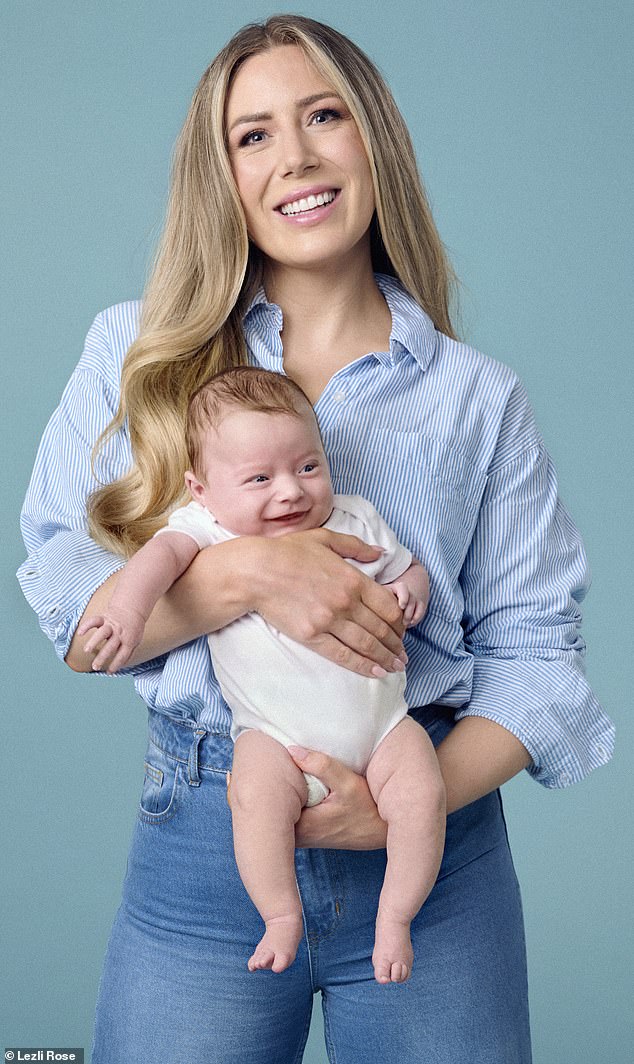
She now sheds joyful tears when recalling the moment. ‘Hugo was slightly blue, so he spent the first night in an incubator, which was tough. But the next morning, seeing his tiny face made me tear up once more.’
Grace spent eight days in the hospital for medical evaluations. “I can’t describe how much I longed to return home and begin life as a family,” she says.
They returned just in time for Hugo to celebrate Christmas Day in his new Santa costume, receiving lots of affection from the family and a “massive stack of gifts.”
Grace enjoys being a mother but acknowledges ‘nothing can prepare you for the sleepless nights and exhaustion’.
A donated uterus can remain for another pregnancy, or for up to five years – after which it must be removed, as the use of anti-rejection medications raises the likelihood of infections and specific types of cancer.
Grace hasn’t yet made up her mind about having another child. “Hugo was more than worth it, but it’s not an easy journey – it’s a big commitment and the next time I would be doing this with a child,” she says.
It’s evident that she finds it hard to believe her fortune in being a mother to one child.
Every year on my birthday, when others asked me to make a wish while blowing out the candles, I wished for a child – yet deep down, I believed it was an empty hope that would never be realized.
But this birthday I didn’t make a wish, as having Hugo here, I couldn’t desire anything more.



 jasdooit
Leave a comment