
People stuck in the United Arab Emirates due to an expanding conflict started leaving on a limited number of evacuation flights on Monday, despite the fact that most commercial air travel throughout the Middle East was still halted.
Limited flights departing from Dubai and Abu Dhabi occurred as the U.S. State Department advised its citizens in 13 countries, including the UAE, Jordan, Saudi Arabia, Egypt, Lebanon, and Oman, to “leave immediately using commercial travel due to significant safety dangers.” Extensive airspace shutdowns and flight cancellations throughout the region reduced the available choices for following this guidance.
Following the U.S. and Israeli strikes on Iran and subsequent counterattacks against Israel and Gulf nations that began on Saturday, commercial air travel has been suspended or significantly limited, resulting in tourists, business people, migrant workers, and religious visitors being stranded in hotels, airports, and on cruise ships.
Airspace remained restricted on Monday across Iran, Iraq, and Israel. Jordan implemented a temporary closure starting in the afternoon of Monday. Several other Gulf nations, such as Qatar, Bahrain, Kuwait, and Saudi Arabia, had partial or temporary restrictions that might be prolonged, as reported by the flight-tracking service Flightradar24.
Approximately 13,000 of the around 32,000 flights planned to and from the Middle East since Saturday have been called off, according to the aviation data company Cirium.
Evacuation flights begin
Airlines conducting evacuation flights are probably receiving support from their respective governments, with the carriers’ home nations possibly sharing some of the financial risk, according to Henry Harteveldt, president of the travel market research company Atmosphere Research Group.
“Airlines will not restart their services until they are completely sure that there is a zero, or as near to zero as possible, chance of their planes being targeted,” Harteveldt stated.
 |
|
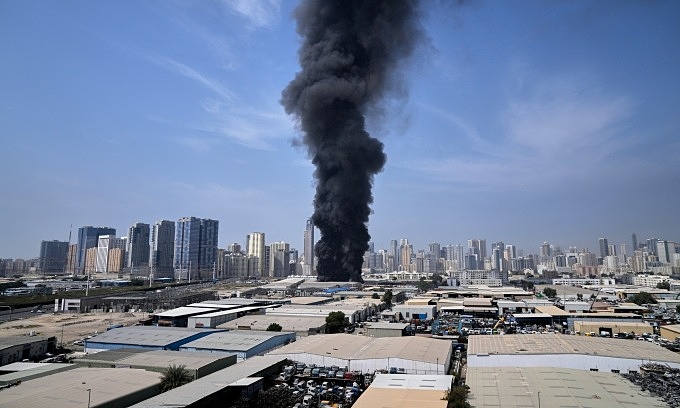
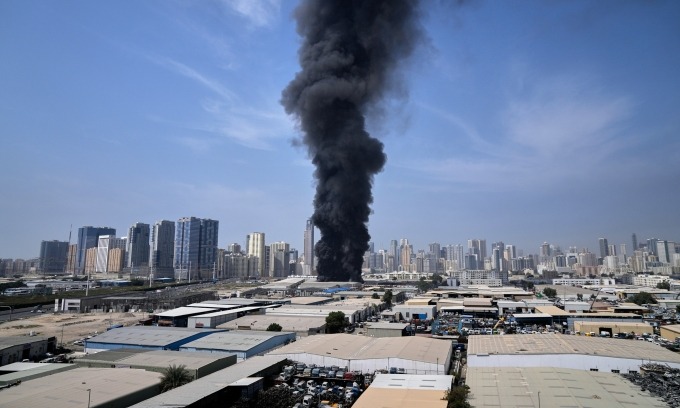
Dark thick smoke rising from the industrial zone of Sharjah City in the UAE, where a warehouse caught fire as Iran carried out attacks on March 1, 2026. Photo by AP |
Long-haul airlines Etihad Airways and Emirates, located in Abu Dhabi and Dubai respectively, alongside low-cost carrier FlyDubai, announced on Monday that they will conduct restricted flights from the nation, which has activated air defense systems to counter Iranian missiles and drones.
At least 16 Etihad Airways flights departed from Abu Dhabi within a three-hour period on Monday, as reported by Flightradar24, with routes covering cities such as Islamabad, Paris, Amsterdam, Mumbai, Moscow, and London. However, the airline’s official website stated that all its regular commercial flights were still halted until mid-afternoon on Wednesday.
Emirates mentioned that passengers who had made earlier reservations would be given preference for seating on the limited flights the airline planned to conduct beginning Monday night. FlyDubai stated it would carry out four departure flights and five return flights. Dubai Airports, the organization responsible for managing the city’s two airports, reported a higher number of flights on Tuesday but advised travelers to visit the airports only if their airline had provided them with a confirmation since operations were still restricted.
Airspace shutdowns disrupt international travel
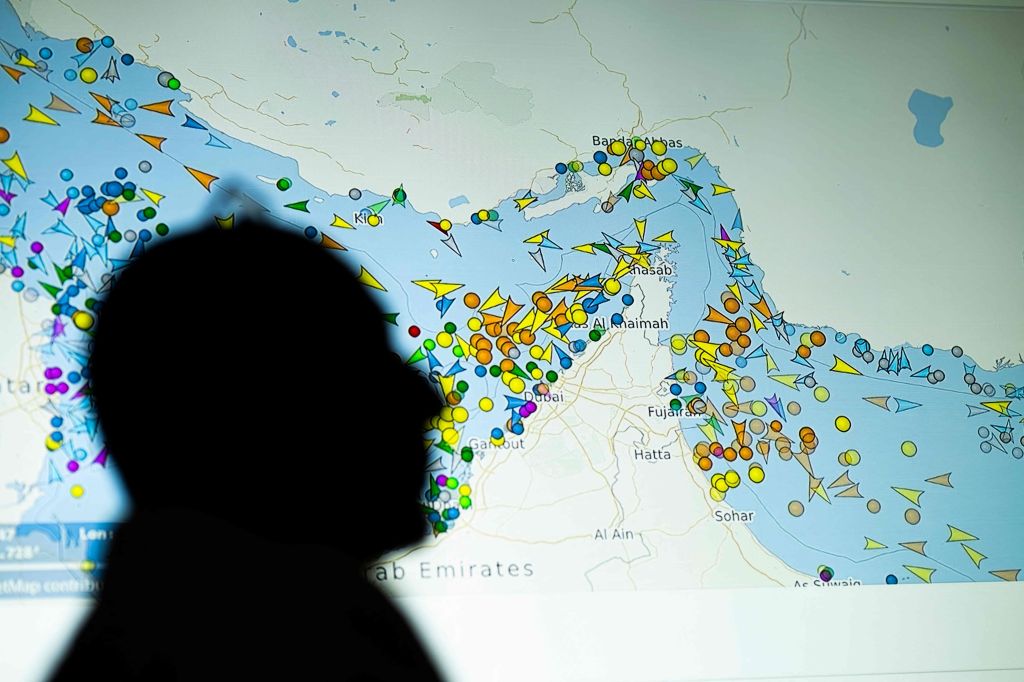
The impacts have been extensive since Gulf airports act as essential global transit points connecting Europe, Africa, and Asia. Dubai International Airport processed a remarkable 95.2 million travelers in the past year, earning it the title of the world’s most congested airport based on international traffic.
Leela Rao, a 29-year-old law student at Georgetown University in Washington, was on one of Monday’s Etihad flights. She found out about the airstrikes while waiting to transfer in Abu Dhabi on Saturday and spent several hours at the airport keeping up with news reports, hearing explosions, and getting alerts to seek shelter before Etihad provided her with a hotel room in Dubai.
I am extremely grateful,” Rao said via text message after arriving in Delhi just in time for a friend’s wedding. “Everyone applauded when we landed.
The Association of Tennis Professionals mentioned that former U.S. Open tennis champion Daniil Medvedev was part of a limited group of players and personnel it was assisting in departing Dubai.
A resident of Scotland, Faizan Khalid, along with his wife and their six-month-old daughter, found themselves stuck in Lahore, Pakistan, on Saturday after their flight back home, which had a stopover in Dubai, was canceled. They have been booked on a new flight scheduled for Wednesday, which also includes a layover in Dubai. Khalid expressed increasing worry as the supply of baby formula for him and his wife is running out.
“Just hoping to return home safely,” he mentioned.
Hen Mazzig, a 35-year-old author based in London, found herself trapped in Tel Aviv as the conflict broke out.
I am truly grateful,” Mazzig said while quickly reorganizing his schedule. “It’s a hassle, but it’s insignificant compared to the magnitude of this.
Evacuation efforts expand
Authorities were rushing to arrange assistance, evacuations, and return flights for their nationals.
The national airline of Israel, El Al, announced it is setting up a large-scale “recovery effort” to repatriate passengers once Ben Gurion Airport near Tel Aviv resumes operations. Travelers who have reservations with El Al and its subsidiary, Sundor, will not incur fees for their seats on these flights, which are anticipated to begin from locations such as New York, London, Paris, Rome, and Los Angeles.
The United States advised Americans requiring assistance with commercial travel to reach out to the State Department. British Prime Minister Keir Starmer stated that conditions on the ground “could stay difficult for a while” but noted that the U.K. government was “reviewing all possibilities to assist our citizens.”
The Philippines raised its travel advisory for the UAE on Monday, categorizing it—alongside Bahrain, Kuwait, Qatar, and Saudi Arabia—at a level that automatically prohibits the hiring of new Filipino workers.
Indonesia reported that over 58,000 of its nationals were stuck in Saudi Arabia, having traveled there to visit the Islamic holy sites during Ramadan.
“It has turned into a pressing humanitarian and logistical challenge,” stated Ichsan Marsha, the representative from Indonesia’s Ministry of Hajj and Umrah. Additionally, thousands of tourists found themselves stuck on Indonesia’s popular island of Bali due to the cancellation of international flights.
Approximately 30,000 German tourists are reported to be stuck throughout the Middle East, according to Germany’s Foreign Ministry. The government stated its intention to deploy planes to Oman and Saudi Arabia to bring back sick travelers, children, and pregnant individuals, while collaborating with airlines to help others whenever feasible.
The Czech Republic announced it is dispatching aircraft to Egypt, Jordan, and Oman to repatriate citizens from Israel and neighboring nations. The United Kingdom mentioned it is getting ready for different scenarios, including a potential evacuation, as over 102,000 individuals have reported their location in the area.



 jasdooit
Leave a comment