

Early this month, advertising agency A announced a two-line corporate value improvement plan on the Korea Exchange’s listing disclosure system (KIND): “Enhancing core business competitiveness. Strategic investments for sustainable growth.” Agency A is not the only one. Semiconductor parts manufacturer B submitted a plan aimed at increasing corporate value, stating: “Establishing strategic plans by business division. Efforts to maximize profits through improving pricing and technological competitiveness and reducing fixed costs. Efforts to secure dividend funds by increasing operating profits.” These “value-up disclosures,” which outline corporate business objectives and shareholder return strategies, often lack detailed information, specific numbers, or industry-specific approaches, simply repeating general principles.
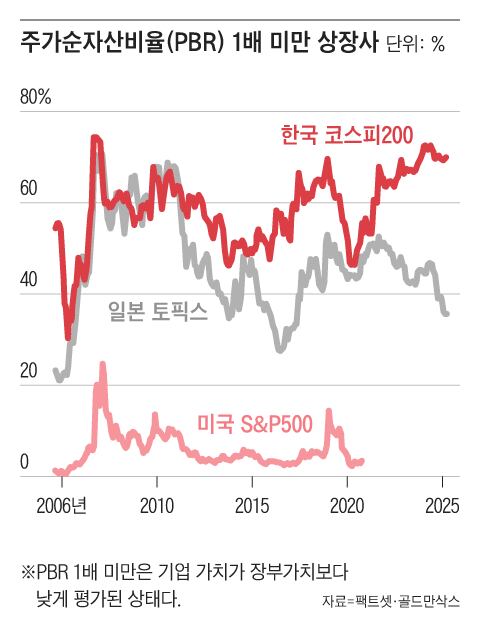
Recently, KIND has observed an increase in these “empty value-up disclosures.” Listed companies are hurriedly submitting disclosures to take advantage of tax benefits under the newly enacted *Special Taxation Restriction Act*, even if the information provided is not meaningful. Furthermore, the government’s decision to publicly list “low PBR” companies (those with a price-to-book ratio below 1) starting this July has prompted firms to submit insufficient disclosures. PBR, which is calculated by dividing the stock price by the book value per share, reflects a company’s market value compared to its net assets.
◇Proliferation of “Empty Disclosures”
As per the Korea Exchange, 409 instances of value increases were submitted in March alone. A significant number of these were from companies with a PBR under 1 and included just two or three lines.
According to Article 104-27 of the *Special Taxation Restriction Act*, businesses that distribute high dividends and are approved by the government may opt for individual taxation on shareholders’ cash dividend earnings. This reduces the tax rate from the current overall income tax (which can be as high as 49.5%) to 14% for annual dividend income up to 20 million South Korean won, 20% for amounts between 20 million and 300 million South Korean won, 25% for income ranging from 300 million to 5 billion South Korean won, and 30% for any amount exceeding 5 billion South Korean won. This measure greatly eases the tax burden.
Experts believe that companies offering high dividends are hurriedly submitting value-up reports to gain these tax advantages. A high-dividend company is considered one that had a dividend payout ratio of 40% or more in the prior fiscal year, or a ratio of 25% or more with a 10% rise in dividends from the previous year.
◇Strive to Leave the “Low PBR” List
Another reason is to avoid being included in the government’s “low PBR” list. The Financial Services Commission has stated that starting in July, companies ranked in the bottom 20% by industry PBR or those with a PBR below 1 will be publicly listed. However, companies that submit value-enhancement disclosures may be temporarily removed from the list, encouraging firms to file even short disclosures to escape the “low PBR” label. A financial industry official noted, “For companies, submitting a disclosure—even without a specific plan—is a common approach. However, vague statements have little impact on real corporate value improvement.”
Certainly, statements from companies with low price-to-book ratios often included general terms such as “enhancing competitiveness,” “increasing capital efficiency,” and “investigating shareholder return strategies.” This has resulted in criticism that these disclosures focus more on tax advantages or preventing negative perceptions rather than real value-creation initiatives.
◇Large Corporations Not Exempt
Even major corporations are not immune. On the 3rd, the Korea Corporate Governance Forum assigned Samsung Electronics and Samsung Life Insurance the lowest rating, an “F,” regarding their value-increasing initiatives. The forum remarked, “Samsung Electronics’ plan consisted of only about 20 lines, while Samsung Life Insurance’s was 10 lines. This was inadequate, even for a ‘simplified’ disclosure, considering Samsung Electronics’ international reputation and the expectations of shareholders over the past two years.”
A representative from the Korea Exchange stated, “Simplified reporting for high-dividend firms is allowed only this year; starting next year, full disclosures will be mandatory. To avoid being listed on the low-PBR category, companies need to present specific plans aimed at improving their PBR.”
Lee Hyo-seop, a senior researcher at the Korea Capital Market Institute, stated, “Japan’s penalty-based method for value-up disclosures frequently led to superficial compliance. It is important to enhance incentives, similar to those in domestic financial holding companies’ genuine disclosures, to address undervaluation and promote voluntary and meaningful engagement.”



 jasdooit
Leave a comment