
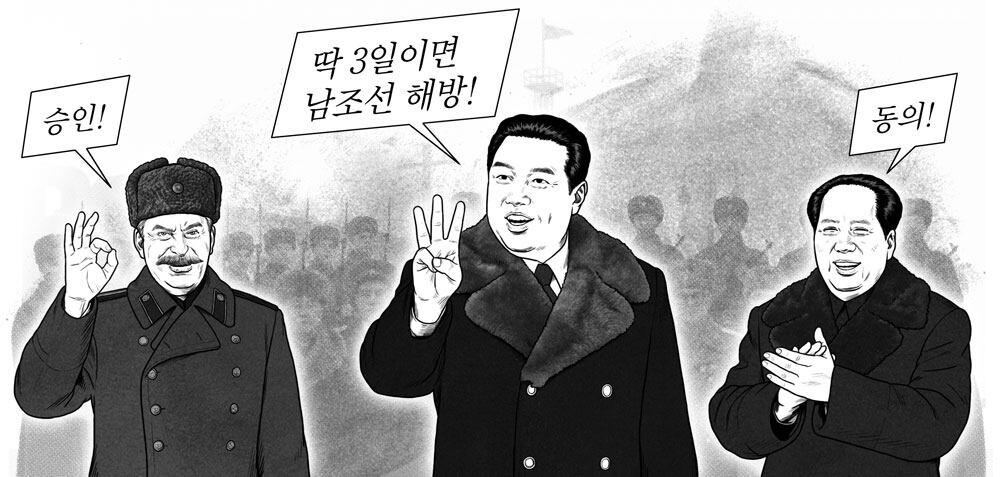
On February 22, 1949, Prime Minister Kim Il-sung and Deputy Prime Minister and Foreign Minister Park Heon-young left Pyongyang by train for North Korea’s initial official trip to the Soviet Union after the formation of its government. After almost two weeks, the group reached Moscow on March 4, and the following day, Stalin held a dinner in honor of Kim Il-sung. During the banquet, Kim Il-sung sought Stalin’s agreement for an invasion of the South, asserting, “Liberating South Korea through military action is unavoidable. The reactionary elements in the South are plotting to permanently split the country. The People’s Army is powerful, and communist guerrillas continue fighting throughout the South.”
However, Stalin firmly turned down the suggestion, stating, “South Korea should not be attacked at this time. Firstly, the strength of the People’s Army has not yet surpassed the South Korean forces. Secondly, American troops are still present in the South. Thirdly, the Soviet-U.S. agreement regarding the 38th parallel is still in effect.” Despite this, he did not completely disregard Kim Il-sung’s aspirations, advising him to patiently prepare for war and wait for the appropriate opportunity. After returning to Pyongyang on April 7, Kim Il-sung sped up the increase in the People’s Army’s personnel and the modernization of its weaponry.
Afterward, the East Asian region witnessed continuous successes for the communist block. In June 1949, as wished by the communist bloc, U.S. forces withdrew from South Korea, leaving only a military advisory team consisting of more than 500 individuals. In August, the Soviet Union successfully carried out a nuclear test, and in October, Mao Zedong, who had won the Chinese Civil War, announced the founding of the People’s Republic of China. Although the entire country turned communist, the United States did not get involved in the civil war. Observing this, Kim Il-sung became convinced that the United States would not interfere in a “Korean civil war” either.
On January 17, 1950, during a farewell lunch for Ambassador to China Lee Ju-yeon at the home of Foreign Minister Park Heon-young, Kim Il-sung asked Soviet Ambassador to North Korea Tikhonov for an audience with Stalin. He stated, “With the completion of China’s liberation, the next step is the liberation of South Korea. An invasion of the south by the People’s Army is necessary. I would like to meet with Stalin to obtain his guidance on this issue. As a communist and someone who has received communist military training, Stalin’s instructions are binding for me. I cannot start a war based only on my own decision.”
By that time, Stalin had also given his approval to Kim Il-sung’s plan for an invasion of the south. Nevertheless, even if he supported the war, he had a broader vision in which the Soviet Union would not take responsibility, leaving the start of the conflict to North Korea and the management after the war to China. In late January, Tikhonov conveyed Stalin’s message to Kim Il-sung: “If it is about this matter, he can meet and discuss at any time.” Kim Il-sung, thrilled, kept asking, “Is that true?”
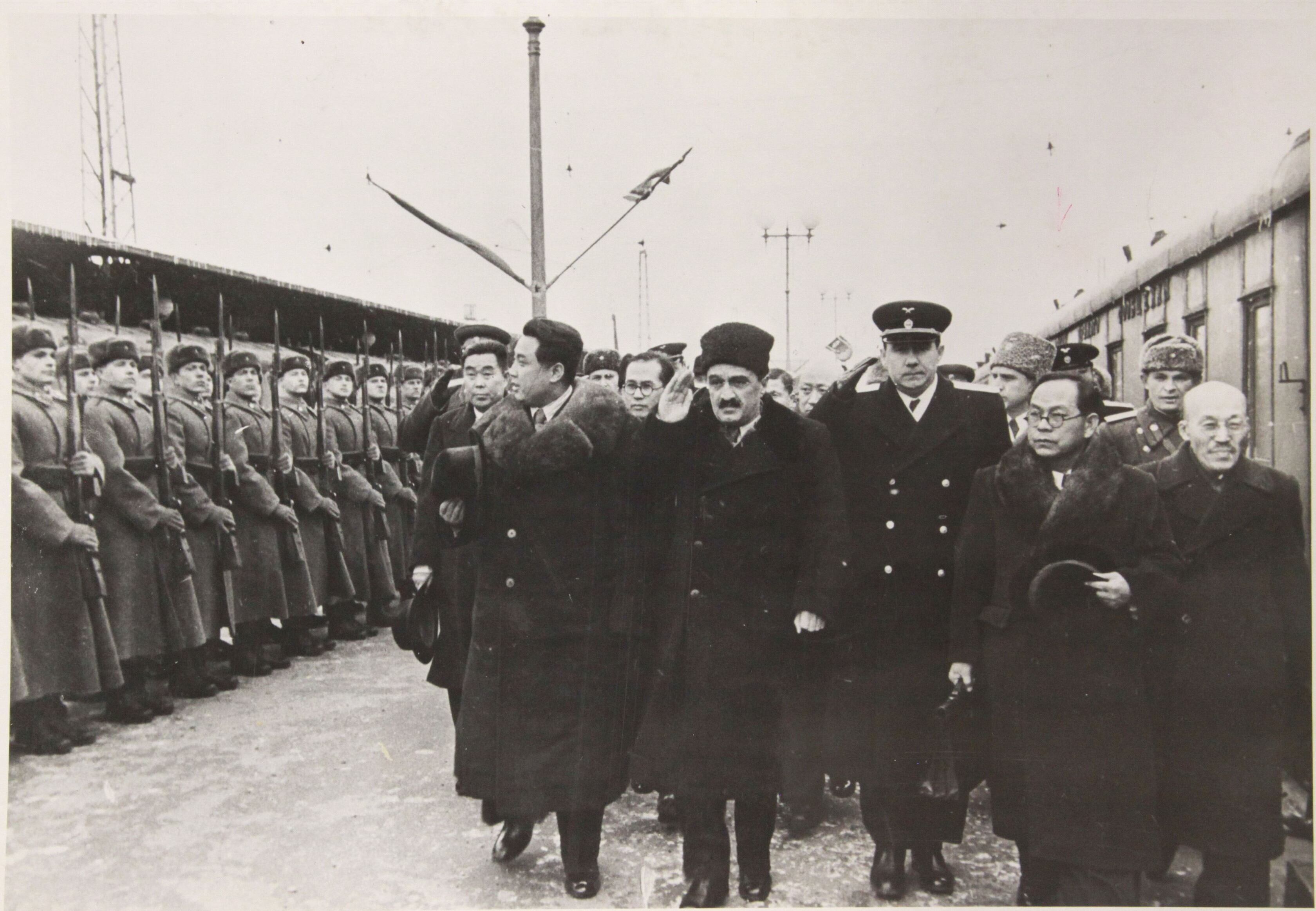
Kim Il-sung and Park Heon-young secretly traveled to Moscow between March 30 and April 25, 1950, three months prior to the start of the Korean War, and met with Stalin on three occasions. Stalin gave his approval to Kim Il-sung’s plan for an invasion of the south, provided that Mao Zedong assured him that China would offer assistance if the situation turned against them following the invasion. Stalin cautioned, “Even if the United States sends troops, the Soviet Union will not get involved in the Korean matter, so the chances of U.S. involvement must be carefully considered.”
Kim Il-sung claimed, “As the Soviet Union and China are supporting us and the United States is not willing to engage in another major conflict, it will not get involved in a ‘Korean civil war.’” On the matter of Chinese backing, he assured Stalin, “Since the victory of the Chinese Revolution, Mao Zedong has repeatedly mentioned that if a conflict arises on the Korean Peninsula, China will back North Korea.” Park Heon-young also backed Kim Il-sung, informing Stalin, “If a war occurs, 200,000 members of the South Korean Workers’ Party will trigger a public uprising and topple the South Korean government.”
Kim Il-sung and Stalin devised a three-stage invasion strategy: “Stage 1: Gather forces close to the 38th parallel. Stage 2: Suggest peaceful reunification with South Korea. Stage 3: If South Korea declines, deny the proposal and begin military operations.” Stalin directed, “The conflict should be resolved quickly, preventing South Korea and the United States from having an opportunity to retaliate.” Kim Il-sung pledged, “By the time the United States recovers its footing, the entire Korean population will be eagerly backing a ‘new government.’”
If the Korean Peninsula were to become communist after China’s own communist transformation, the United States might lose its strategic position in East Asia and could encounter threats reaching as far as Japan and the Pacific. In reality, China’s communist transformation only strengthened the U.S. determination to protect South Korea. However, Kim Il-sung, who strongly believed in the so-called “three-day victory theory,” incorrectly assumed that even if the United States planned to get involved, the People’s Army would “conclude the war in three days,” leaving no opportunity for American intervention.
After returning to Pyongyang on April 25, Kim Il-sung and Park Heon-young flew to Beijing on May 13, just under a month later. The urgency of the situation led to a secret meeting between Kim Il-sung and Mao Zedong that same night. When Kim Il-sung mentioned that Stalin had given his approval for the military unification, China asked for “proof,” which caused the discussions to be temporarily halted. At 11:30 p.m., even though it was late, Premier and Foreign Minister Zhou Enlai went to the Soviet embassy to ask Soviet Ambassador Roshin to have Stalin personally confirm the “approval of the southern invasion.” Soviet Foreign Minister Vishinsky immediately responded via encrypted telegram:
Because of changes in the global situation, Filippov (Stalin’s code name) has accepted Comrade Kim Il-sung’s suggestion about the unification of the Korean Peninsula. Nevertheless, the ultimate decision on this issue must be taken together by North Korea and the Chinese comrades. If the Chinese comrades disagree, the matter should be delayed until a new decision is reached.
From the Soviet Union’s point of view, this was a very practical choice, endorsing the southern invasion while sharing the responsibility between North Korea and China. On May 15, Mao Zedong, upon meeting Kim Il-sung again, “agreed” to the plan for the southern invasion “proposed” by Kim Il-sung and “approved” by Stalin. He also stated, “The Soviet Union cannot easily get involved because of the ’38th parallel agreement’ with the United States, but since China has no such commitments, if U.S. forces become engaged in the conflict, China will send troops to support North Korea.”
The “parties” involved in collaborating to start the Korean War through an agreement between Kim Il-sung, Stalin, and Mao Zedong must have been fully aware. However, since the war began, North Korea has consistently made the obvious false statement that it was a “northern invasion” by the “U.S. imperialists and the Rhee Syng-man puppet government.” Even after the 1990s release of Soviet “top-secret documents about the Korean War” confirmed the southern invasion as a “fact,” North Korea has not abandoned its original position of portraying the conflict as a “fatherland liberation war” against a “northern invasion” by the “United States and South Korea.”
Nam Si-wook, *The Korean War and the United States*, Cheong Media, 2015
Ahn Moon-seok, *A Stroll Through Modern North Korean History 2*, People and Thoughts, 2016
Jeong Byung-jun, *The Korean War*, Dolbegae, 2006
 jasdooit
Leave a comment