

#1. Kim, 25, who was employed at a convenience store in Suwon, Gyeonggi Province, recently received a statement from the store owner saying, “I will press theft charges against you.” Kim mentioned, “The owner previously allowed me to consume expired items, but when I requested unpaid weekly holiday pay after leaving the job, they raised concerns. I said, ‘I have approximately 150,000 Korean won in unpaid leave pay, but I’ll let it go even though it’s unjust.’”
#2. Kim, a 54-year-old individual who manages a café in Guro District, Seoul, encountered a challenging situation last year following the hiring of a part-time employee. The employee had inconsistent attendance, often arriving late and missing shifts, and failed to provide adequate customer service. Kim stated, “When I informed them that they should not come on days when they were unable to work, they responded with a message saying, ‘Are you unfairly terminating my employment? What do you think about not having a labor contract?’” To prevent the matter from worsening, Kim provided two months’ worth of wages and resolved the issue.
The recent debate surrounding the “Cheongju Paik’s Coffee incident” highlights a situation where disagreements between part-time workers and employers led to excessive demands for compensation and criminal charges, clearly showing a lack of trust between both sides. Legal conflicts are becoming more common in small businesses such as cafes, restaurants, and convenience stores. There is increasing worry that independent work environments have turned into “battlefields” where employers and part-time employees clash instead of working together for mutual development.
◇Workers from Alba Weeping Because of Dishonest Employers
A 20s-year-old part-time employee was required to pay 550,000 Korean won in settlement fees for allegedly consuming drinks without permission at Employer A’s store. Later, while employed at Employer B’s branch, the worker was accused of stealing three beverages (worth 12,800 Korean won) without authorization. A leaked audio recording showed Employer A warning the employee: “If the headquarters investigates, you will be charged with theft and won’t get into college,” “Employers have agreed to exchange information,” and “You won’t be able to work at Paik’s Coffee in Chungcheong Province.” This led to public anger, and Employer A returned the settlement money, while Employer B dropped the complaint.
Numerous part-time workers state that unethical employers such as A and B are not uncommon. Lee, 27, who has worked in five cafes, mentioned, “Employers who fail to pay the minimum wage or provide weekly holiday benefits threaten legal action when confronted. I’ve heard that when conflicts occur, employers use a guide to respond with theft accusations and share ‘blacklists’ to prevent certain part-timers from being hired.” For many years, self-employed groups have exchanged tips like preserving CCTV footage of part-timers consuming store food. One employer noted, “Always keep USB drives containing evidence against long-term or night shift employees,” and “Do not record verbal permission to eat discarded items.” Others remarked, “I also gather such materials occasionally,” and “Good job. We need to create criminal records for part-timers.” Ji, 21, who has experience working in a convenience store, said, “The employer monitored me all day through CCTV, treating me like a criminal. When I asked for unpaid wages upon leaving, they said, ‘I will sue you, and you won’t get a job,’ and ‘Do you want to pay millions in fines for a few thousand won?’” Last year, a part-timer was even charged with trespassing for retrieving an apron left during a day off. Although acquitted, the case illustrated the severe reality of frequent legal actions within self-employed sectors.
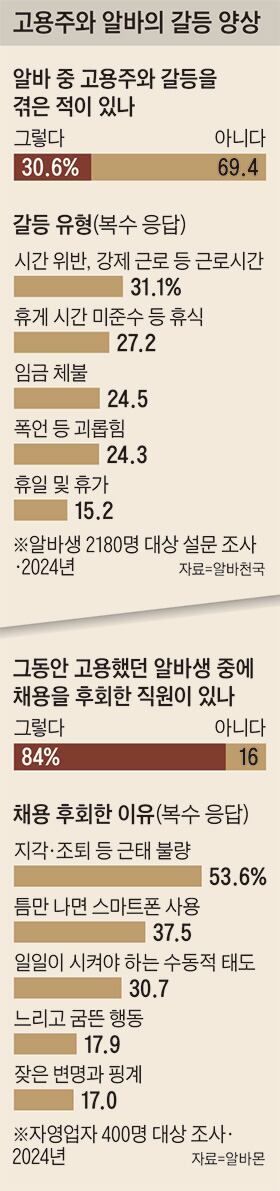
A 2024 survey conducted by the job platform AlbaCheon-guk, which involved 2,180 part-time workers, revealed that 30.6% experienced disagreements with their employers. The primary reasons included violations of working hours (31.1%), problems with rest periods (27.2%), delayed wages (24.5%), and verbal harassment (24.3%) (multiple answers). A separate 2023 survey of 2,457 part-time employees found that 48% encountered issues related to pay either during or after their employment.

◇Employers Exasperated by ‘Unreliable Part-Time Workers’
On the other hand, employers express frustration with what are known as “villain part-timers.” Kim, 46, who manages a café in Gangdong District, Seoul, mentioned, “Part-time workers frequently cancel their shifts at the last minute, claiming they can’t come due to an MT or a date. I’ve never reprimanded them for leaving the store without coverage and have always provided legally mandated compensation, but I’m hesitant to fire them out of concern for being reported.” Lee, who owns a bar in a university area in Gyeongsangbuk Province, recently let go of two part-timers. He stated, “Despite repeated reminders about fundamental service standards—such as not slamming plates or using phones during work—they didn’t improve. My wife and I concluded it’s better to manage the business on our own.”
The self-employed group “Because I’m a Boss, I’m Hurt” receives numerous daily posts highlighting issues with part-time workers: “They frequently miss work without notice once or twice a month, and I can’t terminate their employment,” “MZ part-timers dislike even a single minute of overtime,” “They bring friends to drink without covering the cost,” and “They freely consume store food.” In February, an employer shared, “Part-timers don’t seem to care about missing work or breaking dishes. There are too many disrespectful ones, but I have no recourse.” Comments included, “Part-timers act like royalty,” “Managing part-timers is mentally draining,” and “Handle it with family or on your own.”
According to a 2024 survey conducted by AlbaMon among 400 employers, 84% expressed regret over hiring some part-time workers. The main cause was inadequate attendance (53.6%), followed by regular use of smartphones while working (37.5%) and a lack of initiative that necessitated constant supervision (30.7%) (multiple answers).

◇ “Self-Employed on the Edge, a Struggle Between the Weak”
Although issues caused by unethical employers or careless part-time workers have always been present, disagreements now tend to intensify more often and with greater severity. According to the Ministry of Employment and Labor, the number of suspected labor law violations in companies with fewer than five employees reached 3,825 cases last year—six times the 645 cases recorded in 2018. Lee Ki-eum, a labor lawyer at Ki-eum Labor Office, stated, “Both employers and part-timers are increasingly asking, ‘What legal actions can I take against the other?’ or ‘How can I harass them as much as possible?’ Minor emotional disputes often end up turning into legal confrontations.”
Experts point to underlying problems as the cause of the escalating conflict: the crisis among self-employed individuals and high rates of youth unemployment. Lee Byung-hoon, a retired sociology professor at Chung-Ang University, stated, “Both groups are fragile in the economy. As economic conditions deteriorate, accumulated tensions between them, who have lost both psychological and financial flexibility, are becoming visible.” Kim Dae-jong, a professor at Sejong University, referred to it as a “conflict between the weak.” He explained, “Employers pay more than 10,000 Korean won per hour for labor, so they get upset when part-time workers are careless. Part-timers see their jobs as temporary, which leads to a lack of responsibility or connection.” Lee mentioned the individualism and increased awareness of rights among younger workers, while Kim highlighted the role of social media in facilitating the quick public sharing of complaints.
What steps can be taken to minimize disagreements? Lee Byung-hoon proposed, “Policies need to decrease card charges and rental costs to alleviate the pressures faced by independent workers. At the same time, to tackle the defensive mindset of part-time employees due to job insecurity, the scope of vocational education should be broadened beyond basic tasks.” Lee Ki-eum further noted, “If both employers and part-time workers demonstrate basic politeness—such as saying ‘Thank you’ or ‘You’ve done a good job’—numerous legal conflicts could be avoided.”




 jasdooit
Leave a comment