
Global bond yields are increasing sharply. U.S. Treasury rates, which affect the bond market, have climbed to levels not seen since July 2007, right before the worldwide financial crisis. With worries about inflation rising because of the ongoing U.S.-Iran conflict, some experts believe that “interest rates have started a long-term upward movement.” Investors are now more concentrated on choosing the best investments in the face of higher rates.
◇ Is It Wise to Purchase Underappreciated Bonds Right Now?
As per the financial investment sector, the U.S. 30-year Treasury yield hit 5.20% during trading on the 19th—the highest in approximately 19 years since July 2007. The U.S. 10-year Treasury yield, a key global standard, briefly rose to 4.69%, reaching its peak since January of the previous year. Although the U.S. Treasury yield dropped on the 20th following U.S. President Donald Trump’s statement that peace talks with Iran had reached the “final stage,” it is still close to historic highs. Moreover, the April Federal Open Market Committee (FOMC) meeting minutes released that day indicated some members discussed the possibility of additional rate increases, keeping upward pressure on interest rates.
When interest rates increase, bond prices tend to decrease. In May of last year, the yield on South Korea’s 3-year government bond was approximately 2.3%, but this year it has increased to 3.6%. For investors, this indicates a 1.3 percentage point rise in returns for the same bond over the course of a year. As government bond yields go up, so do the yields on corporate and financial bonds, with their prices falling accordingly, following the same principle across various types of bonds. A bond specialist stated, “If interest rates are considered high, it is beneficial to spread investments across government bonds with different maturities—such as 3-year, 10-year, and 30-year—while also investing some money in higher-yielding corporate bonds or commercial paper (CP) to ensure better returns. However, if rates continue to climb, the value of recently purchased bonds may decrease, highlighting the importance of timing.”
◇ Emphasize on Bond ETFs, Be Wary of Gold
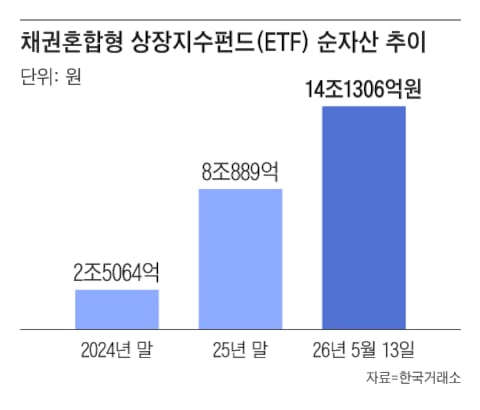
For individuals who are unsure about purchasing bonds directly, bond exchange-traded funds (ETFs) offer a different option. ETFs follow indices made up of government and corporate bonds, allowing them to be easy to access for investors who are not familiar with bonds.
Bond ETFs also involve modifying the mix of short- and long-term bonds depending on the interest rate conditions. During the initial phase of a rate increase cycle, it is beneficial to invest in short-term bond ETFs such as “KODEX Short-Term Bond PLUS” or “SOL Ultra-Short-Term Bond Active.” When rates are approaching their highest point, it is recommended to raise the share of long-term bond ETFs.
Nevertheless, in unstable settings where oil prices vary and interest rates are uncertain, professionals advise concentrating on short-term bonds to minimize risk. Extended maturities are more vulnerable to interest rate fluctuations, causing more significant price variations. Bond values also change according to market demand. For instance, if Mr. Kim purchased a 3% bond half a year ago and current bonds offer 6%, he would need to sell his bond at a lower price because of decreased demand. Although keeping the bond until it matures guarantees income from interest, selling it might lead to financial losses.
Gold, a traditional safe-haven asset, demands careful investment. Unlike bonds, gold does not produce interest, meaning that increasing government bond yields might shift safe-haven demand towards bonds. Indeed, as Treasury yields increased recently, gold prices began to decline. International gold futures are now being traded around $4,500 per ounce—the first time since late March. As a result, gold ETFs, which had risen at the start of the year, have experienced continuous price drops. Choi Jin-young, a researcher at Daishin Securities, said, “Kevin Warsh, a possible next Federal Reserve Chair, seems cautious regarding quantitative easing. If monetary expansion doesn’t happen, the attractiveness of gold as an inflation hedge decreases.”




 jasdooit
Leave a comment