
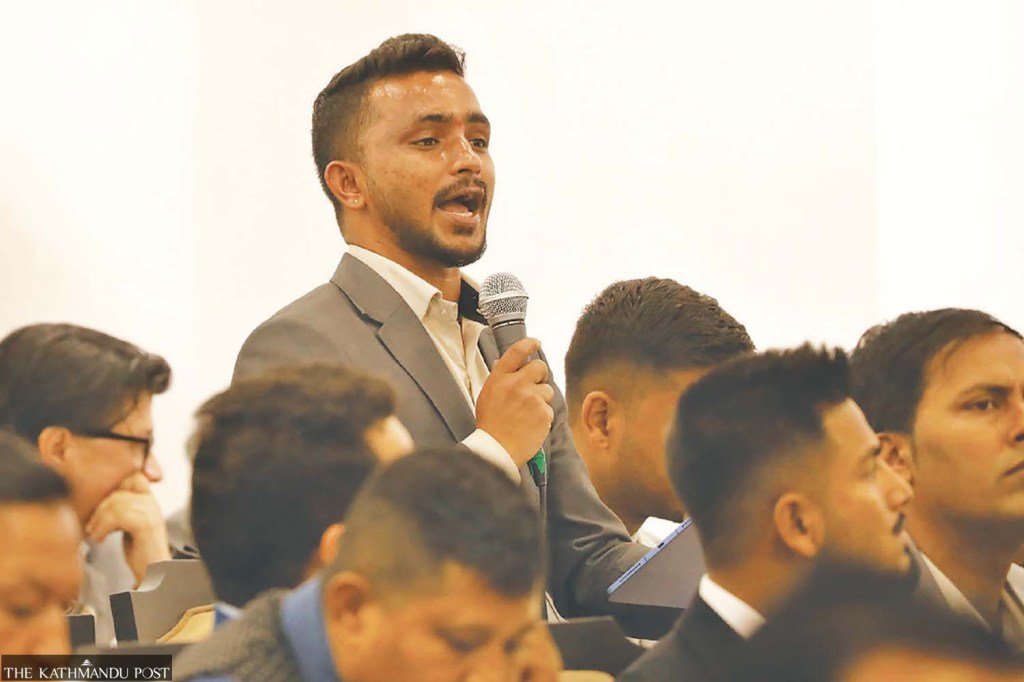
Kathmandu, May 24 — On August 19, 2025, Rastriya Swatantra Party (RSP) member Ganesh Parajuli addressed the now-disbanded House of Representatives, calling for a cohesive national stance on the Lipulekh matter following an agreement between India and China to resume the Kailash Mansarovar pilgrimage route without consulting Nepal.
Referring to the action as an infringement on Nepal’s sovereignty, Parajuli called for then-Prime Minister KP Sharma Oli to speak before parliament and build political agreement on the matter prior to his scheduled trip to China.
The deal between India and China to utilize the Lipulekh route without Nepal’s participation violates international law,” Parajuli stated to support his argument. “People are questioning why the government remains quiet on such a critical matter. The Parliament needs to establish a unified national stance.
Eight months later, on May 1, India’s Ministry of External Affairs stated that the Kailash Mansarovar pilgrimage would restart in collaboration with China. However, when Parajuli, who had been re-elected in the March elections, spoke to parliament on May 12 as the deputy leader of the ruling RSP parliamentary party, he did not refer to Lipulekh.
No member of Parajuli or other RSP legislators has publicly addressed the matter in Parliament since the party assumed power after the youth revolt in September of last year.
The quietness sharply differs from the party’s previous parliamentary engagement.
Starting May 27, 2025, the RSP consistently disrupted House activities, calling for a parliamentary or legal investigation into the alleged participation of former Home Minister Ramesh Lekhak in a visit visa scam that impacted Nepalis traveling abroad. When the then-Speaker Devraj Ghimire dismissed the protests and proceeded with House business from June 16, RSP members intensified their demonstrations by blocking proceedings while wearing blue scarves from June 17 onward.
At that time, Shyam Kumar Ghimire, who was the chief whip of the Nepali Congress, alleged that the party had breached parliamentary conduct. RSP members took positions in the center of the chamber, read books and newspapers, and raised slogans calling for adherence to parliamentary regulations.
The political balance has now shifted.
The RSP currently holds the government with a near two-thirds majority. DP Aryal, who often participated in demonstrations within the House following the 2022 elections, is now the Speaker. Even with ongoing protests from opposition parties, Aryal has continued with the House’s proceedings, approved legislation, and permitted the finance minister, instead of the prime minister, to address inquiries concerning government policies and initiatives.
During Thursday’s House session, members of the primary opposition party, the Nepali Congress, voiced their dissent from their seats, while representatives from the CPN-UML, the Nepali Communist Party, the Shram Sanskriti Party, and the Rastriya Prajatantra Party took their places in the chamber.
Amid shouts for upholding parliamentary rules and proper conduct, Speaker Aryal summoned Finance Minister Swarnim Wagle to introduce the “Alternative Development Finance Mobilisation Bill, 2025,” which was then approved by a majority vote.
On the same day, Minister of Law, Justice, and Parliamentary Affairs Sobita Gautam presented proposals on behalf of the prime minister to review three additional bills: the House of Representatives Member Election (First Amendment) Bill, the Electoral Roll (First Amendment) Bill, and the National Forensic Science Laboratory (Establishment and Operation) Bill, 2024.
Even though time was set aside for theoretical debates, protest actions from the opposition stopped the discussions from taking place.
The RSP, which previously criticized the former Congress-UML coalition for rushing through parliamentary matters, is now encountering comparable accusations from the opposition.
Speaker Aryal also cautioned Harka Sampang Rai, a member of the Shram Sanskriti Party, following his request for a decision compelling the prime minister to attend Parliament and respond to questions from lawmakers.
At the meeting on May 12, RSP member Manish Khanal brought up a procedural issue, opposing the statements made by UML parliamentary party leader Ram Bahadur Thapa. Khanal requested that Thapa’s speech be excluded from the official records, claiming that certain comments were inappropriate.
Nevertheless, according to parliamentary procedures, only certain inappropriate terms or expressions are subject to removal.
These episodes highlight the growingly charged environment during the budget session of the House of Representatives, which commenced on May 11.
The RSP, which won 21 seats just months after being established in 2022, currently holds 182 seats in the 275-member House.
However, during the initial eight days (May 11 to May 21) of the session, RSP representatives seemed hesitant to address wider national concerns during emergency, zero, and special sessions, concentrating mainly on local issues.
Rakshya Bam, a Gen Z activist, mentioned that several RSP legislators seemed reluctant to question the government once they gained power.
RSP lawmakers seem to have retreated from addressing national concerns,” Bam stated. “They refrained from providing clear statements on various topics, including the squatter problem and the regulations. The silence seems connected to either the attraction of power or the fear of losing political benefits.
In the meantime, opposing political groups have implemented a confrontational approach.
On May 13, the House session was suspended twice when opposition members objected to Prime Minister Balendra Shah’s absence while debating the government’s policies and initiatives. In the third meeting, opposition parties refused to participate and disrupted the proceedings after the finance minister responded to queries on behalf of the prime minister.
The initial gathering on May 14 was also suspended because of resistance. On May 19, the session was stopped as the finance minister was not present during the budget-related talks. On May 21, the House was once more suspended following requests from opposition parties for a Q&A with the prime minister.
Speaker Aryal later met with Prime Minister Shah, but doubts regarding his presence in parliament remained. During the second session on May 21, legislation was approved despite opposition demonstrations in the center of the chamber.
The following gathering is set for May 26.
The Shram Sanskriti Party launched a novel method of demonstration by holding up signs that criticized the prime minister’s failure to attend Parliament.
Opposition parties have criticized the government for evading responsibility on matters including the removal of informal settlements, disputed asset disclosures by ministers, and the case involving former home minister Sudan Gurung.
They have also criticized Prime Minister Shah for not addressing legislators’ inquiries regarding the government’s policies and initiatives, suggesting a chief justice without considering seniority, and suspending parliament to issue executive orders.
Nevertheless, RSP representatives have largely remained quiet regarding these national issues.
A former legislator and senior lawyer, Khim Lal Devkota, stated that the RSP is in danger of embracing the same parliamentary practices that have tarnished the reputation of older political parties.
There exists a strong inclination in Nepali politics to support everything while in power and criticize everything while in opposition,” Devkota stated. “People hoped the RSP would establish a new parliamentary atmosphere, but this has not been observed yet.
A former legislator and senior lawyer, Radheshyam Adhikari, blamed the escalating conflict on the prime minister’s ongoing absence from the House and the Speaker’s hesitation to provide definitive decisions.
In a parliamentary system, the prime minister is responsible for the government’s policies and initiatives,” Adhikari stated. “Other ministers may introduce legislation or handle administrative tasks, but they are not able to take the place of the prime minister in responding to Parliament.
He mentioned that parliamentary procedures give the Speaker significant power to order the prime minister or ministers to attend the House.
Once an individual assumes the Speaker’s chair, they must transcend partisan politics,” he stated. “The Speaker holds enough power according to parliamentary rules to compel the prime minister to attend.
Speaker Aryal justified his management of the House sessions, stating that blocking laws due to political conflicts would hinder effective governance.
As Speaker, I think the opposition parties should be involved in discussions and their rights should be acknowledged,” Aryal said to Kantipur. “However, if the House is stopped every time the opposition raises concerns about outside matters, the legislative process will be affected. The nation urgently requires important laws.
He mentioned that opposing political groups should utilize the Business Advisory Committee to express their worries instead of causing interruptions.
“If the opposition avoids discussion, the Speaker cannot indefinitely halt Parliament,” Aryal stated.
A representative from RSP and legislator Manish Jha stated that it was premature to assess the effectiveness of the government or members of parliament.
The House has not yet held ten sessions, and the government is less than two months old,” Jha stated. “Several RSP legislators are new to politics with limited experience. It will require time for the new political structure to develop.
Similarly, RSP member of parliament Toshima Karki mentioned that lawmakers from the ruling party were expressing worries via parliamentary committees and internal communication channels.
We have asked ministers about national issues and obtained promises from them,” Karki stated. “The government hasn’t even finished 100 days. It is still dealing with new problems.
Parajuli also supported the party, stating that RSP members were participating meaningfully instead of just delivering speeches in Parliament.
“Rather than just addressing the squatter problem in Parliament, we also went to detention centers to gain a better understanding of the situation firsthand,” he stated.
Nevertheless, opponents argue that a number of RSP legislators seem unaware of parliamentary customs and protocols.
On May 12, legislator Sushant Vaidik requested that mentions of “Hitler and gas chambers” by an opposition member be erased from the parliamentary records. Nevertheless, the Speaker did not take action on this request.
Rajendra Phuyal, a former secretary of the National Assembly, stated that points of order should explicitly indicate which parliamentary rule has been breached.
If comments damage the dignity of parliament or breach proper conduct, a point of order must be raised right away, citing the appropriate rule,” Phuyal stated. “There is consistently an expectation from the public that young and well-educated legislators will promote a more refined parliamentary atmosphere.
Nepal’s legislative history includes multiple instances where statements have been deleted from official documents. In 2019, former Speaker Krishna Bahadur Mahara directed the removal of the term “nimchharo,” which translates to weak or frail, following its use by the then-prime minister, KP Sharma Oli, during a session in the parliament.
Phuyal mentioned that worries regarding language and conduct in Parliament continue to be unaddressed.
“Parliament is a very respected body, and elected officials are required to show courtesy,” he stated.
The official plans and initiatives of the government for the next financial year were announced on the first day of the budget proceedings.
On May 12, when the House resumed, opposition members, headed by Bhishma Raj Angdembe of the Nepali Congress Parliamentary Party, staged a protest, alleging that Prime Minister Shah acted in an “unparliamentary” way during the President’s speech.
Although the prime minister encountered disapproval from within and outside of Parliament, RSP members mostly remained silent on the matter. RSP member Rajani Shrestha, however, supported the prime minister and opposed the criticisms raised against him in Parliament.
A lawyer and Gen Z activist named Arnab Chaudhary criticized RSP legislators for behaving more like government spokespeople than true members of parliament.
Lawmakers are expected to ensure the government is held responsible, yet several RSP members are supporting it without fully grasping the issues,” Chaudhary stated. “It appears they have overlooked the fact that Parliament and the government are distinct entities.
He mentioned that numerous RSP legislators dedicate most of their speaking time to commending the government, with little attention given to national issues.
Even during six-minute speeches, a significant portion is spent defending the government,” Chaudhary stated. “Their comments on national matters seem weak and indistinct.
In times of crisis and during periods of inactivity, numerous RSP legislators primarily concentrated on local development requests and matters concerning their constituents.
Buddha Ratna Maharjan expressed gratitude to voters and urged respect for the people’s decision. Buddhi Prasad Panta spoke against demolition activities driven by heavy machinery in Birgunj. Bharat Prasad Parajuli requested the reopening of the Arniko Highway and the Tatopani customs checkpoint. Bhumika Shrestha advocated for increased inclusion of gender and sexual minorities within state organizations.
Other legislators expressed worries that included power shortages in Karnali, unlawful river mining, river erosion, deaths in police custody, industrial decline, and funding for local infrastructure.
However, most interventions were limited in scope rather than tackling broader national political issues.
Senior lawyer Devkota stated that members of the ruling party should not view parliamentary scrutiny as being against the government.
Whips should only be used for issues directly related to the government’s survival, but in Nepal, they are applied much more widely,” he stated. “Legislators are elected to ask questions, oversee, and ensure the executive is held responsible.
Opposition to permit the budget report despite demonstrations
Opposition parties calling for Prime Minister Shah to attend Parliament have now taken what they call a “wait-and-see” strategy.
Understanding that the prime minister is unlikely to arrive soon and that the Speaker plans to proceed with parliamentary proceedings despite the demonstrations, the opposition parties have chosen not to interfere with the submission of the national budget.
The following House session is set for May 26, whereas the Constitution mandates the budget to be submitted during a joint meeting on May 29.
Basana Thapa, the chief whip of the leading opposition party Nepali Congress, stated that the party will keep insisting on the prime minister’s presence in accordance with Rule 56 of the House of Representatives’ regulations.
The prime minister is required to respond to lawmakers during this session,” Thapa stated. “However, we do not support hindering the budget or the policies and initiatives. These are for the people, not solely the government.
Padma Aryal, the deputy head of the UML parliamentary party, mentioned that the opposition’s call originated from the regulation mandating the prime minister to attend a question-and-answer session once each month.
The matter concerns responsibility to Parliament,” Aryal stated. “The finance minister will introduce the budget on May 29, and the prime minister’s involvement is not required beyond being present.
Yubaraj Dulal, the chief whip of the Nepali Communist Party, stated that the opposition would pursue an official decision requiring the prime minister to respond to queries from legislators.
Meanwhile, Aaren Rai, the whip of the Shram Sanskriti Party, stated that the party would finalize its parliamentary approach during a meeting on May 25.
Speaker Aryal stated that he met Prime Minister Shah on Thursday and mentioned that the prime minister promised to address lawmakers “at the right moment”.
Conversation with the prime minister is still taking place, Aryal stated. “Talks will remain ongoing with both the governing and opposition parties.”




Leave a Reply