
The chip industry is going through a significant upswing, yet a rising divide in how employees are treated, such as in pay, has appeared within the semiconductor and electronic parts fields.
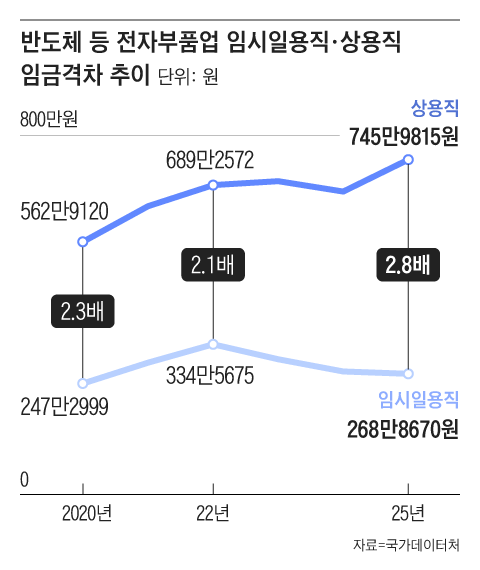
As per the Ministry of Data and Statistics’ Survey of the Labor Force, the average monthly salary for regular employees (those working for more than a year) in the ‘manufacturing of electronic components, computers, video, sound, and communication equipment’ sector last year was 7,459,815 South Korean won, which is 2.8 times higher than the 2,688,670 South Korean won earned by temporary (1–12 months) and daily (less than one month) workers. This difference is the highest since data collection started in 2020. The ratio, which was 2.1 times in 2022, has increased for three years in a row since 2023. Although temporary and daily workers saw an 8.7% rise in wages over five years from 2020 to last year, regular employees experienced a 32.5% increase.
The gap between different workplace sizes is also growing more significant. Full-time employees in companies with 300 or more staff earned 9,420,000 South Korean won, whereas those in smaller companies (fewer than 300 employees) made just 4,500,000 South Korean won—roughly double the amount.
The growing disparity in wages is noticeable throughout various sectors. A review of working conditions based on employment type indicates that last year, full-time employees in every industry made an average of 4,570,000 South Korean won monthly, which is 2.4 times more than the 1,920,000 South Korean won earned by part-time workers.
The difference in additional payments was very noticeable. Full-time employees were given 5,870,000 South Korean won as extra payments last year, whereas part-time workers received just 490,000 South Korean won.






Leave a Reply