
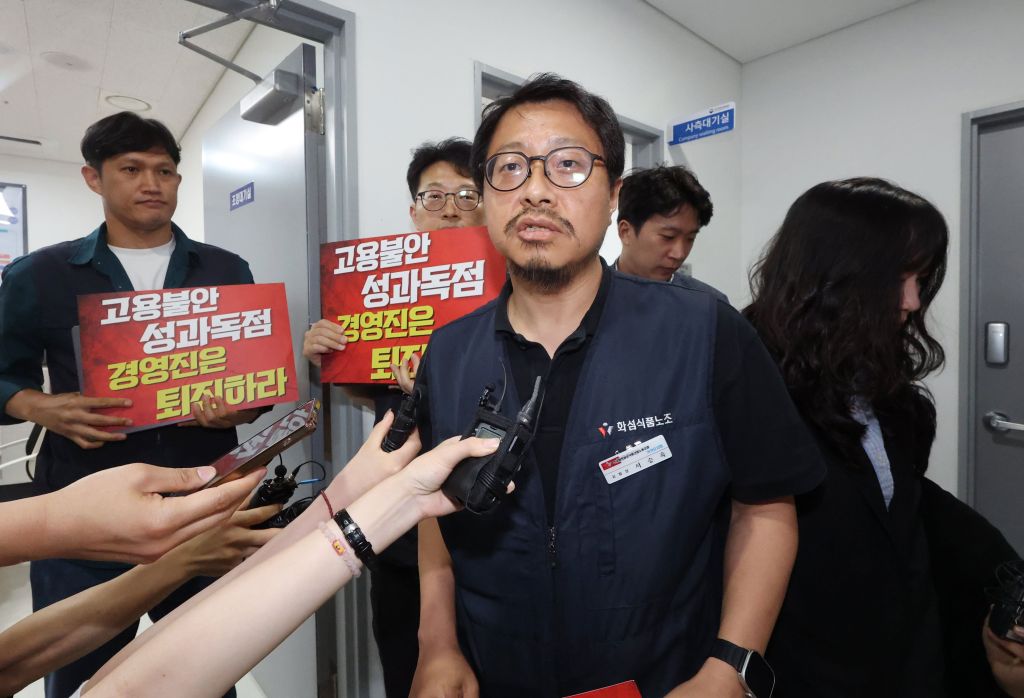
Negotiations over wages between Kakao’s labor and management have broken down following unsuccessful attempts to reduce the gap during mediation by the Labor Commission. A strike, which would be the first in Kakao’s history, is now expected. Industry experts point to structural problems that have developed within Kakao in recent years as the cause of this strike. An industry insider stated, “Kakao has repeatedly directed profits from its main office to its subsidiaries, leading to insufficient pay for employees at the headquarters and growing frustration. Moreover, Kakao’s union has weakened its negotiating strength by supporting strikes alongside unions of its subsidiaries, making discussions with management more challenging.”
Kakao’s headquarters labor and management engaged in an 8-hour intense negotiation session at the Gyeonggi Regional Labor Commission on the 27th, but did not manage to agree on wage issues. Consequently, the union has obtained the legal right to challenge the decision. A strike vote organized by Kakao’s union was previously approved on the 20th. The union is anticipated to begin the strike next month.
The increase in labor-management disputes arises from long-standing complaints about performance bonuses. In February, Kakao provided performance bonuses to all staff members, yet more than half received less than half of their monthly wage. An expert in the internet sector stated, “Considering the number of employees at headquarters, even 10% of operational profit as performance bonuses would be approximately 10 million won per person. Kakao’s inability to reach this level has resulted in ongoing frustration regarding poor pay relative to competitors in the industry.”
Employees have expressed dissatisfaction with Kakao for cutting pay while directing huge amounts of money into unprofitable subsidiaries under the pretense of expansion. For example, Kakao allocated almost 1 trillion won to create and manage Kakao Brain, Kakao Enterprise, and Kakao Healthcare, yet none have produced satisfactory outcomes. Kakao Brain was eventually merged back into the main office due to continuous losses. An insider from the investment sector stated, “Kakao’s approach of separating business units into subsidiaries and listing them has resulted in wasted capital, leaving employees at the headquarters without proper performance bonuses.”
The performance of the headquarters has also dropped. Although Kakao reported record-high combined revenue and operating profit last year, the operating profit of the headquarters alone decreased by 10.5% compared to the previous year. This negative trend has been ongoing since 2023.
Internal criticism focuses on the union’s involvement in the crisis. At present, Kakao’s headquarters union is engaging in solidarity actions with affiliated unions, such as Kakao Pay, Kakao Enterprise, DK Techin, and XL Games. However, each union has its own set of priorities: the headquarters is mainly concerned with performance bonuses, while XL Games and DK Techin are pushing for job security. Some workers believe that the union’s solidarity activities make negotiations more difficult. A Kakao employee remarked, “Negotiations with management are already tough when only focusing on the headquarters’ performance bonuses. It’s uncertain whether the union can handle subsidiary issues at the same time.”
As the ongoing labor-management disputes continue, frustration among shareholders increases. Kakao’s inability to offer a defined strategy for the generative AI period has caused its stock value to decline, despite the KOSPI reaching new record levels. Kakao’s stock has dropped to less than a quarter of its highest point (169,500 Korean won).
Nevertheless, a sudden service interruption due to a strike is improbable. A source within the messaging industry stated, “Automated systems manage server-based platforms such as KakaoTalk, so a strike will not completely stop services. However, new updates might be postponed, and AI service development could experience a slowdown.”





Leave a Reply