
Sir Keir Starmerhas faced allegations of greatly reducing disability benefit payments that are now taking effect, enabling recipients to wait several years before undergoing subsequent evaluations.
Individuals receiving Personal Independence Payment (Pip) who are 25 years old or older will now be eligible for their funds over a period of four years following the first evaluation, compared to the previous duration of nine months.
Following a second review, individuals who depend on Pip will receive an additional six years before their eligibility for the benefit is reassessed. The amendments take effect immediately.
Pip is designed to assist individuals with daily chores and additional expenses when someonesuffers from a long-term physical or mental health condition or impairmentThe payment ranges from £121.20 to £778.40 every four weeks for over 3.9 million claimants.
The authorities have cautioned that without adjustments to evaluation periods, the social benefits system might face a severe breakdown due to an unprecedented accumulation of mental health cases.
The cost to taxpayers for mental health-related benefits is rising sharply – yet the proposed changes have caused outrage among those who argue the UK’s welfare system is already overly generous.
The Conservative Party’s shadow minister for work and pensions, Helen Whately, stated: ‘Reviews are the only method we have to ensure an award remains accurate.’
Reduced reviews result in more individuals receiving assistance for extended periods, leading to higher expenses for taxpayers. Those capable of working may remain on benefits for years without any inquiry into the appropriateness or fairness of this situation for them or for the taxpayer.
Rather than addressing the crisis, Labour is weakening the standards that determine if awards are just.
Shimeon Lee of the Taxpayers’ Alliance stated: ‘Taxpayers are likely to be worried that ministers seem to be cutting back on inspections and prolonging benefits.’
With the welfare bill already increasing rapidly, fewer reviews could make it more difficult to ensure assistance aligns with claimants’ present situations.
The authorities need to address the growing backlog in evaluations and confront the rising expenses of social assistance, rather than subtly lessen oversight.
The Government’s own independent welfare monitor, the Social Security Advisory Committee, has already expressed significant worries regarding the move to increase the disparity in Pip reviews.
The official records indicate that the regulator requested officials to present a ‘more explicit, written legal justification’ for the change, and that ministers offer an ‘elaboration of the policy’s purpose’.
Notes from the same gathering showed the Government stating that without the modification, ‘the main issue is that the evaluation system will “collapse” if capacity issues are not resolved’.
It stated: ‘Although long-term changes are being planned, there is an urgent requirement to take action immediately.’
Currently, mental health issues account for 39 percent of all Pip claims – the biggest category by a significant margin.
Expenditure on disability benefits is projected toincrease from £39.1 billion in 2023/24 to £58.1 billion in 2028/29, as stated by the Office for Budget Responsibility.
This amount would account for approximately 4 percent of overall public expenditure, and 2 percent of the GDP.
Individuals receiving Pip received an average of £6,900 each during the 2023/24 period.
The Government’s proposals to alter the qualifying conditions for Pip were delayed last year following a revolt among MPs in the House of Commons.
The work and pensions minister, Sir Stephen Timms, initiated an investigation into Pip, which is anticipated to present its findings this autumn.
Government statistics published in March indicated that the number of individuals in England and Wales receiving Jobseeker’s Allowance had reached a new peak of almost four million.
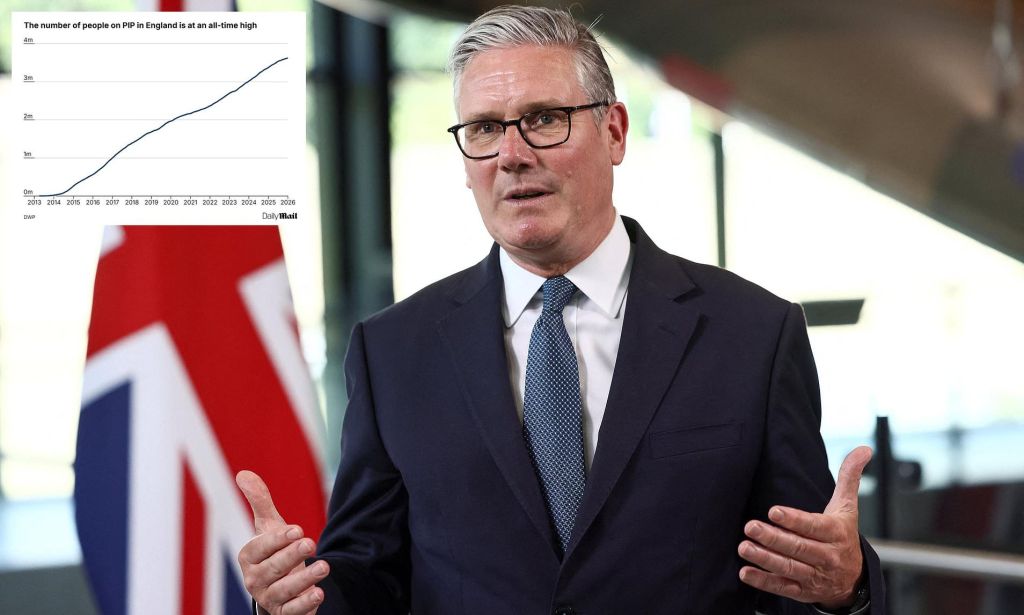
Approximately 3.93 million individuals in England and Wales were receiving personal independence payments in January 2026. This marked an increase of 233,080, or 6 percent, compared to 3.69 million a year prior.
The number of people making claims has nearly doubled since the start of comparable data seven years ago in January 2019, when the total was 2.05 million.
A rising percentage of individuals receiving Pip are teenagers and young adults.
Approximately 16.6 percent of applicants in January of this year were between the ages of 16 and 29, an increase from 14.6 percent in January 2019.
A comparable increase was observed among individuals aged 30 to 44, making up 21.0 percent in January of this year, compared to 19.0 percent in 2019.
In January, individuals aged 45 to 59 accounted for 29.2 percent of claimants, a decrease from 37.4 percent in 2019.
The percentage of individuals aged 60 to 74 increased slightly during the period, moving from 29.0 percent to 31.0 percent.
The figure in England alone — without Wales — is 3.63 million.
On Sunday, Pat McFadden, the Secretary for Work and Pensions, dismissed requests to lower employers’ National Insurance payments in an effort to assist young individuals in securing employment.
Although a significant report released last week showed that more than one million young individuals are classified as ‘Neets’ — meaning they are not engaged in education, work, or training — Mr. McFadden stated during an interview with Sky News on Sunday that the UK’s job participation rate remains “quite strong.”
A representative from the Department for Work and Pensions stated: ‘These adjustments will assist in saving the UK taxpayer £1.9 billion throughout the parliamentary term and enable us to provide tailored job support.’




 jasdooit
Leave a comment