

- Receive your news directly by 7am – subscribe to our new Morning Mail newsletter at no cost
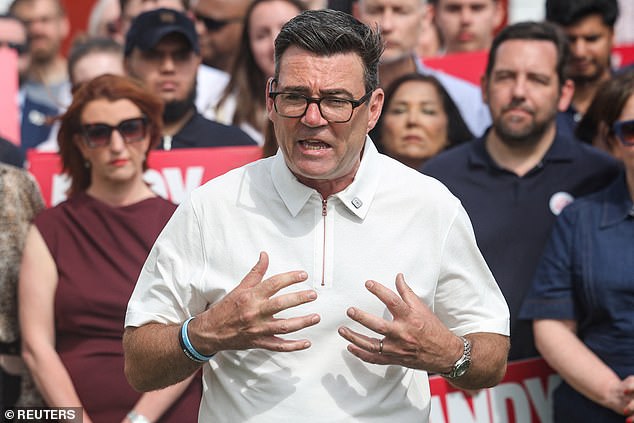
Andy Burnhamhe utilized his victory speech from yesterday to present bold policy commitments covering a wide range of issues, including nationalization and education changes.
The new Makerfield MP presented a series of policies that lacked specifics but had the potential to increase taxes and expenditures significantly.
He promised to put an end to “trickle-down economics” by making large-scale nationalization a key part of his plan.
Addressing a community football field, he reiterated his caution toLabourthat his election signified the ‘final opportunity for change’ – yet he acknowledged that he had not received a ‘blank check’ from Makerfield voters.
Appearing to echo Jeremy CorbynThe 2017 election slogan, “For the many, not the few,” he called for an “economy that benefits everyone, not just a select few in distant locations.”
The former mayor of Greater Manchester presented a set of policy requirements that are expected to serve as the core element of his approach if he were to replace SirKeir StarmerAs Prime Minister. However, they were labeled a fantasy ‘wish list’ by critics.
Mr. Burnham advocated for widespread government involvement in critical sectors including energy costs, water charges, and train fares. While he did not provide specifics, he suggested this would mean bringing them back under public ownership, similar to his action when he took charge of Manchester’s bus system.
He promised a “campaign for reindustrialization” throughout the North, calling for “significant changes in Whitehall.” This would involve modifying public procurement regulations to focus on supporting British industry and companies, he mentioned, and added, “It’s about time we began supporting British businesses.”


He further desires an adjustment to the educational framework “so that youth raised here have well-defined routes into this emerging sector.”
An MP with a Cambridge background stated that the dominance of education through ‘the university path’ should be substituted with an option that provides a technical or educational route for all.
Mr. Burnham also promised to ensure job placements for every individual between the ages of 16 and 18 who wished for one, calling it “the kind of transformation we need to offer hope to young people.”
A boost for Home Secretary Shabana Mahmood came as he also expressed a desire to move more quickly and aggressively in addressing both legal and illegal immigration.
Mr. Burnham criticized large-scale immigration as a ‘low-cost method of acquiring labor,’ reflecting worries he had encountered repeatedly during door-to-door conversations throughout the campaign.
Speaking about ‘houses in multiple occupation’ (HMOs), he mentioned that areas like Makerfield have turned into ‘HMO Britain’, urging businesses and the Government to ‘listen to the voters’ and put an end to the inequity of placing illegal migrants on working-class neighborhoods.
However, critics were harsh. A supporter of Sir Keir cautioned that Mr. Burnham would ‘damage the markets’ and trigger a mortgage rate crisis similar to Liz Truss’s, stating, “A lengthy list of desires is not how you attain the role of Prime Minister.”
There is a significant distinction between winning a by-election and becoming Prime Minister.
Regarding his plans, they stated: ‘The financial obligations already undertaken are unfeasible. It’s unrealistic economics, and [Labour MPs] are aware of that.’
It followed a warning from immigration minister Mike Tapp, another supporter of Starmer, that departing too much from Labour’s election promise would necessitate a new general election. He stated to the BBC, “Every candidate running must clearly outline what they intend to do for the country, and if their plan deviates significantly from the manifesto, it’s very challenging not to call for a general election.”
A supporter of Mr. Burnham warned frankly that he and possible leadership opponent Wes Streeting had “demonstrated limited readiness” before the election.
Mr. Burnham has engaged well-known economic consultants to ease concerns in the market that he might make the same errors as Liz Truss, reportedly including former Bank of England chief economist Andy Haldane and former Goldman Sachs chief economist Jim O’Neill. Nevertheless, it was disclosed yesterday that institutions like JP Morgan were advising their clients that Mr. Burnham was likely to violate Rachel Reeves’s fiscal guidelines for government borrowing. He states his support for these rules, even though he previously encouraged Britain to stop being “in hock” to bond markets.
Goldman Sachs noted that his proposals might push back the timing of interest rate reductions by the Bank of England.
Last night, a YouGov survey conducted for The Times revealed that only 21 percent of voters across the country were well-informed or somewhat familiar with his plans as Prime Minister, 36 percent had no knowledge, and 43 percent were aware of only a little.




Leave a Reply