
President Lee Jae Myung clearly set a market price of 5 billion South Korean won as the benchmark for “extremely expensive housing.” At a Cabinet meeting on the 14th, the president inquired through a YouTube live comment section about public views on “extra costs for owners of a single ultra-expensive home” and the “standards for defining ultra-expensive housing.” Many responded with “over 3 billion won,” prompting him to say, “Unexpected. I had assumed it would be around 5 billion won.”
With significant public attention on defining “ultra-high-priced housing”—a phrase not yet included in existing laws—the president’s explicit reference to a specific figure has resulted in various interpretations suggesting a de facto standard has formed. This strengthens predictions that the government’s upcoming tax reform proposal, set to be revealed later this month, will involve increasing holding taxes on ultra-high-priced housing.
Transforming the 5 billion won market value into the publicly disclosed price (which is used for tax calculations) results in roughly 3.45 billion won, according to this year’s 69% rate of reflecting apartment prices in the market. This supports rumors that the government is looking at a range of 3 billion to 3.5 billion won for the publicly declared values.
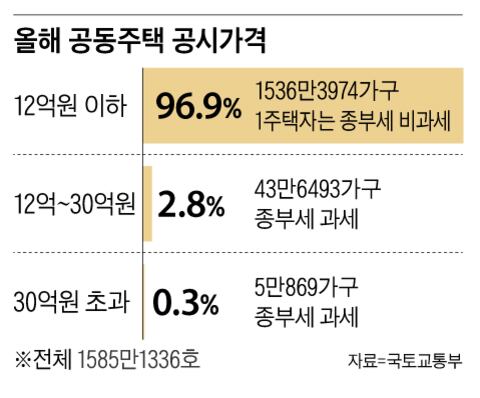
If taxes are imposed at this level, the majority of impacted properties would be located in Seoul. Out of 50,869 apartments that have a publicly disclosed price above 3 billion won this year, 50,519 (99%) are situated in Seoul—accounting for 0.3% of the country’s total of 15.85 million households.
Even typical apartments (84㎡ of exclusive space) in the Gangnam and Seocho districts may be taxed. For instance, the RAEMIAN One Bailey and Acro River Park located in Banpo-dong, Seocho-gu, have officially announced prices of approximately 4.5 billion won and 3.5 billion won for 84㎡ units, respectively. Some 84㎡ units at RAEMIAN Daichi Palace in Daechi-dong, Gangnam-gu, also surpass 3 billion won.
Possible tax approaches involve establishing a new tax category or increasing taxes within existing categories. The present overall property tax uses rates ranging from 0.5–2.7% across seven categories, covering values from under 300 million won to more than 9.4 billion won. Modifying these categories and raising the highest rates may allow for “targeted taxation” focused solely on extremely expensive properties.
International examples include France, which applies a wealth tax of as much as 1.5% to property owners whose net assets surpass 1.3 million euros (approximately 2.2 billion won). The UK intends to implement a “mansion tax” in 2028, imposing extra local taxes on properties valued above 2 million pounds (around 4 billion won).
Nevertheless, these nations impose wealth taxes in addition to current property taxes. Opponents claim that South Korea’s thorough real estate tax already fulfills this purpose. Professor Kim Woo-cheol from the Taxation Department at the University of Seoul remarked, “While other countries apply a single property tax rate, South Korea implements a progressive comprehensive real estate tax, resulting in high holding taxes for expensive homes. Imposing heavier taxes on extremely costly properties is considered punitive.”




Leave a Reply