
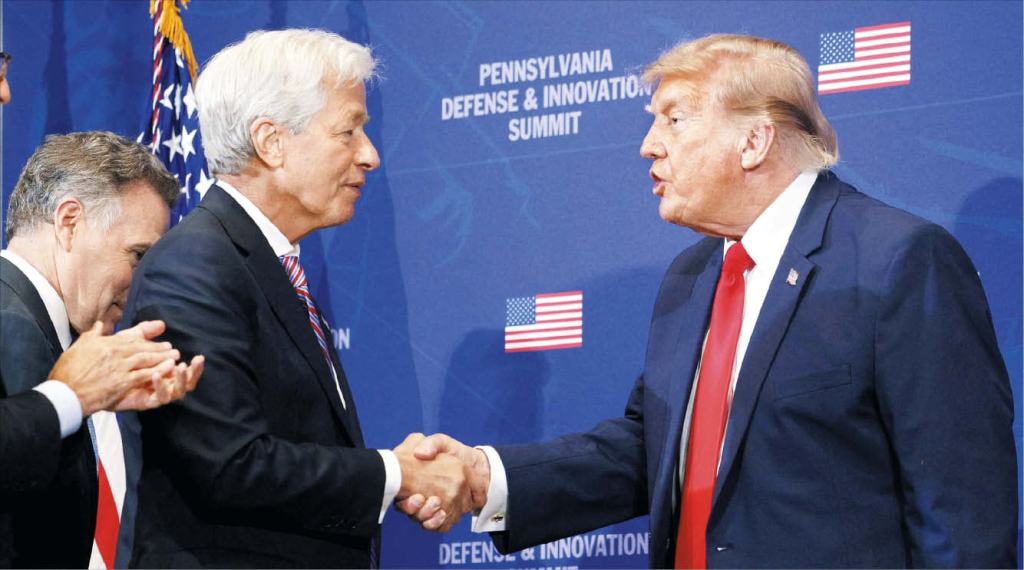
U.S. President Donald Trump highlighted the importance of enhancing the U.S. Navy on July 15 (local time), noting the importance of collaboration with South Korea. He also mentioned the potential for acquiring vessels produced outside the United States. This has sparked discussions that the South Korea-U.S. shipbuilding partnership ‘MASGA (Make American Shipbuilding Great Again)’ might see increased progress. However, additional regulatory adjustments are necessary for MASGA to produce concrete outcomes.
At the ‘Defense and Innovation Summit’ hosted at the U.S. Army War College in Pennsylvania, President Trump remarked, “We need to restore our Navy,” and mentioned, “Therefore, we will examine some companies from South Korea and other nations.” He added, “They are working with us in the shipbuilding industry, and we will also construct vessels directly. We intend to acquire some ships manufactured ‘outside the region.’ We will obtain numerous warships.”
Trump also stated, “Two major National Security Multi-Mission Vessels (NSMV) will be constructed at the scenic and historically significant Philadelphia (Hanwha Philly) Shipyard,” and further noted, “We plan to allocate 10 billion dollars for defense in Pennsylvania, generating more than 4,000 job opportunities.” The Hanwha Philly Shipyard serves as a significant site for the MASGA initiative.
Michael Coulter, the CEO of Hanwha Defense USA, was present at the event and was personally introduced by President Trump. Coulter thanked the administration for the chance to construct radar-equipped ships announced on that day, saying, “South Korean shipyards build about one vessel each week. We intend to establish that capacity in Philadelphia.”
It is still uncertain if Trump’s reference to “some ships produced outside the region” pertains to vessels constructed overseas. Nevertheless, taking into account his earlier inquiry to President Lee Jae Myung during last month’s G7 summit—“Can you quickly build 10 U.S. warships?”—it is believed that the statement was aimed at examining possibilities for shipbuilding abroad. Considering the limited capabilities of the U.S. shipbuilding sector, acquiring warships built overseas might serve as a feasible option for naval development.
The United States bans the foreign building of Navy ships under the Burns-Taft Act. For South Korean shipyards to build U.S. Navy vessels directly, legal changes are required, although approval from Congress is still a significant challenge. As a result, the South Korean government and shipbuilding sector are hoping that President Trump will exercise his executive power to exceptionally allow the construction of U.S. Navy ships in South Korea.
South Korean firms are also getting ready for cooperation within the MASGA initiative. When the U.S. Navy recently issued Requests for Information (RFI) to local shipbuilders about combat ships and tankers, HD Hyundai Heavy Industries and Hanwha Ocean promptly provided design and construction details. All three leading shipbuilders, including Samsung Heavy Industries, responded in the tanker category. Industry insiders anticipate noticeable developments soon. On the 23rd, the ‘Korea-U.S. Shipbuilding Cooperation Center’ will be established in Washington, D.C., with involvement from officials and industry representatives from both nations. The center will implement programs aimed at enhancing shipyard efficiency and training local staff as requested by the U.S. side.






Leave a Reply