
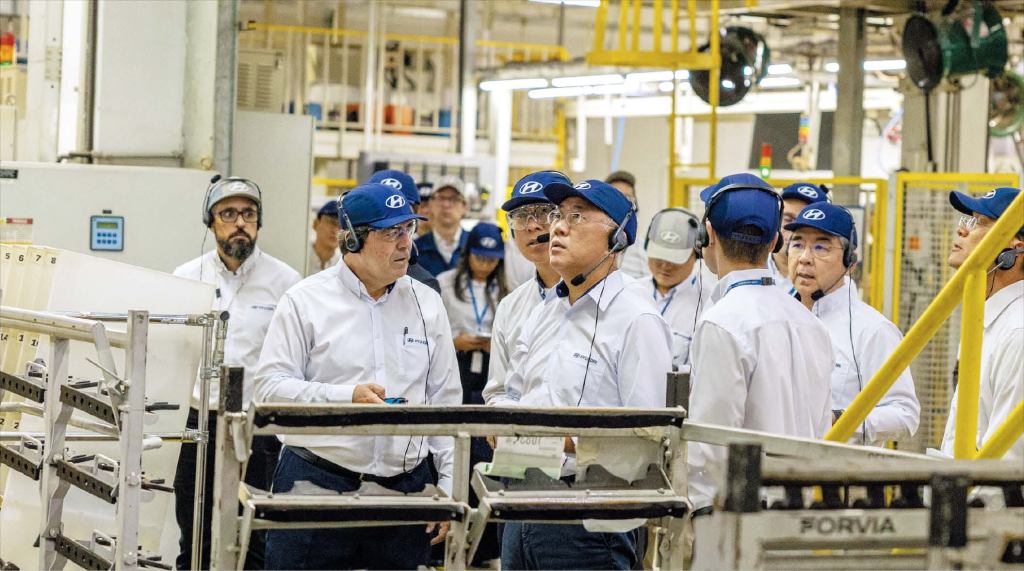
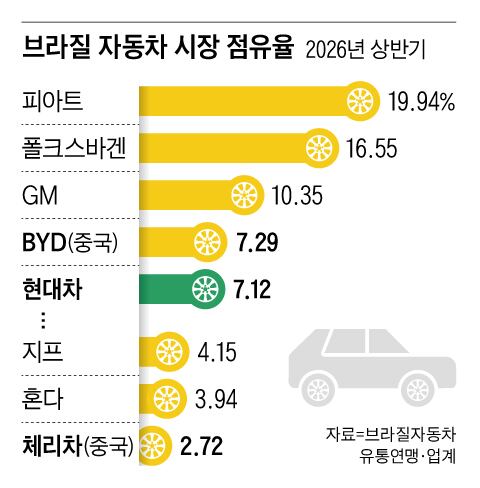
Hyundai Motor has been manufacturing and selling approximately 200,000 vehicles each year at its Pirassununga facility in São Paulo, Brazil, since 2012. Within Brazil’s annual market of 2.5 million vehicles, Hyundai consistently held the fourth position until last year, behind Italy’s Fiat, Germany’s Volkswagen, and the United States’ GM (General Motors). However, during the first half of this year, it was surpassed for the first time by Chinese automaker BYD (Build Your Dreams). BYD achieved a 7.29% market share, slightly exceeding Hyundai’s 7.12%. To bypass Brazil’s 35% import tax, BYD purchased Ford’s local plant in 2021 and started producing locally last year.
BYD intends to develop its Brazilian factory into a central point for the entire South American region. Moreover, Chinese car manufacturers such as JAC Motors and Chery are quickly boosting their footprint in Brazil, turning the South American market—valued at approximately 4.5 million vehicles each year—into a crucial focus for Chinese automakers’ expansion efforts.
Hyundai has started to address this trend. It intends to manufacture small electric vehicles (EVs) in Brazil and Mexico in order to reduce costs and create a “ethanol hybrid” tailored for Brazil, which combines ethanol and gasoline. Chung Eui-sun, Executive Vice Chairman of the Hyundai Motor Group, visited the Brazilian facility on the 27th (local time) to personally examine these plans.
◇Localizing and Offering Cost-Effective Sustainable Vehicles as Key Approach
At the location, Chung Eui-sun remarked, “Although there are numerous challenges and tasks due to changes in Brazil’s industrial setting and a new competitive environment, surmounting this crisis will lead to the next phase of growth and a significant advancement.” Although he did not directly state it, this was seen as an allusion to competition against Chinese car manufacturers. On the 28th, during a Korea-Brazil business roundtable, he informed reporters, “China is also actively implementing local strategies,” and noted, “We still have a long journey ahead.”
Chung highlighted comprehensive localization and environmentally sustainable vehicle approaches as crucial. Latin American nations, such as Brazil, began shifting towards electric vehicles later than others, yet the market is expanding quickly. Brazil, which faced the oil crisis in the 1970s, extensively utilizes FFV (Flexible Fuel Vehicle) technology, enabling cars to operate on both gasoline and ethanol derived from locally available sugarcane. Hyundai is working on a high-efficiency “FFV-based hybrid” to advance this further. Chung’s initial visit to the Brazilian facility was to the R&D center, the core of this innovation.
Hyundai also intends to manufacture small electric vehicles in Latin America. On the 29th (local time), Kia, a subsidiary of the group, revealed plans to invest 649 million dollars (933 billion Korean won) in Mexico to create an electric vehicle production facility. Starting next month, the EV3, which was previously made only in Korea, will also be produced at Kia’s Nuevo León plant in Mexico. Hyundai is also considering the production of compact electric vehicles at its Brazilian factory. The objective is to improve price competitiveness by producing locally and prevent being surpassed by Chinese automakers throughout Latin America.
◇Boosting Chinese Car Manufacturers’ International Expansion
Chinese car manufacturers are making significant investments in Latin America as an alternative to North America, where market entry is complicated by U.S.-China relations. GWM (Great Wall Motors) purchased Mercedes-Benz’s Brazilian factory in 2021 and started local manufacturing last year. Chery Automobile has joined forces with Brazilian car distributor CAOA to produce SUVs locally. Chery’s sales have increased quickly, and it made its debut in Brazil’s top 10 best-selling brands during the first half of this year.
BYD entered the Argentine market in October of last year, boosting the sale of electric and plug-in hybrid vehicles. Xpeng officially launched in Mexico in March, introducing the electric SUVs G6 and G9. The company is establishing sales, service, and parts supply networks in major Mexican cities, aiming to use this as a foundation for expanding the localization of its products, services, and technology throughout Latin America.




 jasdooit
Leave a comment