
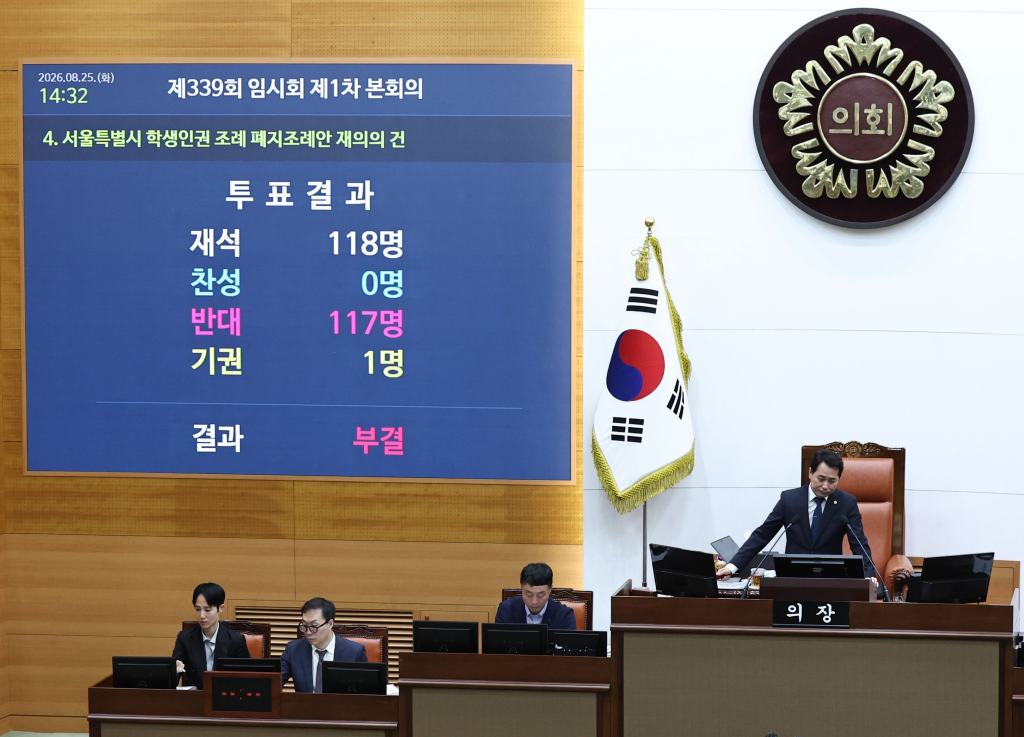
On August 25, the main chamber of the Seoul Metropolitan Council. The electronic board displayed the voting results for the motion to abolish the “Seoul Student Human Rights Ordinance”: 0 in favor, 117 people against, and 1 people abstaining. The chamber instantly buzzed. “Not a single vote in favor?” Even the People Power Party, which had led the push to abolish the ordinance, saw no votes in support. Out of the party’s 38 council members, 37 voted against the motion, and 1 abstained. The motion to abolish the ordinance was rejected.
The motion to abolish the ordinance passed the council last December when the People Power Party held the majority. The party argued that the ordinance overly emphasized student rights, infringing on teachers’ authority. However, Seoul Metropolitan Office of Education Superintendent Jung Keun-sik requested a reconsideration in January, prompting the council to vote again. To re-pass the motion, a majority of attending council members and at least two-thirds of those present must vote in favor. On this day, a “yes” vote meant confirming the abolition, while a “no” vote meant rejecting it.
Since then, the political landscape of the Seoul Metropolitan Council has shifted. In the June 3 local elections, the Democratic Party became the majority party, holding 80 seats, while the People Power Party holds 38. Even if all People Power Party members voted in favor, the motion would still fail without significant support from the Democratic Party. However, it was unusual that not a single “yes” vote came from the People Power Party, which had spearheaded the abolition effort.
The People Power Party leadership released an official statement 27 hours after the vote. The statement said, “Given the symbolic significance of this being the first ordinance handled by the 12th Seoul Metropolitan Council, we prioritized cooperation. We plan to gather opinions from all sectors and prepare a reasonable amendment.” This explanation suggested the party aimed to revise the ordinance in collaboration with the education office rather than insist on abolition under the Democratic Party’s majority.
However, dissenting voices emerged within the People Power Party. One council member claimed, “I understand the leadership mistakenly guided members to vote against the motion.” They misunderstood that a “no” vote meant supporting abolition, when in fact it rejected it. Another People Power Party member said, “The leadership repeatedly instructed us to ‘press no,’ and we thought that meant supporting the abolition.”
Criticism also arose within the party regarding the leadership’s explanation. One council member stated, “If it was a mistake, they should have admitted it, apologized, and clarified the party’s stance. It’s absurd to talk about cooperation now.”
The leadership offered a different perspective. A council member from the leadership team said, “There were aspects where the leadership’s strategy was not properly communicated to the members.”
Within the Democratic Party, there were surprised reactions. One Democratic Party council member said, “We didn’t expect such a high number of ‘no’ votes.” Another added, “We had no prior discussions with the People Power Party before the vote.”
On August 25, Seoul Metropolitan Office of Education Superintendent Jung Keun-sik stated during the council session, “We will cooperate with the council to revise the student human rights ordinance to respect not only students’ rights but also teachers’ authority and strengthen students’ responsibilities and duties.”





Leave a comment