
“Justice cannot be upheld with tainted hands.”
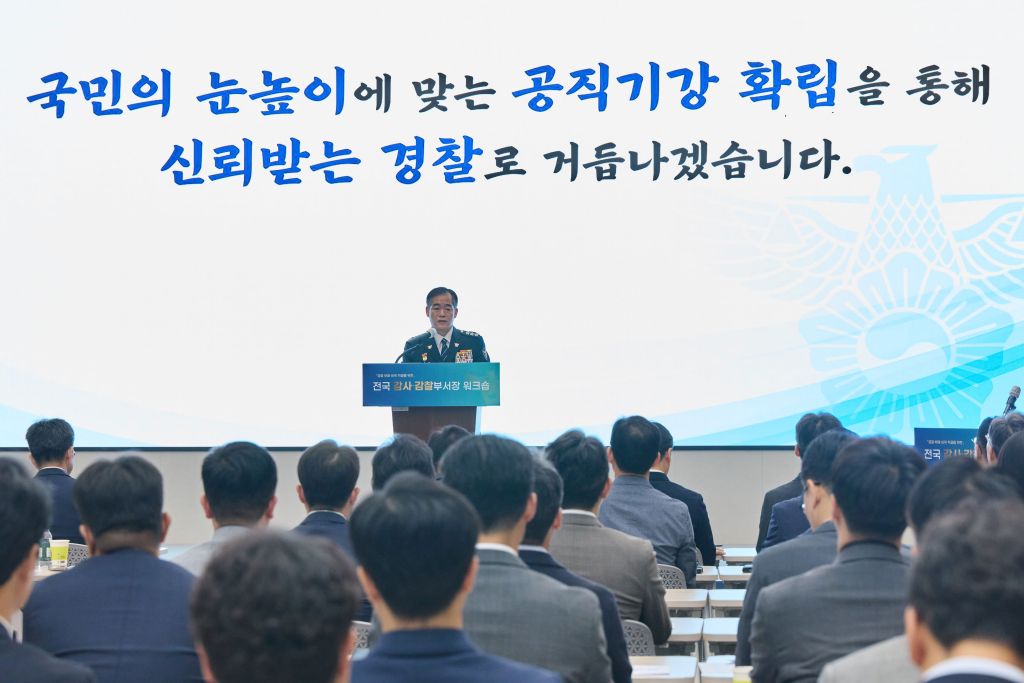
Kim Jong-chul, acting head of the National Police Agency, made this remark on the 7th during a workshop for nationwide police audit and inspection department heads held at the National Police Agency in Seodaemun-gu, Seoul. The event gathered 73 individuals, including the head of the Human Rights Audit Bureau at the National Police Agency headquarters, section and team leaders, and audit and inspection team leaders from metropolitan and provincial National Police Agency offices nationwide. Additionally, 267 hearing audit and human rights officers from police stations across the country participated via video conference.
The workshop aimed to strengthen the resolve of police audit and inspection officers nationwide to eradicate internal corruption and root out “sentimentalism” within the organization. Recently, misconduct cases involving police officers have persisted. In the Jeonnam-Gwangju high school girl murder case involving Jang Yoon-gi, the investigating officer leaked case information to Jang’s father, a police officer with whom he had prior work connections. In Jeju, a police officer falsely closed a missing person case after claiming contact with the missing individual, only for the person to later be found dead. There was also the “Geoje King” case, where a police officer allegedly abused influence to commit personnel manipulation and power abuse. In another instance, an undercover investigation to catch a distributor of digital sexual exploitation material revealed the perpetrator was a current police officer.
Amid ongoing concerns about excessive police authority following the revised Criminal Procedure Act, the National Police Agency held this workshop to address internal misconduct and restore public trust. The agency stated, “In a climate of heightened public concern over internal corruption, this workshop was organized to share the police’s commitment to taking strict action against serious misconduct that undermines public trust, regardless of rank or position.”
Kim emphasized, “For major investigative misconduct such as case manipulation, concealment, bribery, or leaking investigation information, we will apply exclusionary disciplinary measures without hesitation. We will also respond strictly to misconduct that erodes public trust, including drunk driving and sexual misconduct.” He added, “Internal ‘cover-ups’ and ‘sentimentalism’ within the police can lead to significant public distrust. Audit and inspection departments must respond more rigorously to misconduct.”
This was Kim’s third gathering with key police command figures since taking office early last month. On September 3, his first day in office, he summoned all metropolitan and provincial National Police Agency chiefs to the headquarters, where they collectively read the Police Charter, vowing to restore public trust damaged by the Jang Yoon-gi case and the Jeju false closure of a missing person case. On October 1, the day before the revised Criminal Procedure Act took effect, he convened all nationwide investigation commanders of superintendent rank and above to dispel concerns about police investigative capabilities.
Some within the police analyze that Kim is emphasizing the organization’s self-reform capabilities amid government and ruling party pushes for “police reform.” A senior police officer working in the Seoul area remarked, “This is likely an effort to show that internal reform is possible without external pressure. Given that Kim is being mentioned as a potential candidate for the next National Police Agency head, this also serves to highlight his leadership in uniting the police force.”



Leave a comment